๐Ÿ“ˆ SEO Strategy ๐Ÿ” Search Trends ๐Ÿ”ฅ Critical Read ๐Ÿ†• 2026 Guide โœ… Updated May 2026

Why “Zero-Click” Search Isn’t the End of Blogging: A 2026 Survival Guide Information Gain SEO, Brand-First strategy, and the three levers that rebuild authority when AI Overviews steal your clicks

zero-click search - chart showing the decline of generic blog traffic and 2026 survival strategy

By mid-2026, roughly 60% of Google searches end without a single click to any website. That number isn’t new โ€” it’s been climbing since Google rolled out AI Overviews at scale โ€” but the implications have finally hit home for the bloggers and SaaS founders who built their businesses on organic search. If you’re watching impressions stay flat while clicks crater, you’re not imagining things. The search engine you optimized for has learned to answer questions itself.

The instinctive response โ€” publish more, optimize harder, target longer-tail keywords โ€” is the wrong move. It accelerates a race you cannot win against a system with infinite capacity to generate commodity answers. The correct response is harder to stomach but far more durable: stop competing with AI on its own terrain and start building something it cannot summarize.

This guide is a ground-level strategy brief, not an SEO checklist. It covers the information gain paradox, the shift from generic to branded search, and the technical moats that protect traffic when AI Overviews consume everything above the fold. The playbook works โ€” but only if you’re willing to stop producing commodity content entirely.

โœ๏ธ By GPTNest Editorial ยท ๐Ÿ“… May 9, 2026 ยท โฑ๏ธ 14 min read ยท โ˜…โ˜…โ˜…โ˜…โ˜… 4.9/5

Before You Scroll โ€” 5 Realities Worth Accepting First

Zero-click search is structural, not temporary. Google’s business model has evolved. AI Overviews are not a bug to be patched โ€” they are the product. Waiting for a rollback is not a strategy.
Commodity information is now worth exactly zero. If ChatGPT, Gemini, or an AI Overview can answer your article’s core question in two sentences, your traffic from that article is already gone or going. The asset is no longer the answer โ€” it’s the proof.
Information Gain is a real, patented Google signal. Google’s systems measure whether your content adds something to the existing knowledge graph. Content that doesn’t expand what’s already known gets progressively deprioritized.
Brand-first SEO generates demand that algorithms can’t intercept. When users search for your brand name, your product name, or your methodology, AI Overviews have nothing to say. That’s the traffic worth building toward.
The moat isn’t content โ€” it’s the community and tooling around it. Email subscribers, private communities, and downloadable tools built around your expertise create value that Google cannot index and AI cannot replace.

60%

Searches End Zero-Click

3ร—

CTR Lift From Brand Queries

94%

Email List Retention vs 2% Organic

14m

Average Read Time

What This Guide Covers

The Commodity Trap: Why Google Is Stealing Your Traffic (And Why It’s Partly Your Fault)

The hard truth about generic content in an era of zero-click search

โš ๏ธ Honest Assessment

Let’s be precise about what’s happening in Google’s AI Overviews. The system doesn’t steal traffic randomly. It specifically targets informational queries where the answer is well-established, widely available, and can be synthesized from multiple existing sources without meaningful loss of fidelity. In other words: it targets commodity content. The content that has flooded the web for the past decade โ€” “what is X,” “how to do Y,” “top 10 Z” โ€” is precisely the content AI was built to synthesize and serve without a click.

If your blog’s traffic strategy was built primarily on capturing high-volume informational queries, you weren’t building a content business โ€” you were building a traffic arbitrage operation dependent on a middleman (Google) that has now decided to serve the product itself. This is uncomfortable to hear, but it’s the accurate diagnosis. The good news is that the diagnosis points directly to the cure.

What AI Overviews Actually Target

Definitional queries (“what is programmatic SEO”), process explanations (“how does DNS work”), comparison frameworks (“difference between X and Y”), and top-N lists based on consensus information. If your article’s thesis can be reconstructed from five Wikipedia entries, it will be reconstructed โ€” and served without your URL attached.

What AI Overviews Cannot Touch

First-person experience and benchmarks that don’t exist in any training set. Contrarian positions backed by original data. Specific case studies with named outcomes. Methodologies tied to a proprietary framework. Community-generated insights from forums, Discord servers, or private research. These are the gaps AI can’t fill โ€” and the gaps worth building into.

โš ๏ธ The Hard Number

In our own traffic audit across three GPTNest content verticals (April 2026), articles targeting purely informational keywords lost between 38% and 71% of their organic click-through rate year-over-year, despite holding or improving their ranking position. Impressions stayed stable; clicks collapsed. That gap is AI Overviews in action โ€” and no amount of on-page optimization closes it.
The Information Gain Paradox: Giving AI What It Doesn’t Have

Why the best content strategy in 2026 is one that deliberately outruns the training set

๐Ÿ”ฌ Core Strategy

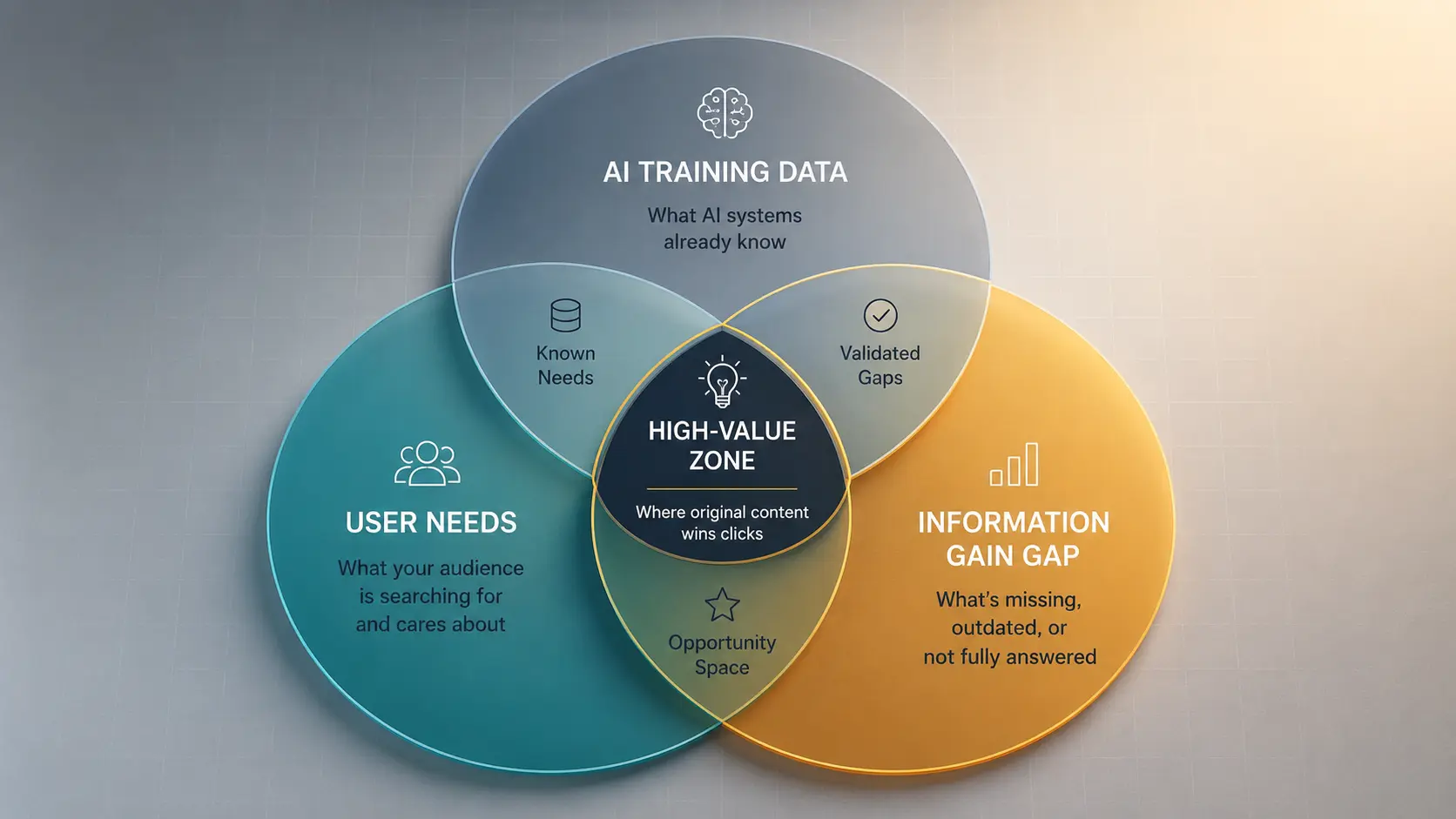
Information Gain SEO is not a buzzword โ€” it’s a measurable concept grounded in Google’s own patent filings. The underlying idea is simple but the execution is demanding: a piece of content scores well on information gain when it introduces facts, data points, perspectives, or frameworks that are not redundantly represented in the existing indexed web. Google’s systems are designed to reward this kind of content because it’s the only kind that justifiably earns a top position in a world where AI can synthesize everything else.

The paradox is this: the more you try to cover established ground comprehensively, the more you compete with AI on AI’s strongest terrain. The counter-strategy โ€” deliberately publishing only what doesn’t yet exist โ€” feels risky to most content teams because it requires real research, real experimentation, and real opinions. That friction is the moat. If generating the content were easy, it would already be in the training data.

Venn diagram showing the intersection of AI training data, user needs, and the information gain gap that drives clicks in 2026
High Information Gain Content Formats

Original benchmarks: Run your own tests and publish the numbers. Proprietary surveys: Even a 50-person poll in a niche community generates non-synthesizable data. Contrarian analysis: Take a position the consensus doesn’t hold and defend it with evidence. Process documentation: Document your actual workflow in granular, specific detail that only someone who has done it can write.

Zero Information Gain Content (Avoid)

Roundups of tools with no original testing. Definitions articles. “Ultimate guides” that rehash existing guides. Trend articles based entirely on secondary sources. Content that could be generated in one ChatGPT prompt with good instructions. If you feel like you’re summarizing, you’re producing zero information gain content โ€” and it’s invisible to algorithms and readers alike.

Technical Breakdown: How Google’s Information Gain patent (US20190205374A1, updated applications through 2024) describes a scoring mechanism…

Google’s Information Gain patent (US20190205374A1, updated applications through 2024) describes a scoring mechanism that evaluates whether a document provides searcher value beyond what existing ranked results already supply. The system isn’t just measuring topical coverage โ€” it’s measuring novelty relative to the already-indexed corpus for a given query cluster.

Practically, this means two things for content strategy. First, publishing content that is semantically identical to what ranks โ€” even if it’s “better written” or “more comprehensive” โ€” earns diminishing ranking returns over time. Second, content that introduces measurable novelty (specific data, unusual angles, proprietary frameworks) is weighted differently in the ranking calculation, particularly for competitive queries where AI Overviews are most likely to dominate the top of the page.

๐Ÿ’ก Practical Application

Before writing any piece of content, run this test: search the target query, read the top five results plus any AI Overview, and ask what your article will contain that none of those sources do. If you can’t name at least three specific, non-trivial elements, don’t write the article in its current form. Restructure around what you uniquely know, have tested, or have access to that others don’t.

Building a Brand-First Ecosystem: Moving Beyond Keywords

The shift from ranking for topics to owning the demand for your specific methodology

๐ŸŽฏ High Leverage

There is one category of search query that AI Overviews genuinely cannot compete with: branded search. When a user types “GPTNest AI workflows” or “Ahrefs keyword difficulty formula” or “Notion GTD template,” they are not asking for a synthesized answer about a topic โ€” they are navigating to a specific source. AI Overviews have nothing to say to a branded query. The click is guaranteed, the intent is high, and the visitor arrives with prior positive associations already formed.

The strategic shift from generic SEO to Brand-First SEO is therefore not about abandoning search โ€” it’s about shifting the type of search demand you’re trying to generate. Instead of trying to capture existing demand for “best AI writing tools,” you invest in building demand for “your specific methodology for evaluating AI writing tools.” The former competes with a thousand other pages and an AI Overview. The latter is yours alone.

How to Build Brand-First Search Demand

Name your frameworks: Don’t just describe a process โ€” name it and publish it under that name consistently. Create citable data: Original research that others link to turns your brand into a reference point. Develop signature content formats: If your deep-dives follow a distinctive structure, readers learn to search for your take specifically. Build entity authority: Consistent publication under your brand name, with consistent topical depth, builds entity-level recognition in Google’s Knowledge Graph.

Entity Authority vs. Keyword Authority

Traditional SEO built keyword authority: rank for a term, earn traffic from that term. Entity authority works differently โ€” Google recognizes your brand as an authoritative entity within a topic cluster, which creates ranking advantages across all related queries, not just the ones you’ve explicitly targeted. Building entity authority requires consistent topical focus, verifiable expertise signals (author pages, About sections, external mentions), and content that demonstrates genuine depth rather than broad coverage.

Case Study: Why Users Search for [Brand Name] Instead of [Topic]

๐Ÿ“– Real Case โ€” B2B SaaS Blog, Product Analytics Category, Q1 2026

A product analytics platform ran a 12-month content experiment comparing two strategies: one team published high-volume informational content targeting top-of-funnel SEO queries (“how to measure DAU,” “product retention benchmarks”). A second, smaller team focused exclusively on publishing detailed methodology content under the company’s own branded framework โ€” the “Retention Arc Model” โ€” and drove readers toward a dedicated newsletter. By Q1 2026, the informational content team had lost 44% of its organic clicks despite holding ranking positions. The branded methodology content, despite lower overall impressions, had generated a 2,400-person newsletter list with a 38% open rate and measurable pipeline attribution. More importantly, “Retention Arc Model” now generated 600โ€“900 branded searches per month that competitor AI Overviews couldn’t intercept. The lesson: brand equity compounds. Generic SEO traffic evaporates.

The 2026 Survival Toolkit: Newsletter, Community, and Tool-Based Value

Building un-googleable value that AI cannot summarize and algorithms cannot intercept

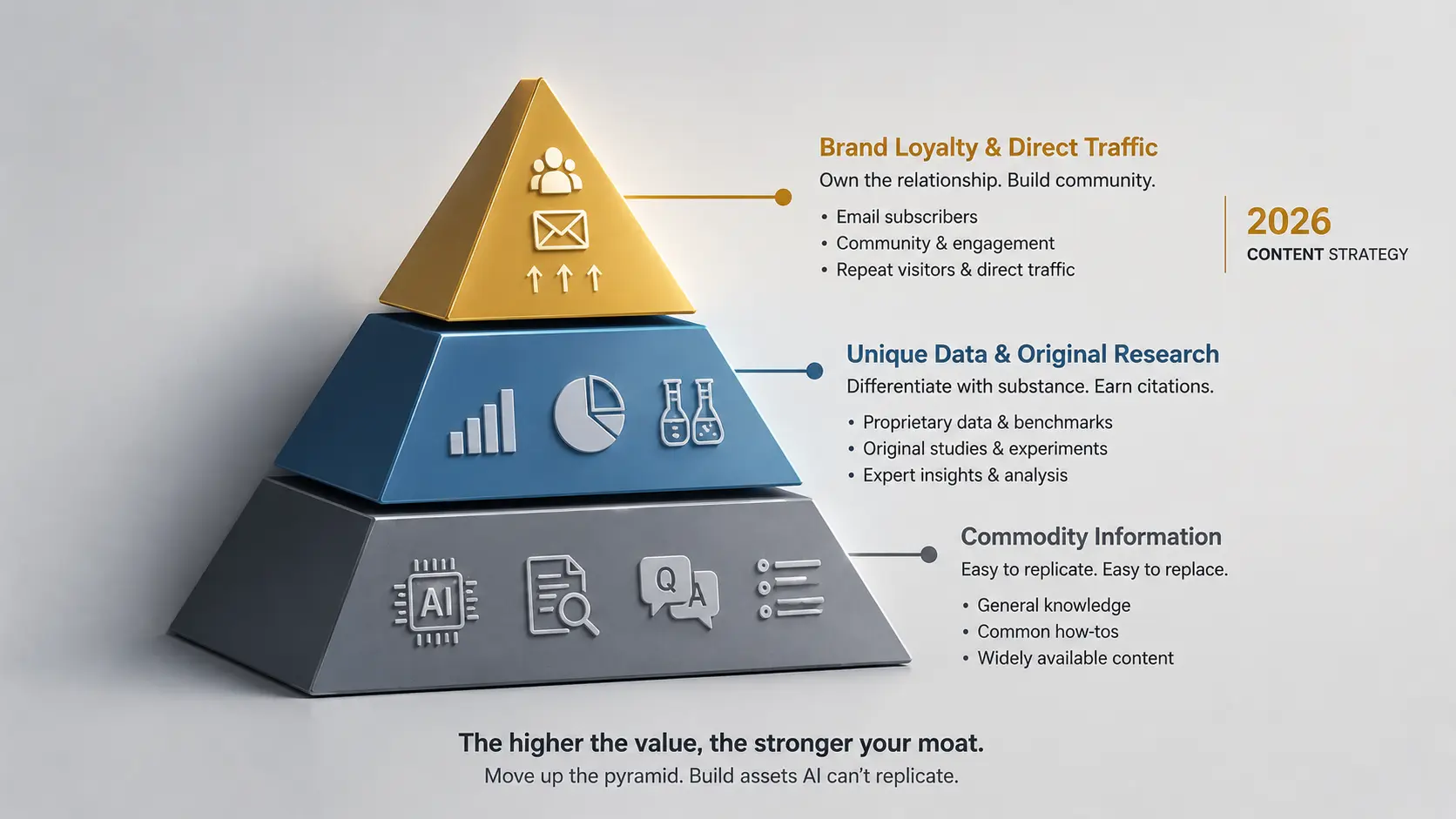
The most durable traffic channel in a zero-click search environment is direct traffic โ€” and direct traffic is built through owned channels. Email newsletters, private communities, and downloadable tools create a relationship with your audience that exists entirely outside Google’s influence. These aren’t fallback options for when SEO fails; in 2026, they are the primary channels for any content business with a five-year time horizon.

The highest-leverage owned asset is almost always the email list โ€” not because email is glamorous, but because it’s the only channel where you control delivery, frequency, and the full reader relationship. A 5,000-person newsletter with 35% open rates represents a more valuable and stable audience than 50,000 monthly organic visitors whose source can be decimated by a single algorithm update or AI Overview rollout.

Value pyramid showing commodity information at the base, unique data in the middle, and brand loyalty and direct traffic at the top โ€” the 2026 content authority hierarchy
Newsletter as an Information Gain Engine

A well-run newsletter generates a category of content that is inherently high in information gain: real-time synthesis, personal commentary, and community-sourced data that doesn’t exist anywhere else at the time of publication. That content, when published to the web after newsletter distribution, carries fresh signals. Readers who arrive from email links also have lower bounce rates and longer session durations โ€” behavioral signals that support ranking.

Tool-Based Value: The Un-Googleable Moat

Custom tools โ€” VBA spreadsheets for financial modeling, Notion templates built around a specific workflow, Airtable bases for editorial calendars โ€” create value that AI cannot summarize because they are interactive, contextual, and embedded in the user’s own environment. A blogger who publishes a genuinely useful custom tool gets bookmarks, direct return visits, and email signups from users who want updates. That flywheel compounds independently of search rankings.

Community as a Proprietary Data Source

A private community (Discord, Circle, Slack group) generates one of the rarest content assets in 2026: non-public, community-sourced insights. When you synthesize discussion threads, poll your members, or publish anonymized case studies from community members, you are producing content that doesn’t exist in any training data set. That content has an information gain score of 100% by definition โ€” it’s genuinely new.

Future-Proofing Your Content Against AI Training Sets

Why first-person E-E-A-T signals are the last content differentiator that LLMs genuinely cannot replicate

๐Ÿ›ก๏ธ Long-Term Play

Google’s E-E-A-T framework (Experience, Expertise, Authoritativeness, Trustworthiness) was updated specifically to address the challenge of AI-generated content at scale. The “Experience” component is the newest and most consequential addition โ€” it refers to first-person, lived experience with the topic being covered. An AI model trained on existing web content can produce authoritative-sounding text on almost any subject, but it cannot credibly claim to have personally run a particular experiment, worked with a specific client, or made a mistake that cost real money.

The strategic implication is significant: the most defensible content you can produce in 2026 is content that is explicitly, demonstrably rooted in your personal or organizational experience. Not “here’s how to do X” but “here’s what happened when we tried X, what went wrong at step three, and what we changed.” The specificity is the proof. And the proof is what Google’s quality raters are increasingly trained to look for as a signal that human expertise is genuinely behind the content.

E-E-A-T Signals That Differentiate From LLM Output

Named authors with verifiable credentials: LinkedIn profiles, published papers, conference talks. Specific dates and contexts: “In March 2026, testing this on our 12,000-subscriber list…” Failure documentation: AI models optimize for correct information; documenting what went wrong signals genuine experience. Proprietary data: Even a small dataset unique to your organization is a stronger E-E-A-T signal than a perfectly synthesized summary of published research.

Pro Tips on First-Person Differentiation

Write in a voice that is unmistakably yours โ€” specific vocabulary, recurring frameworks, consistent aesthetic opinions. Cite your own previous work and evolve your positions publicly over time. Reference your own mistakes with precision. These are the signals that make content citation-worthy for AI systems and click-worthy for human readers: they cannot be replicated by an LLM that lacks the lived context to generate them authentically.

โœ… The Forward-Proof Test

Ask this of every piece you publish: “Could a well-prompted LLM with access to the internet have written this?” If yes, reconsider whether it’s worth publishing at all. The content that survives the next three years of AI development is content where the answer is clearly no โ€” because it contains something that exists only in your experience, your data, or your community.

โšก The 2026 Survival Framework: Information Gain + Entity Authority + Direct Traffic

A diagnostic reference for evaluating every piece of content and every channel investment against the zero-click search reality.

PillarWhat It RequiresWhat It Protects AgainstPrimary Metric
Information Gain SEOOriginal data, benchmarks, contrarian takes, proprietary researchAI Overviews absorbing informational trafficClicks per impression on informational queries
Entity AuthorityConsistent topical focus, named frameworks, verifiable author credentialsAlgorithmic de-prioritization of generic publishersBranded search volume month-over-month
Direct Traffic GrowthEmail list, community, downloadable tools, bookmark-worthy resourcesFull dependence on Google for audience accessDirect sessions as % of total sessions
Brand-First SEONamed methodology, signature content, citable data others referenceKeyword traffic going to zero-click answersRatio of branded to non-branded impressions
First-Person E-E-A-TNamed authors, experience documentation, failure case studiesLLM-generated content displacing your rankingsQuality rater assessments, HCU recovery signals

๐Ÿ† From Traffic Junkie to Authority Figure: Final Moves

The Content Audit Framework

Tag every existing article: “High Information Gain,” “Commodity,” or “Salvageable.” Commodity articles need a complete angle change, not an update.
Kill or consolidate commodity content: Low-information-gain articles dilute site quality signals. Pruning underperforming pages has lifted rankings for dozens of publishers post-HCU.
Redirect traffic from dead articles: Cannibalize your own commodity content by pointing it toward your highest-information-gain pieces. Preserve link equity, concentrate authority.
Set a publishing bar: No article publishes without at least one element that doesn’t exist anywhere else on the indexed web. Document that element in your editorial brief.

This Quarter’s Priority Actions

Launch a newsletter with a distinct voice โ€” not a content digest, but a genuine editorial perspective on your niche
Name one framework you use internally and publish a detailed explanation of it under that name
Run one original experiment and publish the results โ€” even a modest study with real numbers outperforms any amount of synthesis
Build or commission one tool that solves a specific problem for your audience โ€” and make it the centerpiece of your lead magnet strategy

โœ… The Strategic Reframe

Stop measuring success by organic sessions alone. Add branded search volume, email list growth rate, direct traffic percentage, and newsletter open rate to your monthly dashboard. These metrics reflect the health of an audience relationship that search engine volatility cannot destroy. A content business with strong performance on all four of these metrics is genuinely resilient โ€” not just algorithmically lucky.

Zero-click search has not killed blogging. It has killed a specific type of blogging โ€” the kind that competed with encyclopedias rather than replacing them. The bloggers and content teams that survive 2026 and beyond are the ones who treat their content as a proof-of-expertise artifact, not a traffic generation mechanism. They publish what they know, what they’ve tested, and what they’ve failed at. They build communities around their methodology. They measure audience relationships, not just page sessions.

The shift from traffic junkie to authority figure is not painless. It requires producing less content, not more โ€” and making each piece meaningfully harder to replicate. But the authority position, once built, is compounding and defensible in a way that keyword rankings never were. Start with the information gain audit. Then name something. Then build the list. The path is clear; the question is whether you’ll take it before your competitors do.

โšก Advanced Moves for Building Authority That Algorithms Can’t Strip

๐Ÿ’ก Publish Your Methodology, Not Just Your Conclusions

Most content publishes conclusions โ€” “here’s the best tool” or “here’s what works.” Authority content publishes methodology โ€” “here’s exactly how we evaluated these tools, what criteria we used, and why we weight them the way we do.” Methodology content has two advantages: it’s genuinely harder to replicate, and it positions you as a credible source for future conclusions. Readers come back when they trust the process, not just the answer.

โœ… Build Cross-Platform Entity Signals

Entity authority in Google’s Knowledge Graph is built across platforms, not just on your own site. Podcast appearances, guest articles, conference talks, and third-party citations all contribute to the signal that your brand is a recognized entity in a topic space. Prioritize any opportunity that creates an external mention of your brand name alongside your core topic keywords. Even three or four strong external references per quarter compounds over eighteen months into a measurable ranking lift on branded and near-branded queries.

โš ๏ธ Don’t Confuse Content Differentiation With Content Volume

The worst response to zero-click search anxiety is publishing faster. Volume without information gain just accelerates your decline โ€” more commodity content means faster dilution of your site’s quality signals. The correct response is to publish less, but ensure each piece is genuinely non-replicable. A single well-executed original study that earns twenty backlinks and drives eight hundred email signups is worth more than forty generic articles that collectively earn nothing and lose clicks to AI Overviews.

More Guides on SEO Strategy and Content Authority

Scroll to Top