⚖️ Legal & IP 💰 Monetization 🔥 Trending 🆕 2026 Guide ✅ Updated April 2026

How to Sell AI-Generated Content Legally in 2026 (Complete Guide) Copyright rules, platform policies, disclosure practices, and where to actually get paid

sell AI-generated content legally - complete 2026 guide for creators

If you’ve been creating content with AI tools and wondering whether you can actually sell it — legally, without running into copyright trouble — you’re not alone. The rules around selling AI-generated content have evolved quickly in 2026, and the short answer is: yes, you can sell it. But the how matters more than most people realize. This guide breaks down what you need to know before you list a single file.

We’re talking about real, practical steps — not legal theory. Where to sell, what to disclose, how to price, and which mistakes to avoid from the start. Whether you’re generating blog posts, stock images, music, or design assets, the core principles apply across the board.

The landscape isn’t as complicated as it looks. Once you understand the three or four issues that actually matter, most of the anxiety goes away — and the opportunity becomes a lot clearer.

✍️ By GPTNest Editorial · 📅 April 27, 2026 · ⏱️ 13 min read · ★★★★★ 4.8/5

Before You Read — 5 Things Worth Knowing First

Copyright on AI content is unsettled — but manageable. In most countries, purely AI-generated work doesn’t receive automatic copyright protection. That affects how you sell it, not whether you can.
Your tool’s license matters more than you think. Every AI platform has its own terms. Some grant you full commercial rights. Others restrict selling output entirely. Reading the ToS for your specific tool is not optional.
Disclosure is becoming standard practice. Many marketplaces now require sellers to label AI-generated content. Getting ahead of this builds trust and protects you from future policy changes.
Human creative input raises your legal standing. The more meaningfully you shape, edit, and transform AI output, the stronger your claim to the work — and the more valuable it usually is anyway.
Platforms, not just laws, set the real rules. Etsy, Adobe Stock, and Gumroad each have their own policies. Legal compliance and platform compliance are two separate checklists.

6

Key Legal Principles

8+

Platforms That Accept AI Content

Value Boost From Human Editing

13m

Average Read Time

What You’ll Learn in This Guide

Reading Your AI Tool’s Commercial Terms

The step most people skip — and the one that causes real problems

Before you sell a single piece of AI-generated content, you need to read the Terms of Service for the specific tool that made it. This is not optional. Different platforms have very different rules about commercial use, and they vary significantly even within the same product category.

Midjourney, for example, grants paid subscribers broad commercial rights to their generated images. Adobe Firefly is designed specifically for commercial use and trained on licensed content, which makes it one of the safer choices for selling. Some free-tier tools, however, restrict commercial use entirely — meaning anything you generate on a free plan can’t be legally sold without upgrading.

What to Look For in Any AI Tool’s ToS

Check for: (1) whether commercial use is permitted on your plan tier, (2) whether the platform retains any license to your output, (3) whether there are restrictions on specific types of content or categories, and (4) whether you’re required to credit the tool in any way when selling.

2026 Snapshot — Key Tool Positions

ChatGPT / OpenAI: Commercial rights granted to output. Midjourney (paid): Commercial use allowed above a revenue threshold. Adobe Firefly: Commercially safe by design, IP indemnification available on enterprise. Stable Diffusion (self-hosted): Open weights, generally permissive — but check model-specific licenses.

📖 Real Case — Digital Artist, Casablanca, 2025

A graphic designer built a side income selling AI-generated pattern packs on Etsy — until a platform policy change flagged her account. The issue wasn’t that the work was AI-generated. It was that she’d been using a tool whose free-tier terms didn’t allow commercial sales. She upgraded to a paid plan, re-read the ToS, and relisted. The store was back within a week. The lesson: tool terms change, and checking them once isn’t enough. Build a quarterly review into your workflow.

Disclosure — When, Where, and How to Label AI Content

Transparency isn’t just ethical — it’s increasingly a legal and platform requirement

🎯 High Impact

In 2026, disclosure expectations have moved from “nice to have” to “standard practice” — and in some sectors, they’re becoming mandatory. Stock photo platforms like Adobe Stock and Shutterstock now require sellers to tag AI-generated images. Several freelance marketplaces require disclosure in project proposals. The EU’s AI Act has created binding transparency rules for AI-generated content in commercial contexts, and similar legislation is developing elsewhere.

The good news: disclosure doesn’t kill demand. Buyers who care will appreciate the honesty. Buyers who don’t care will still buy. And being transparent upfront protects you from chargebacks, disputes, and account suspensions — all of which are more disruptive than an honest label.

How to Disclose Effectively

Keep it simple and factual. “This artwork was created using AI image generation tools and edited by the artist” covers most cases. For written content: “Drafted with AI assistance and edited by [your name].” For templates or packs: include a note in the product description and the file metadata where possible.

Disclosure Doesn’t Mean Devaluing

Frame your disclosure around the value you add, not as an apology. “Created with AI tools and professionally refined for commercial use” positions the product as a quality-controlled deliverable. The AI is the tool; your judgment and workflow are the product.

✅ Quick Habit

Create a standard disclosure template you paste into every listing. Update it quarterly as platform requirements shift. Keeping this consistent across all your products takes two minutes and prevents the kind of policy violations that get stores suspended.

Adding Human Value — Why It Matters Legally and Commercially

The difference between a file you generated and a product worth buying

Raw AI output is a starting point, not a finished product. The sellers consistently earning real income from AI content aren’t just generating and uploading — they’re curating, editing, packaging, and contextualizing. That human layer is what separates a five-dollar asset from a fifty-dollar one, and it’s also what builds your legal position.

For written content, this means editing for voice, accuracy, and structure — not just grammar-checking. For images, it means color grading, cropping for different aspect ratios, removing artifacts, and organizing into coherent collections. For templates or tools, it means testing real-world usability and writing clear documentation. None of this takes enormous time, but each step meaningfully increases what a buyer is actually getting.

Human Value Layers That Sell

Curation: Selecting the best 20 from 200 outputs. Editing: Fixing artifacts, improving structure, matching a brief. Packaging: Organizing into collections with clear use cases. Documentation: Writing clear instructions, license summaries, and usage guides. Each layer compounds the perceived value.

Niche Expertise Is the Real Differentiator

A generic AI image pack is commoditized. A curated pack of “100 Social Media Templates for Independent Coffee Shops” — built with AI, refined by someone who understands that market — is a product. Niche knowledge shapes what you generate, what you cut, and how you present it. That knowledge can’t be easily replicated.

📖 Real Case — Content Creator, Rabat, 2026

A freelance writer started selling AI-assisted blog post drafts on a content marketplace. Initial results were mediocre — buyers found the posts too generic. She shifted her approach: instead of selling raw drafts, she began specializing in the legal technology niche, drawing on three years of prior work in that field. She used AI to generate first drafts, then heavily edited for accuracy, voice, and industry-specific detail. Her rates tripled. The AI did the heavy lifting; her expertise made the work trustworthy and specific enough to command a real price.

Where to Sell AI-Generated Content in 2026

The platforms that work, what they accept, and what to watch for

The marketplace landscape for AI content has matured significantly. Some platforms have embraced it with clear policies; others are still figuring it out. Knowing where to list — and what each platform requires — saves you from wasted effort and avoids policy violations that damage seller ratings.

The most important thing to check before listing anywhere is whether the platform explicitly permits AI-generated content in your category. Policies change, and a platform that accepted AI images in 2024 may have tightened rules since. Check the current seller guidelines, not what you read in a forum six months ago.

Platforms Currently Open to AI Content (With Proper Disclosure)

Gumroad: Creator-friendly, broad acceptance, good for digital products and bundles. Adobe Stock: Accepts AI images with explicit AI label; strong distribution. Etsy: Permits AI-generated digital downloads with disclosure in listing. Fiverr / Contra: Service-based selling where AI tools are part of your workflow. Payhip, Lemon Squeezy: Direct-to-customer; you set your own policies.

Platforms With Tighter Restrictions

Shutterstock: Requires AI disclosure and has specific submission queues — volume caps apply in some categories. Getty Images: Still cautious; accept AI only in limited, clearly labeled tracks. Creative Market: Permits AI-assisted work but scrutinizes fully automated output. Always check the current contributor agreement before submitting.

Pricing and Positioning Your Work

How to price AI content without underselling or overselling

One of the most common mistakes new sellers make is dramatically underpricing AI content because it feels “easier” to make. The value of a digital product isn’t determined by how long it took to create — it’s determined by what problem it solves and how well it solves it. A high-quality prompt pack that saves a buyer three hours of research is worth whatever that time is worth to them.

That said, the market is competitive. Buyers are aware that AI tools exist and that generation is relatively cheap. The pricing floor has dropped for commoditized content. This makes niche positioning even more important — a well-targeted product at a reasonable price consistently outperforms generic content at any price.

Pricing Framework for AI Digital Products

Low-touch, generic: $5–15 (icon packs, basic templates, prompt lists). Niche, curated, edited: $20–60 (industry-specific content bundles, refined image sets). Comprehensive packages with documentation: $60–150+ (full brand kits, editorial content systems, specialized tools). Price based on the buyer’s outcome, not your input cost.

Positioning That Works

Don’t hide that your product is AI-assisted — frame it as a feature. “Professional-grade, AI-powered, human-refined” is a stronger positioning than pretending it was made entirely by hand. Buyers in 2026 respect efficiency. What they don’t accept is poor quality. Lead with the outcome and let the production method be a proof point for speed and scalability.

Building a Compliant, Repeatable Sales Workflow

From first generation to first sale — and keeping it consistent

The difference between someone who makes occasional sales and someone who builds a real income stream from AI content usually comes down to process. Ad hoc creation leads to inconsistent quality and compliance gaps. A simple, repeatable workflow eliminates most of the risks and keeps output quality high without adding much time to each product.

Step 1 — Verify Before You Create

Before generating anything for sale, confirm: (1) your tool’s current ToS allows commercial use on your plan, (2) the platform you’re selling on accepts this content category, (3) you know what disclosure is required. Five minutes here prevents account suspensions later.

Step 2 — Generate, Curate, Refine

Generate more than you need. Curate ruthlessly — only include outputs that meet your quality standard. Refine the selected pieces: fix artifacts, adjust formatting, add your editorial layer. The curation and refinement step is where your product becomes yours in a meaningful way.

Step 3 — Document and Package

Write clear product descriptions that explain the use case, format, and license. Include a simple license note with each product (commercial use permitted / editorial use only / etc). Add metadata where platforms support it. Good documentation reduces support questions and increases buyer confidence.

Step 4 — Monitor and Adapt

Set a quarterly calendar reminder to review the ToS for your main tools and selling platforms. Subscribe to creator newsletters from those platforms. Policy changes happen — the sellers who adapt quickly keep their businesses intact; the ones who ignore changes lose listings and sometimes accounts.

⚡ Platform Comparison — AI Content Policies 2026

A quick-reference snapshot of major platforms and their current stance on AI-generated content sales.

PlatformAI Content Accepted?Disclosure Required?Key Condition
GumroadYesRecommendedSeller sets own terms — be explicit in listings
Adobe StockYesMandatory (AI tag)Must select AI-generated flag at submission
Etsy (Digital)YesRequired in listingDisclose in product description; no handmade claim
ShutterstockYes (limited)MandatorySeparate AI submission track; volume limits apply
Creative MarketSelectiveRequiredHuman creative contribution must be evident
FiverrYes (as workflow tool)Case by caseDisclose to buyers; deliver quality, not raw output
Getty ImagesLimitedMandatoryAI-specific submission category only; review required

🏆 Pro Tips for Selling AI Content the Right Way

The Seller’s Compliance Checklist

Before each new product: Verify tool ToS and platform policy. Check for any category-specific rules you might have missed.
In every listing: Include a clear, honest disclosure statement. State the license terms the buyer receives.
Quarterly: Review your active listings against any updated platform policies. Update disclosures as requirements evolve.

Habits Worth Building This Week

Create a “compliance doc” where you paste the relevant ToS excerpts for your main tools and platforms
Write one standard disclosure template you can adapt for each listing format
Pick one niche and generate your first curated pack — start with quality over quantity
Set a calendar reminder to review platform policies every 90 days

✅ The One Action Worth Taking Today

Open the Terms of Service for whichever AI tool you use most, search for “commercial,” and read those three paragraphs. Then check the seller guidelines on whichever platform you plan to sell on. This twenty-minute investment is the foundation of a compliant business — and it’ll save you from problems that take days or weeks to fix later.

Selling AI-generated content legally in 2026 isn’t complicated — but it does require attention to a few things most people skip. Read your tool’s terms. Disclose clearly. Add genuine value before you sell. Know which platforms match your content category. These aren’t burdensome steps; they’re the foundation of a business that lasts longer than the next policy update.

The sellers doing well in this space aren’t just generating content at scale. They’re applying real judgment, real expertise, and real care to what they put in front of buyers. That’s what earns repeat customers, good reviews, and a reputation that survives whatever the legal landscape looks like next year. Start with the compliance basics, then focus on making something worth buying.

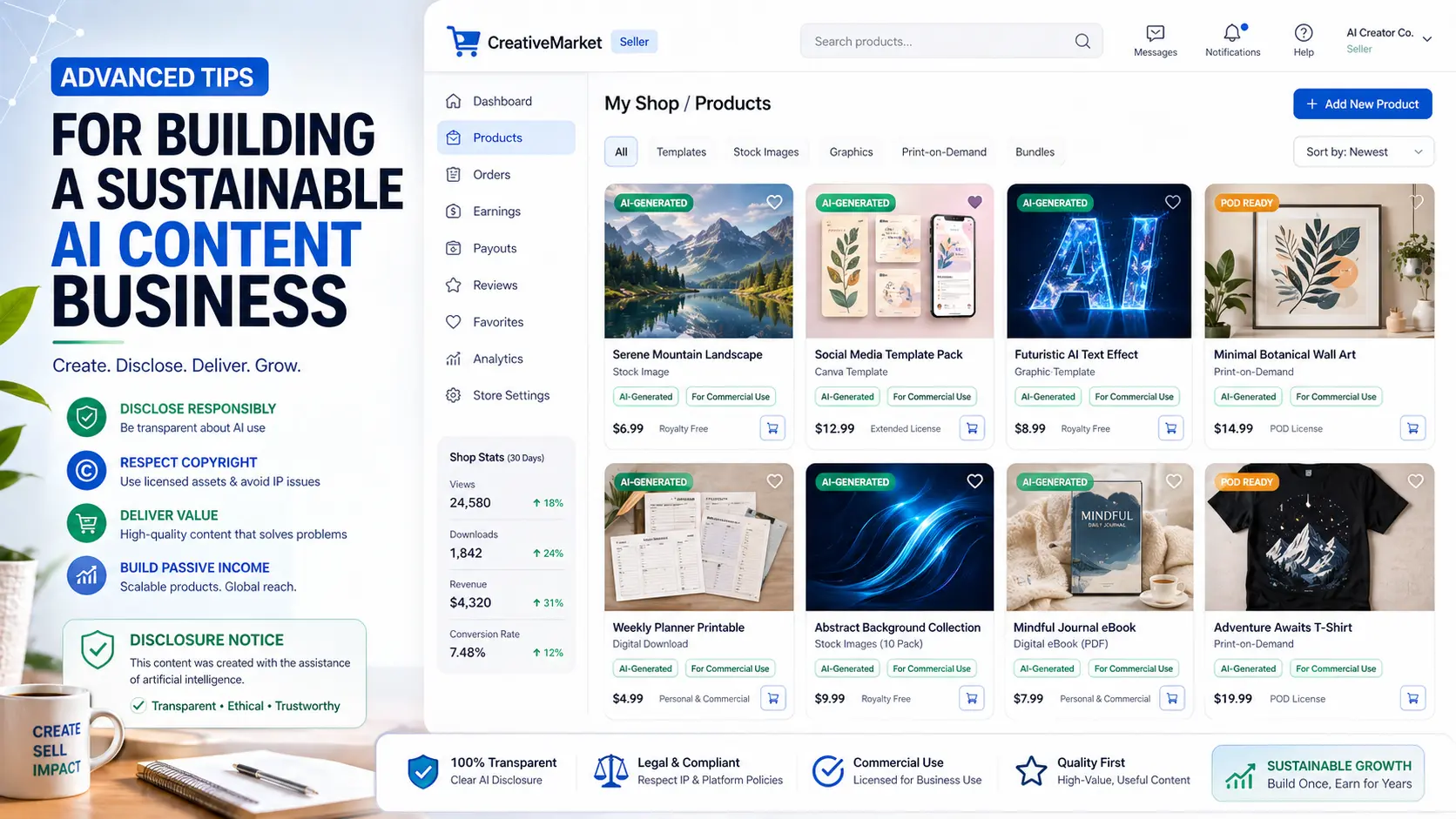
⚡ Advanced Tips for Building a Sustainable AI Content Business

Digital marketplace shop interface showing well-organized AI-generated content listings with proper disclosure labels and pricing — 2026 seller best practices

💡 Build a Product Line, Not Just Individual Products

The most efficient AI content businesses aren’t selling one-off files — they’re building collections. A “Volume 1” pack with a clear niche creates a natural reason for buyers to return for Volume 2. Consistent naming, branding, and quality standards across a series builds recognizable seller identity faster than scattered individual products.

✅ Use Your Own Purchases to Benchmark Quality

Before listing anything, ask: would I pay this price for this product if I found it in a marketplace? If the honest answer is no — tighten the curation, improve the documentation, or lower the price. Buyers develop pattern recognition for quality quickly, and reviews compound. Starting with strong quality is much easier than recovering from early bad reviews.

⚠️ Don’t Chase Volume at the Expense of Compliance

The temptation to list as many products as possible as fast as possible is real — but one policy violation can take down a store that took months to build. Slow, compliant growth beats fast, risky growth. Build your compliance habits before you scale your volume. A business with ten well-protected products is in a stronger position than one with a hundred questionable ones.

More Guides on AI Content and Monetization

Scroll to Top