The Blueprint for No-Code AI Automation: Building Enterprise Systems Without Code
โš™๏ธ Enterprise Automation ๐Ÿ”— No-Code AI ๐Ÿ”ฅ Architecture Deep-Dive ๐Ÿ†• 2026 Framework โœ… Updated May 2026

The Blueprint for No-Code AI Automation: Building Enterprise Systems Without Code A three-tier architecture framework for CTOs, Operations Directors, and Technical Founders deploying scalable AI pipelines in 2026

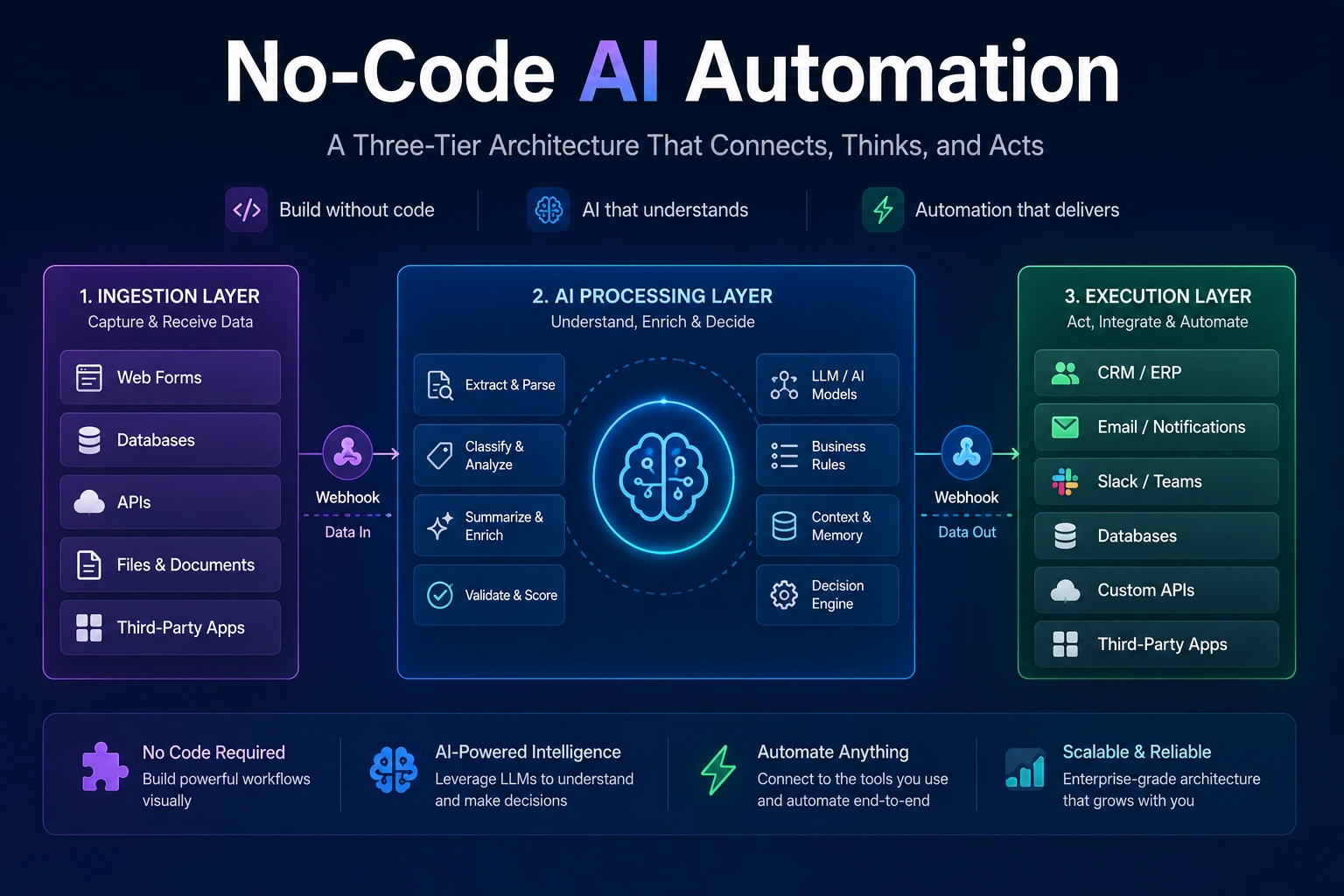
no-code AI automation - Three-tier architecture diagram showing ingestion, AI processing, and execution layers connected by webhook data flows

Seven years of managing engineering teams and overseeing systems deployments across complex digital infrastructures has taught me one unambiguous lesson: the organizations winning on operational efficiency in 2026 are not those with the largest engineering headcount โ€” they are those with the most agile delivery methodology. No-code AI automation is no longer a shortcut for people who cannot code. It is a legitimate, battle-tested software delivery paradigm capable of orchestrating enterprise-grade data pipelines that route, transform, and act on information at scale.

The landscape shifted decisively when foundational LLM APIs โ€” the reasoning engines behind GPT-4o, Claude Sonnet, and Gemini Pro โ€” became accessible via a single authenticated POST request. Visual builders like Make, n8n, and Zapier’s enterprise tier can now wrap those calls inside conditional logic graphs, iterate over JSON arrays, trigger downstream ERP webhooks, and handle failure states โ€” all without a single line of syntax written by a developer. What was a prototyping tool in 2022 is now a legitimate deployment surface for production business process automation.

This article breaks down the structural architecture of a robust no-code AI automation system, explains the advanced logic patterns that make it production-worthy, and addresses the security and compliance questions that enterprise stakeholders will inevitably raise.

โœ๏ธ By AI Systems Architect ยท 7 Years in Engineering Oversight & Solutions Architecture ยท ๐Ÿ“… May 16, 2026 ยท โฑ๏ธ 21 min read ยท โ˜…โ˜…โ˜…โ˜…โ˜… 4.9/5

Before You Read โ€” 5 Realities of Enterprise No-Code AI in 2026

No-code does not mean no architecture. A visual builder without a deliberate structural design produces chaos at scale. The three-tier model in this article is the framework that separates operational pipelines from hobby automations.
LLM API calls are the new middleware. The AI processing node in a no-code workflow replaces hundreds of lines of conditional business logic. Understanding how to condition a prompt is now a core systems design competency.
Semantic routing is the architectural breakthrough. Using an LLM to classify inbound intent and branch workflow execution accordingly eliminates the brittle keyword-matching rules that made older automation fragile.
Security is an API configuration question, not a platform question. Data privacy in no-code systems is governed by how API calls are structured and where credentials are stored โ€” not by the visual builder’s interface.
Error handling is where most no-code automations fail. Production systems require explicit fallback branches, failure notifications, and retry logic. This is buildable without code โ€” but only if you plan it deliberately.

3

Architecture Tiers in a Production No-Code System

70%

Reduction in Middleware Dev Time Reported by Early Adopters

$0

Custom Code Required for Advanced Conditional Branching

<1d

Typical Build Time for a Three-Tier Pilot Pipeline

In This Framework Article

Disrupting the Codebase: Why Agile Enterprises Are Moving to Visual AI Orchestrators

The case for no-code AI automation as a strategic delivery methodology โ€” not a workaround

๐Ÿง  Strategic Context

The conventional approach to enterprise middleware has always been the same: identify a business process, write a specification, assign a development team, wait through a sprint cycle, test, deploy, and maintain. This loop โ€” expensive, slow, and heavily dependent on engineering bandwidth โ€” was never optimized for the speed at which modern business conditions change. When a procurement process needs a new approval tier, or a customer intake flow needs to account for a new compliance requirement, the traditional stack cannot respond quickly enough to match operational reality.

Visual AI orchestrators solve this by compressing the delivery cycle from weeks to hours. When an Operations Director can describe a data flow visually, connect it to a live API, and deploy it by end of business โ€” without a pull request, a code review, or a staging environment โ€” the organization’s ability to respond to change becomes a structural advantage rather than a periodic project.

I want to be explicit about what this is not. No-code AI automation does not replace software engineering for product development, custom application logic, or algorithmic computation. What it replaces is the heavy, custom-coded middleware layer that most organizations have historically built to move data between SaaS systems, trigger actions based on business rules, and generate outputs from structured inputs. That layer โ€” the connective tissue of the enterprise stack โ€” is where visual builders with embedded LLM nodes are now operationally superior.

๐Ÿ’ก The Agile Framing That Changes Everything

Frame no-code AI automation as an agile software delivery method, not a tool category. When leadership understands that a visual pipeline is a deployable system with version history, audit logs, and structured error handling โ€” and not a spreadsheet macro โ€” the conversation about enterprise adoption changes entirely.
The Three-Tier Architecture of No-Code AI Automation

The structural model that separates production pipelines from hobbyist automations

After overseeing deployments across multiple operational contexts over seven years, I have observed that virtually every durable, scalable no-code AI automation can be reduced to the same three structural tiers: an Ingestion Layer, a Processing Engine, and an Operational Execution Layer. Organizations that build within this framework produce systems that are maintainable, auditable, and extensible. Those that do not tend to produce spaghetti automations that collapse under real-world edge cases.

The power of this three-tier model is its separation of concerns. Each layer has a single, clearly defined responsibility. Ingestion receives and normalizes data. The Processing Engine applies intelligence and makes routing decisions. The Execution Layer acts on those decisions by writing to databases, calling ERP endpoints, or triggering downstream communications. When something breaks โ€” and in complex pipelines, something always eventually breaks โ€” the modular structure allows you to isolate the fault immediately.

โœ… The Foundational Principle

No module in your no-code system should be responsible for more than one of these three functions. A node that both parses an inbound webhook payload AND calls an LLM AND updates a CRM record is a liability โ€” not an efficiency. Decompose it.

Ingestion, Processing, and Execution Layers Explained

Breaking down each structural tier with operational specificity

๐Ÿ—๏ธ Architecture

Each of the three tiers has distinct technical responsibilities that, when implemented correctly, produce a system that behaves predictably under variable data conditions.

Tier 1 โ€” Data Ingestion Layer

This is the system’s front door. Data enters via inbound webhooks (HTTP POST from a CRM, form submission, or third-party event trigger), scheduled pollers that query APIs on intervals, or email parsers that extract structured fields from unstructured message bodies. The sole responsibility of this layer is to receive raw data, validate that it conforms to expected schema, normalize it into a consistent internal format, and pass it to the Processing Engine. Any malformed payload that cannot be normalized should be caught here and routed to an error queue โ€” before it ever reaches the intelligence layer.

Tier 2 โ€” AI Processing Engine

This is where the intelligence lives. The Processing Engine receives the normalized payload from the Ingestion Layer and applies one or more LLM API calls to transform, classify, summarize, or generate structured data. In a mature implementation, this layer uses a conditioning prompt that is parameterized by the incoming data โ€” meaning the LLM receives a dynamically constructed context, not a static template. The engine may also implement agentic loops: iterative sequences where the LLM’s output is fed back as input for a subsequent reasoning step, enabling multi-stage logic that would otherwise require significant custom code. The output of this layer is always a structured JSON payload ready for the Execution Layer.

Tier 3 โ€” Operational Execution Layer

The Execution Layer receives the structured output from the Processing Engine and acts. Actions include updating database records via a REST API, triggering outbound webhooks to ERP or CRM endpoints, sending formatted notifications to communication platforms, writing rows to a data warehouse, or initiating a downstream automation sequence in a parallel pipeline. This layer contains no intelligence โ€” it only follows instructions embedded in the payload delivered by the Processing Engine. That strict separation is what makes the system testable: you can mock the Processing Engine’s output and validate the Execution Layer in complete isolation.

๐Ÿ“– Architecture in Practice โ€” B2B SaaS Operations Team, 2025

An operations team managing inbound enterprise support requests built a three-tier pipeline in Make. The Ingestion Layer captured emails via a monitored inbox and extracted the sender domain, subject, and body into a normalized object. The Processing Engine called the Claude API with a conditioning prompt that classified the request by urgency, category, and required department. The Execution Layer then updated the support CRM, created a Jira ticket in the correct project, and sent a Slack notification to the responsible team lead โ€” all triggered automatically, all without a developer writing routing logic. The pipeline processed 200 to 300 requests per week with a documented false classification rate under 3%.

Harnessing Advanced Logic: Branching, Loops, and Semantic Routing

The visual logic patterns that replace hundreds of lines of conditional middleware code

๐Ÿงฉ Advanced Patterns

The most common objection from engineering teams when evaluating no-code AI automation is the assumption that visual builders cannot handle complex conditional logic. This was a legitimate criticism three years ago. It is not today. Modern enterprise visual builders support conditional branching trees that evaluate the contents of JSON fields, compare structured values, and execute different execution paths based on multi-field compound conditions โ€” all configured via point-and-click interfaces that generate the same underlying logic as hand-written if/else chains.

Iterator modules handle array-based processing: when an inbound payload contains a list of records โ€” say, fifty line items from a purchase order โ€” the iterator unpacks each element and routes it through its own processing sub-path, aggregates the results, and passes a compiled summary to the next node. This is the functional equivalent of a forEach loop, implemented without writing a function. Nested JSON parsing is handled through dot-notation field references that are available in every modern platform’s data mapping interface.

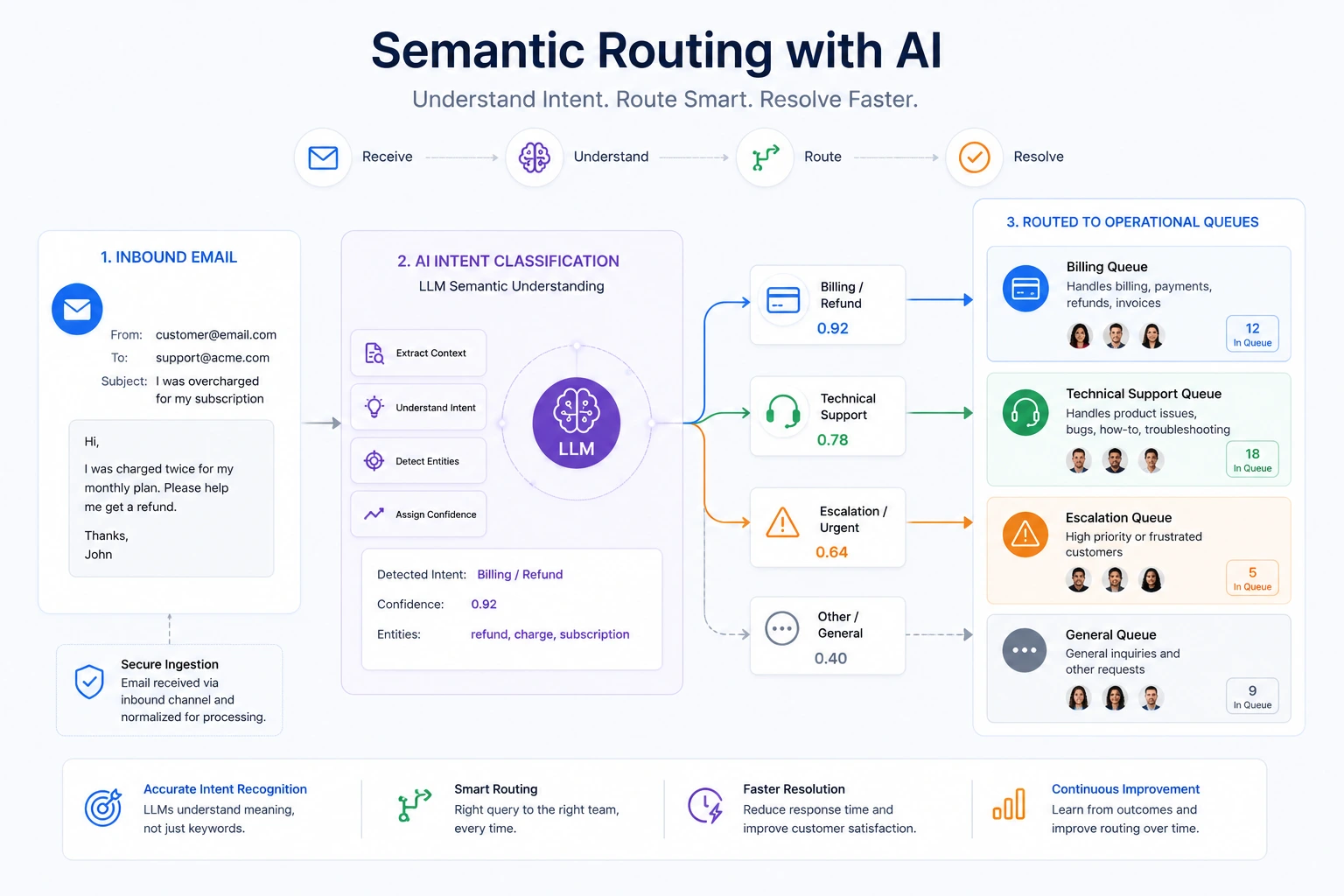
Semantic routing flowchart showing an inbound customer email classified by LLM intent node and branched into billing, technical support, and escalation operational queues

โš ๏ธ The Common Failure Mode

The most frequent mistake in complex no-code branching is evaluating the LLM’s raw text output directly in a condition node. Always instruct your LLM to return a structured JSON object with a defined classification field โ€” for example, {"intent": "billing_dispute", "confidence": 0.94} โ€” and evaluate the intent field in your branch condition. Evaluating free-form text produces brittle, unpredictable routing.

How an AI Node Automatically Decides Your Workflow Direction

Semantic routing โ€” the architectural pattern that replaces brittle keyword matching

๐ŸŽฏ Semantic Routing

Semantic routing is the practice of using an LLM’s natural language understanding to classify inbound data by intent and then using that classification to determine which downstream execution path to activate. It is the single most powerful architectural concept available in no-code AI automation, and it fundamentally changes what kinds of problems a visual pipeline can solve.

Traditional automation routing is lexical: it looks for keywords, matches patterns, and branches on exact values. This means it fails every time a user phrases a request in an unexpected way, uses a synonym, or submits data in a slightly different structure. Semantic routing evaluates meaning, not syntax. An LLM classification node can correctly route a message that says “I was charged twice for last month” to the same billing queue as “there’s a duplicate transaction on my account” โ€” without any rule written to handle the variation.

The implementation pattern is consistent regardless of the platform. Configure an HTTP request node to call your preferred LLM API โ€” OpenAI, Anthropic, or an open-weight model hosted internally. In the request body, construct a system prompt that defines the classification taxonomy and instructs the model to return only a structured JSON object. Pass the inbound data as the user message. Parse the returned JSON in a subsequent data transformation node. Then route to your conditional branching tree based on the parsed intent field. The entire sequence typically takes four to six nodes in a visual builder, with no custom code at any step.

Routing Prompt Design โ€” Best Practice

Your classification system prompt should define between three and eight intent categories. More than eight creates ambiguity at classification boundaries. Each category should include two to three example phrases. Instruct the model explicitly: “Return only valid JSON. Do not include any additional text, explanation, or markdown.” Include a catch-all category โ€” for example, “unclassified” โ€” for inputs that do not clearly map to any defined intent.

Confidence Threshold Gating

Instruct the LLM to include a confidence score alongside the intent classification. In your branching logic, add a gate condition: if confidence falls below a defined threshold (typically 0.75 to 0.85), route to a human review queue rather than proceeding with automated execution. This prevents low-confidence classifications from triggering incorrect downstream actions in edge cases.

Agentic Loop Pattern

For multi-step reasoning tasks, implement an agentic loop: pass the LLM’s output back as input to a second API call with additional context. This allows the system to refine its classification, validate its own output against business rules, or generate a follow-up action based on the result of the first reasoning step โ€” all within a single workflow, without writing recursive functions.

Connecting the Stack: Webhooks, REST APIs, and Secure JSON Payloads

The data transport layer that ties ingestion to execution across your enterprise stack

The connective tissue of any no-code AI automation system is its ability to transmit structured data reliably between endpoints. Every modern enterprise SaaS platform โ€” CRM, ERP, HRIS, marketing automation โ€” exposes a webhook receiver and a REST API. Your no-code pipeline lives between them, receiving events from one system, processing them through the AI layer, and writing results to another.

Inbound webhooks are the most reliable ingestion trigger for event-driven architectures. When a deal is updated in your CRM, the platform fires a POST request to your pipeline’s unique webhook URL with a JSON payload containing the event details. Your Ingestion Layer receives this, validates the payload signature (most platforms sign webhook deliveries with an HMAC hash โ€” always verify this in your first validation node), normalizes the data structure, and passes it downstream.

Outbound API webhook orchestration โ€” calling external endpoints from within your pipeline โ€” follows a simple HTTP request module pattern available in every enterprise visual builder. The critical design discipline is payload hygiene: your Execution Layer nodes should only send the specific fields required by the target API, never the full internal payload. Strip unnecessary fields in a data transformation node before every outbound call. This reduces exposure surface and keeps your API calls within rate limits and payload size constraints.

๐Ÿ’ก JSON Payload Parsing Without Code

Nested JSON parsing โ€” accessing a value three or four levels deep in a structured object โ€” is handled through dot-notation path references in every major platform’s data mapping layer. For example, body.customer.billing.address.city maps directly to the correct field without writing a parser. When an LLM returns a nested JSON structure, use a dedicated JSON parse module to flatten it into named variables before your branching conditions evaluate it.

Eliminating the Failure Points: Error Handling and Fallbacks in Visual Builders

The production discipline that separates operational pipelines from fragile automations

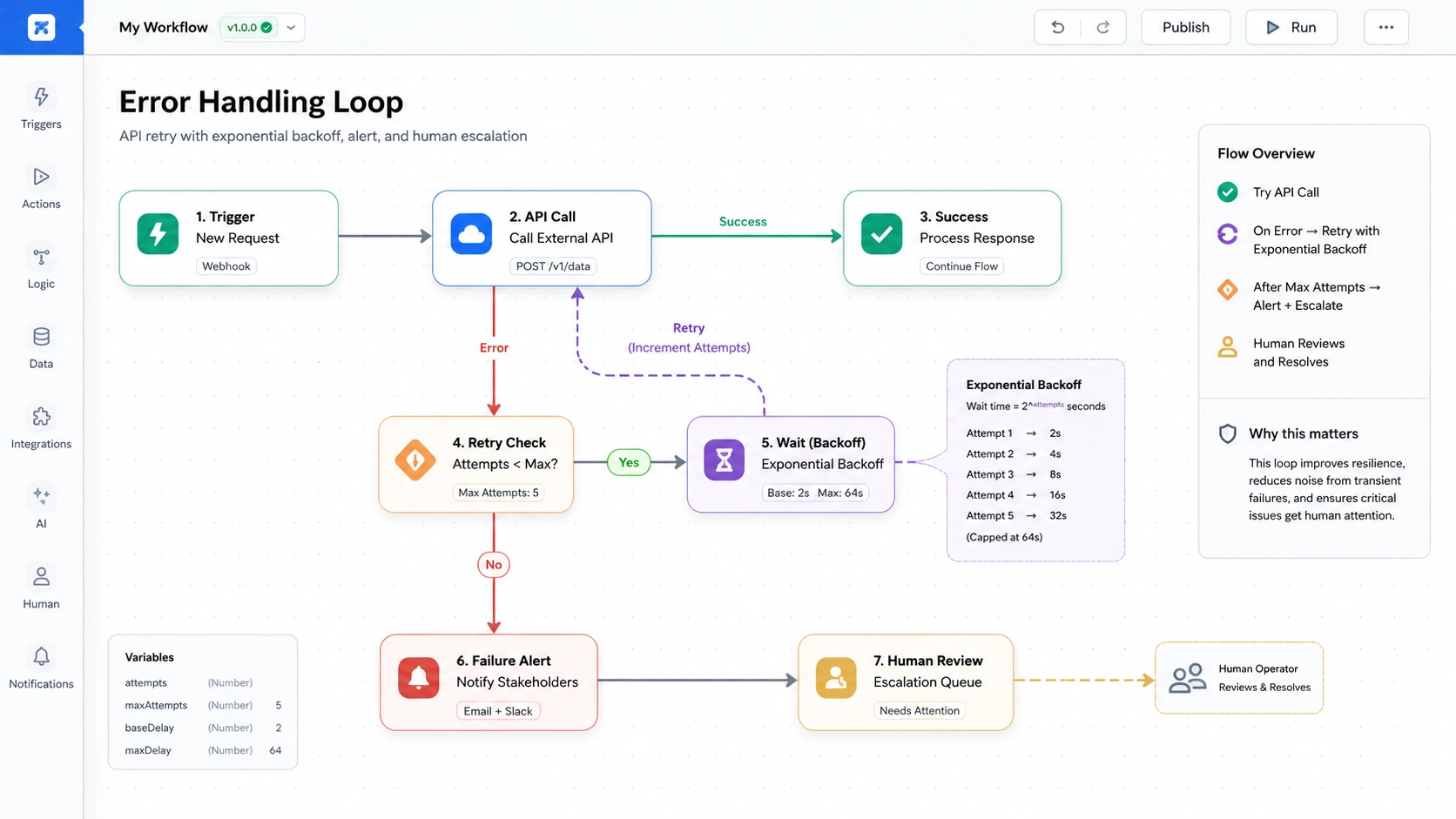
Error handling loop diagram in a no-code visual builder showing API retry logic with exponential backoff, failure alert node, and human review escalation queue

The most common failure mode in production no-code AI automation systems is not the AI processing step โ€” it is the assumption that upstream data will always arrive in an expected format and that downstream APIs will always respond successfully. Neither is guaranteed. A robust error-handling architecture is the difference between a system that silently drops records on failure and one that routes failures to a recoverable state.

Every enterprise-grade visual builder exposes an error handler configuration at the module level. This allows you to attach a specific fallback route to any node that might fail. When that node throws an exception โ€” a timeout, a malformed response, an API rate limit error โ€” the execution is routed to the error path rather than terminating the scenario. Your error path should, at minimum, log the failed payload to a persistent store, send a structured alert to the responsible operations contact, and optionally trigger a retry sequence with a configurable delay interval.

Retry Logic Pattern

For transient API failures โ€” rate limits, temporary service unavailability โ€” implement a retry loop with exponential backoff. Most platforms support a Wait module that pauses execution for a configurable interval before re-attempting a failed node. Configure three retry attempts at 30, 60, and 120 second intervals. If all three fail, route to the permanent failure handler.

Structured Error Logging

Every failed payload should be written to a dedicated error log table with the following fields: timestamp, pipeline name, error type, original payload hash, node where failure occurred, and human-readable error message from the API response. This structure enables forensic analysis of failure patterns and supports the systematic improvement of your pipeline’s resilience over time.

โœ… The Operational Standard

A production no-code pipeline should have a documented failure rate of under 2% for any given data input class, with 100% of failures logged and at least 80% recoverable via automated retry or human-assisted reprocessing. If you cannot audit failure rates, your error handling is insufficient for enterprise deployment.

Enterprise Compliance and Security in No-Code AI Automation

Why secure API architecture protects corporate data more effectively than most teams assume

The security question that arises in every enterprise evaluation of no-code AI automation is the same: when we send internal data to an LLM API, where does it go and who can see it? This is a legitimate and important question, and the answer is substantially more favorable than most security teams initially assume โ€” provided the API calls are structured correctly.

API-level LLM access is categorically different from consumer-facing interfaces like ChatGPT’s web application. When your no-code pipeline calls the OpenAI API or Anthropic API via an authenticated HTTP request, the data transmitted is subject to the enterprise data processing agreement (DPA) that governs the API tier โ€” not the terms of a consumer product. Crucially, enterprise API tiers from all major LLM providers offer zero data retention (ZDR) options, meaning the payload is processed in memory and not stored, logged, or used for model training. You should confirm ZDR availability and explicitly enable it for your organization’s API account before processing any sensitive internal data.

Credential management is the other axis of security that requires deliberate configuration in no-code systems. All API keys โ€” LLM API keys, CRM credentials, webhook signing secrets โ€” should be stored in the platform’s credential vault with role-based access controls, never hardcoded into module configurations. Most enterprise platforms support environment-scoped credential stores that rotate automatically and generate audit logs on every access.

โš ๏ธ Data Minimization Before the AI Call

Apply data minimization at the Ingestion Layer before any payload reaches your LLM API call. Strip personally identifiable information (PII) fields that are not required for the classification or transformation task. If the AI node is performing intent classification on an email subject line, it does not need the sender’s full contact record. Structuring your prompts to receive only the minimum necessary data reduces compliance exposure regardless of the API tier’s data retention policy.

๐Ÿ“– Compliance Configuration โ€” Financial Services Operations, 2026

A financial services operations team needed to automate the classification and routing of inbound client queries, but legal review had initially blocked the proposal on data privacy grounds. After the security team reviewed the enterprise API DPA, confirmed zero data retention was enabled, and reviewed the data minimization configuration in the Ingestion Layer โ€” which stripped account numbers and personal identifiers before the LLM call โ€” the pipeline received approval for deployment. The pipeline processed only anonymized query text for classification purposes, with all PII retained exclusively in the on-premises CRM system.

โšก No-Code AI Platform Capability Comparison

Enterprise visual builder assessment for production AI pipeline deployment โ€” May 2026.

PlatformLLM API IntegrationError HandlingEnterprise SSO / RBACBest For
Make (Integromat)Native + HTTP modulePer-module error routesEnterprise tier onlyComplex multi-branch pipelines
n8n (Self-hosted)HTTP node + LLM nodesError trigger nodesFull RBAC availableData privacy, on-premise compliance
Zapier EnterpriseOpenAI + HTTP actionZapier Manager alertsSSO + team controlsSME ops teams, CRM automation
Power AutomateAzure OpenAI connectorScope-level error handlingMicrosoft Entra nativeMicrosoft 365 enterprise stack
ActivepiecesOpenAI + Anthropic piecesFlow-level error branchesSelf-hosted RBACOpen-source enterprise deployments

๐Ÿ The Era of the Agile Enterprise

Strategic Advantages Delivered

Deployment velocity: A three-tier no-code pipeline that would take a developer team two to three weeks to build and deploy as custom middleware can be operational in one to two days using a visual builder with an embedded LLM node.
Iteration cost: Modifying a routing rule, updating a prompt, or adding a new execution branch takes minutes in a visual builder. The same change in a coded system requires a developer, a code review, and a deployment cycle.
Organizational leverage: Operations Directors and Technical Founders can directly build, own, and iterate on their own automation infrastructure โ€” without creating a queue of engineering requests for every process change.

Conditions for Production Readiness

Explicit three-tier architecture with documented separation of concerns between ingestion, processing, and execution
Structured JSON output from all LLM API calls, validated before reaching any branching condition
Error handling on every external API call with retry logic, failure logging, and human escalation paths
Data minimization applied at ingestion with PII stripped before any LLM API call; ZDR confirmed at the API tier

โœ… The Practitioner’s Conclusion

No-code AI automation has arrived at a technical maturity threshold where the three-tier architecture described in this article can be implemented by a competent operations professional โ€” without writing code โ€” and deployed to handle genuine enterprise workloads with measurable reliability. The discipline required is architectural, not syntactical. Get the structure right, get the error handling right, and get the security configuration right. The intelligence layer will take care of the rest.

The solopreneur deploying a hundred-step automation pipeline that classifies inbound leads, enriches them via API, routes them by intent, updates a CRM, and sends a personalized outreach sequence โ€” all without engineering support โ€” is not a curiosity. In 2026, that person is operating a no-code AI automation systems architecture that would have required a small development team three years ago. The same dynamic is playing out inside enterprise operations departments across every vertical. The organizations that recognize no-code AI automation as a legitimate delivery methodology โ€” and invest in the architectural discipline to deploy it correctly โ€” are building a structural operational advantage that compounds over time.

The blueprint is in this article. The tooling is available today. The only remaining variable is the decision to build.

โšก Implementation Priorities for Enterprise Teams

๐Ÿ’ก Start With a Single High-Volume Process

Identify one business process that currently requires manual routing or classification of inbound data โ€” support tickets, lead scoring, purchase order approval, contract intake. Build the three-tier pipeline for that single use case first. Measure it for thirty days. The operational evidence from a real deployment is more persuasive to enterprise stakeholders than any proof-of-concept demonstration.

โœ… Document Your Prompt Architecture Formally

Every LLM conditioning prompt in a production pipeline should be version-controlled in your organization’s documentation system with a change log, a defined owner, and a testing record. Prompt changes are configuration changes. Treat them with the same governance discipline you apply to API configuration changes in a coded system.

โš ๏ธ Validate Before You Scale

A semantic routing configuration that performs well on 20 test cases may misclassify edge cases at volume. Run a structured validation exercise of at least 200 real historical records through your classification node before enabling live routing. Document your false positive and false negative rates by category. This baseline is also your benchmark for measuring improvement after prompt iterations.

More Enterprise AI & Automation Guides

Scroll to Top