🏗️ Enterprise AI 🔍 RAG Architecture 🔥 B2B Deep Dive 🆕 2026 Guide ✅ Updated May 2026

Building a Custom AI Agent for Your Business: A Step-by-Step RAG Guide Enterprise RAG implementation with vector databases, embeddings, and LLM orchestration — for CTOs, technical founders, and IT leads

build custom AI agent - Enterprise RAG architecture diagram showing document ingestion pipeline and query retrieval workflow

Every enterprise evaluation of large language models eventually runs into the same wall: the model confidently answers questions about your internal products, legal policies, or proprietary processes — and gets them completely wrong. That’s not a bug in the model. It’s a fundamental limitation of how off-the-shelf LLMs work. They were trained on public internet data, not your company’s knowledge base. Building a custom AI agent for your business means solving this problem at the architecture level — and that means implementing Retrieval-Augmented Generation (RAG).

This guide is written for technical decision-makers — CTOs, engineering leads, and developers — who need to go beyond “ChatGPT wrapper” prototypes and build custom AI agent that is accurate, maintainable, and grounded in real business data. We’ll cover the full stack: from understanding why RAG outperforms fine-tuning for most enterprise use cases, through vector database selection and embeddings, to deploying a LangChain orchestration workflow that your team can actually rely on.

This is not a five-minute tutorial. It’s an architectural blueprint for teams who are serious about building something production-grade.

✍️ By GPTNest Editorial — Senior AI Solutions Architect · 📅 May 1, 2026 · ⏱️ 15 min read · ★★★★★ 4.9/5

Before You Build — 5 Architecture Decisions That Determine Success

RAG is not fine-tuning. These are fundamentally different approaches. RAG gives the model a dynamic reference library at inference time. Fine-tuning modifies the model’s weights permanently. For most enterprise use cases involving proprietary or frequently-changing data, RAG is the correct choice.
Chunk size is a critical parameter. How you split your documents before embedding has an outsized effect on retrieval quality. This decision deserves deliberate experimentation, not a default value copy-pasted from a tutorial.
Your system prompt is load-bearing architecture. It is not a polite greeting. It defines the agent’s scope, behavior, guardrails, and how it uses retrieved context. A weak system prompt produces an unreliable agent regardless of retrieval quality.
Hallucinations don’t disappear — they shift. RAG dramatically reduces factual hallucination by grounding responses in retrieved documents. But it introduces a new risk: the model confidently citing a retrieved passage that is outdated or out of context. Your evaluation pipeline must account for this.
Token costs are an engineering concern, not an afterthought. Every retrieved chunk gets appended to the prompt. Without careful optimization, a production RAG system can generate API costs that are orders of magnitude higher than a simple LLM call.

5

Pipeline Stages to Production

3

Core Tech Stack Layers

~70%

Hallucination Reduction vs. Vanilla LLM

15m

Average Read Time

What This Guide Covers

The Core Architecture: Why RAG Wins When You Build Custom AI Agent

Why most enterprises get this architectural decision wrong — and what to choose instead

🏗️ Foundation

When teams first explore building a custom AI agent, the discussion almost immediately turns to fine-tuning — the idea of training the model on internal data until it “knows” the company’s information. It’s an intuitive concept. It’s also the wrong tool for most enterprise problems.

Fine-tuning modifies a model’s weights — the billions of numerical parameters that encode everything it knows. This is expensive (GPU compute hours), slow (days to weeks per training run), and fragile: when your internal documentation updates, the model is immediately stale and requires retraining. Perhaps more critically, fine-tuning exposes your proprietary data to the training process, which introduces data governance and privacy risks that are difficult to fully mitigate when you build custom AI agent systems.

RAG takes a completely different approach. Rather than trying to bake knowledge into the model, RAG gives the model a reference library at the moment it answers a question. When a user asks something, the system first retrieves the most relevant passages from your document corpus, then injects them directly into the prompt alongside the question. The model reads them in real time and generates a response grounded in your actual content.

conceptual flowchart comparing how a new knowledge update is implemented: Fine-tuning requires retraining the model’s base weights (long-cycle, expensive), whereas RAG only updates the external retrieval library (immediate, low-cost).
Why RAG Wins for Business Data

Your documentation changes. New policies, updated product specs, revised legal terms. With RAG, updating the knowledge base means updating the vector database — a fast, reversible operation. With fine-tuning, it means another training run. RAG also keeps your data in your infrastructure, reducing exposure to third-party model training pipelines.

When Fine-Tuning Is Appropriate

Fine-tuning makes sense when you need to change the model’s behavior or communication style — not just what it knows. Teaching a model to output structured JSON in a specific schema, respond in a particular tone, or follow domain-specific reasoning patterns are legitimate fine-tuning use cases. Knowledge injection is not.

💡 Architecture Decision

The practical rule: if the question is “what does our system know?”, use RAG. If the question is “how does our system behave?”, consider fine-tuning. Most enterprise internal agents need the former.

The Enterprise AI Tech Stack

Vector databases, LLM APIs, and orchestration frameworks — what each layer does and why it matters

A production RAG system has three distinct layers. Understanding what each layer does — and the specific tools available at each level — is essential for making informed architectural choices. These are not interchangeable commodity components; each decision has downstream implications for performance, cost, and maintainability —a dynamic you must understand before you build custom AI agent pipelines.

conceptual diagram of the enterprise AI tech stack layers, showing the modular architecture where Orchestration (LangChain) connects Data Storage (Vector DB) with Reasoning (LLM API) to power the custom agent.
Layer 1 — Vector Database

The vector database stores your document embeddings and handles similarity search. Pinecone is the leading managed option — simple API, excellent performance, and zero infrastructure overhead, making it the pragmatic choice for teams that don’t want to manage their own database cluster. Qdrant is a strong open-source alternative that can be self-hosted for stricter data residency requirements. Weaviate and pgvector (PostgreSQL extension) are viable options when you need to integrate vector search into an existing data stack.

Layer 2 — LLM API

The language model handles the final generation step — reading the retrieved context and producing the response. OpenAI’s GPT-4o and Anthropic’s Claude Sonnet are the dominant enterprise choices in 2026, each with strong context windows suitable for injecting multiple retrieved passages. For cost-sensitive applications, GPT-4o-mini and Claude Haiku deliver strong retrieval-grounded performance at significantly lower token costs.

Layer 3 — Orchestration Framework

LangChain is the most widely-adopted orchestration framework for RAG workflows. It provides pre-built abstractions for document loading, text splitting, embedding pipelines, retrieval chains, and memory management. LlamaIndex (formerly GPT Index) is purpose-built for data indexing and retrieval use cases and often requires less boilerplate for pure RAG workloads. For teams building complex multi-step agent workflows, LangGraph — LangChain’s graph-based agent framework — provides the control flow primitives needed for production-grade agentic systems.

📖 Architecture Case — Legal Tech SaaS, Series A, 2026

A legal technology company needed an internal agent that could answer questions about client case files, precedents, and internal playbooks — over 40,000 documents. They evaluated fine-tuning first. A vendor quoted six weeks and significant GPU compute costs for an initial training run, with ongoing retraining required as case files were added. They pivoted to a LlamaIndex + Qdrant (self-hosted for data residency) + Claude Sonnet stack. First functional prototype: ten days. Full production deployment: six weeks. They retained complete data sovereignty and could add new documents to the knowledge base in under an hour.

Step-by-Step: How to Build Custom AI Agent for Business

The full technical workflow — from raw documents to a grounded LLM response

🔧 Core Build

The RAG pipeline has two distinct phases that run at different times. The ingestion phase runs offline (or on a schedule) and transforms your raw documents into searchable vector embeddings. The retrieval phase runs at inference time — when a user asks a question — and retrieves relevant context before calling the LLM. Understanding this separation is fundamental to debugging and optimizing the system.

workflow diagram illustrating the complete RAG lifecycle, separating the asynchronous Ingestion Phase (offline document loading, chunking, and embedding) from the synchronous Retrieval Phase (query time similarity search and LLM context injection).

The Complete RAG Pipeline

📄 Raw Docs
✂️ Chunk
🔢 Embed
🗄️ Vector DB
🔍 Retrieve
🤖 LLM

1 Data Ingestion & Chunking

The ingestion phase begins with loading your source documents — internal PDFs, Confluence pages, Notion exports, Slack archives, Google Docs, or any structured text corpus your team works with. LangChain provides loaders for virtually every common format: PyPDFLoader, ConfluenceLoader, NotionDirectoryLoader. Once loaded, documents are split into smaller passages — chunks — before embedding.

visualization of chunking strategies, contrasting how small chunk sizes for dense technical documentation compare against larger chunk sizes with overlapping windows for narrative documents to preserve context.
Chunk Size — The Critical Variable

Most tutorials default to 512 or 1024 token chunks without explanation. In practice, optimal chunk size depends heavily on document type. Technical documentation with dense, self-contained paragraphs benefits from smaller chunks (256–400 tokens) that map cleanly to individual concepts. Narrative documents like case studies or policy manuals often require larger chunks (600–900 tokens) to preserve context. Plan for experimentation — your first chunk size is a hypothesis, not a decision, which is crucial when you build custom AI agent retrieval layers.

Overlap Strategy

Every text splitter should include a chunk overlap — a segment of tokens that repeats between adjacent chunks. A 10–15% overlap (e.g. 50 tokens of overlap on a 400-token chunk) prevents critical information from being severed at a chunk boundary. Without overlap, a sentence split across two chunks may be retrieved as incomplete context in either direction.

⚠️ Common Ingestion Mistake

Treating all document types identically. A 50-page legal contract and a 3-page product FAQ deserve different chunking strategies. Building a preprocessing layer that routes document types to appropriate splitters pays dividends immediately in retrieval precision.

2 Generating & Storing Embeddings

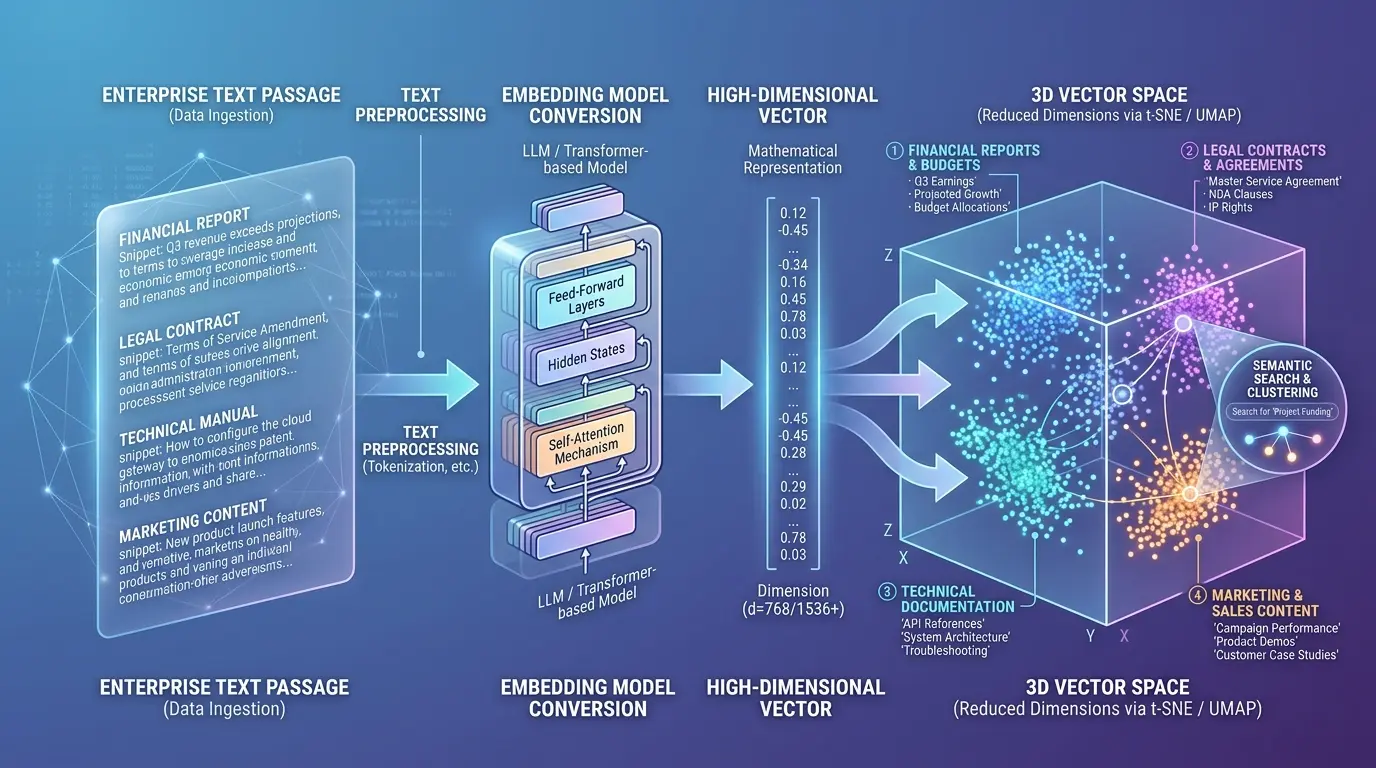
Text chunking and vector embedding diagram showing how document passages are converted to high-dimensional vectors for semantic similarity search

Once chunked, each passage is passed through an embedding model — a neural network that converts text into a dense numerical vector (typically 768 to 3072 floating-point numbers). These vectors encode semantic meaning: passages about similar topics cluster together in vector space, enabling similarity-based retrieval. These vectors are stored in the vector database alongside the original text and metadata.

Embedding Model Selection

OpenAI’s text-embedding-3-small is the current recommended default for most enterprise RAG systems. It delivers strong multilingual performance at 1536 dimensions, with a token cost roughly 5x lower than text-embedding-3-large. For maximum control over data privacy, open-source alternatives like nomic-embed-text or the E5 family from Microsoft can be self-hosted with minimal performance degradation on most enterprise document types.

Pro Tip — Token Cost Control

Embedding costs are incurred once per document chunk at ingestion time, not at query time. The expensive operation is the LLM call. Budget your token spend accordingly: optimize embedding by batching chunks in groups of 100+ per API call, and optimize inference costs by being precise about how many chunks you retrieve — 3 to 5 well-targeted passages almost always outperform 10 noisier ones.

3 The Retrieval Process

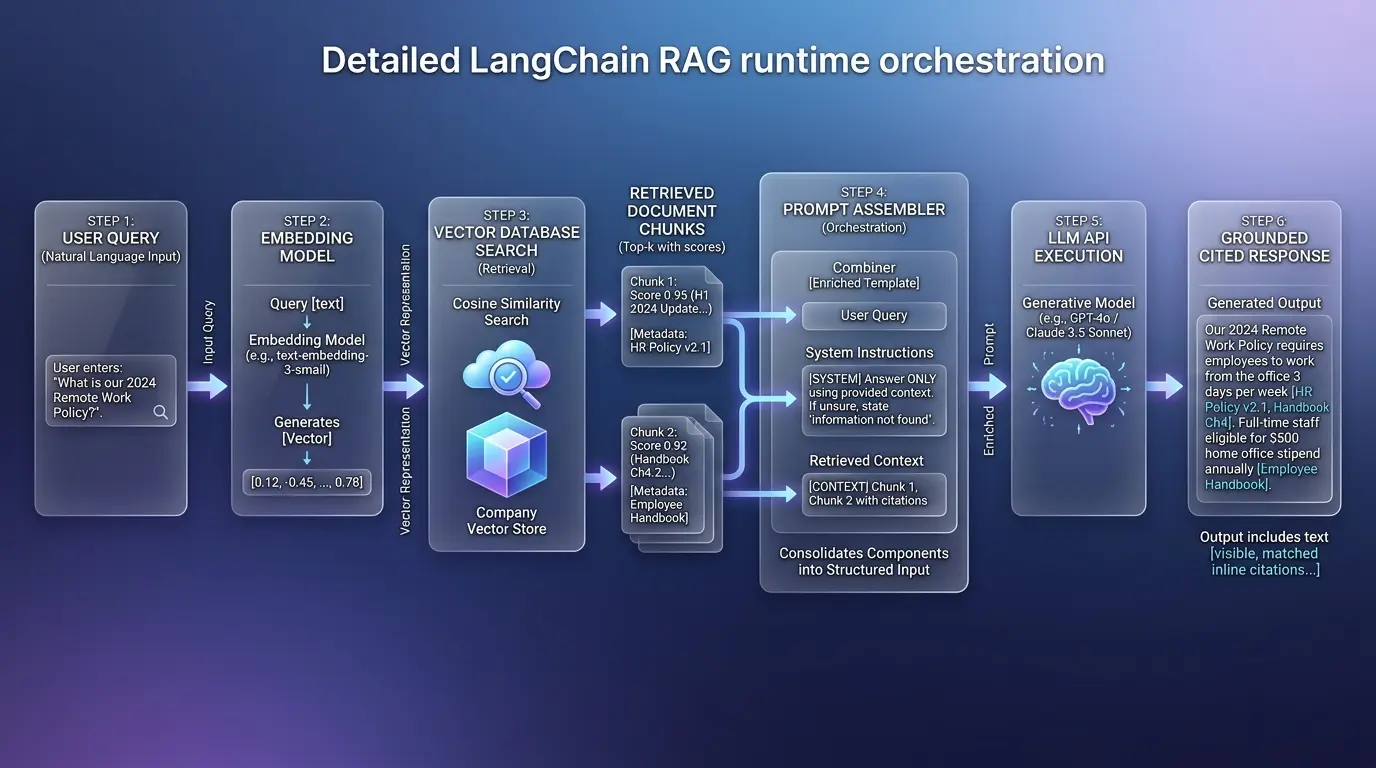
When a user submits a query, it is first converted to a vector using the same embedding model used during ingestion. The vector database then performs an approximate nearest-neighbor (ANN) search, returning the top-k chunks whose vectors are most similar to the query vector. This similarity is typically measured using cosine similarity — a geometric measure of the angle between two vectors that captures semantic relatedness regardless of exact word overlap.

conceptual visualization comparing standard keyword search (BM25) vs dense vector retrieval, using cosine similarity to map how natural language queries find semantically related context even when exact keywords are missing.
Similarity Search vs. Keyword Search

Vector similarity retrieval finds semantically related content even when the exact words don’t match. A query about “termination of employment” can retrieve a chunk about “ending a work contract” because they occupy similar regions of vector space. This is the core advantage over traditional keyword-based search (BM25) for natural language queries.

Hybrid Search — The Production Standard

In production, the highest retrieval precision typically comes from combining dense vector search with sparse keyword search (BM25 or similar) — a pattern called hybrid search. Both Pinecone and Qdrant support hybrid search natively. For domains with a lot of specific nomenclature (part numbers, legal article references, product codes), pure vector search sometimes misses exact-match requirements that keyword search handles trivially.

4 Crafting the System Prompt with Context

LangChain RAG orchestration diagram showing query flow from user through vector database retrieval to LLM response generation

The system prompt is the architectural document that defines your agent’s identity, behavior, and constraints. In a RAG system, it also instructs the model on how to use the injected context. Retrieved passages are typically inserted between the system prompt and the user message using a structured template that clearly delineates source material from user input.

System Prompt Structure for RAG

A well-structured RAG system prompt has four parts: (1) Agent identity and scope — who the agent is and what domain it covers. (2) Context instruction — explicit instruction to answer using only the provided context passages. (3) Uncertainty handling — what the agent should say when the retrieved context doesn’t contain a sufficient answer (“I don’t have enough information in the available documentation to answer this accurately”). (4) Format and tone guidance — length, structure, and voice appropriate for your user base.

The Citation Requirement

Instruct your agent to cite the source document and section for every factual claim. This is both an accuracy mechanism and a trust-building feature. Users are more likely to verify and rely on outputs when they know exactly where the information came from. It also gives your team a direct debugging path when the agent makes errors — you can trace the answer back to a specific retrieved passage.

✅ Pro Tip — Context Window Management

Order your retrieved passages by relevance score before inserting them into the prompt — most relevant first. LLMs attend more strongly to content at the beginning and end of long contexts than to content in the middle. This ordering maximizes their influence on the final response and determines success when you build custom AI agent outputs for enterprise users.

Testing, Guardrails, and Hallucination Prevention

Why a working prototype is not a production-ready agent — and how to close the gap

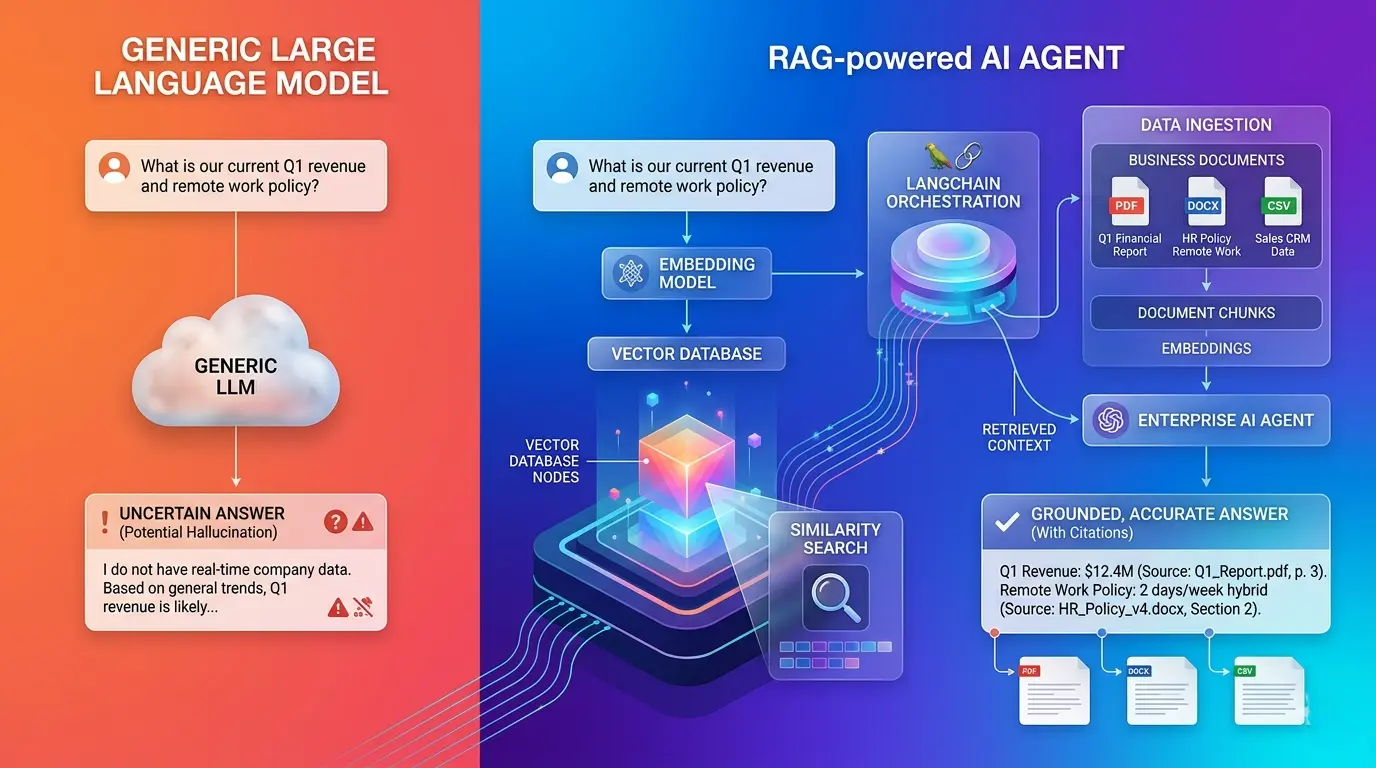
Getting a RAG system to return coherent, contextually relevant answers in a demo environment is a meaningful milestone. Getting it to behave reliably and safely in production — across thousands of diverse user queries, including adversarial ones — is a different engineering challenge entirely. This is where most enterprise AI projects stall.

dashboard visualization of the RAGAS evaluation framework, displaying groundedness score (faithfulness to context), answer relevance (addressing user intent), and retrieval precision (correct context identification) across a test query dataset.
Evaluation — The Retrieval Layer

Before evaluating the LLM output, evaluate retrieval quality independently. For a sample of 50–100 representative queries, manually verify that the correct passages are being retrieved in the top-3 results. Low retrieval precision is the single most common cause of poor end-to-end performance — and it cannot be solved by improving the system prompt. The fix is almost always in chunking strategy, embedding model selection, or hybrid search configuration.

Evaluation — The Generation Layer

RAGAS (Retrieval-Augmented Generation Assessment) has emerged as the standard framework for automated RAG evaluation in 2026. It measures faithfulness (does the answer stay within the retrieved context?), answer relevance (does it actually address the question?), and context precision (did the retrieved passages contain the necessary information?). Integrate RAGAS into your CI pipeline before any production deployment.

Input Guardrails

Define explicit scope boundaries in your system prompt and implement a query classification layer upstream of the RAG pipeline. If a user asks a question that falls outside the agent’s knowledge domain, the agent should say so cleanly rather than hallucinating an answer from general training data. A simple intent classifier — even a lightweight LLM call using a fast model like GPT-4o-mini — can route out-of-scope queries before they reach the retrieval pipeline.

Output Guardrails

Implement a post-generation verification step for high-stakes applications. This can be as simple as a secondary LLM call that checks whether the generated response is fully supported by the retrieved passages — a grounding check. Any claim in the output that cannot be traced to the context should be flagged or removed. This adds latency and cost, but for legal, compliance, or medical applications it is non-negotiable once you build custom AI agent guardrails.

📖 Production Lesson — HR Tech Company, 2026

An HR software company deployed an internal policy Q&A agent for their clients’ employees. In testing, accuracy was strong. In production, they discovered a pattern they hadn’t anticipated: employees were asking questions that were partially in-scope (covered by company policy documents) but also required jurisdiction-specific legal interpretation not present in those documents. The agent blended retrieved policy content with general legal knowledge from its training data — producing confident, plausible, and occasionally incorrect answers. The fix was a hybrid guardrail: the system prompt was updated to explicitly prohibit legal interpretation, and a topic classifier was added to route questions with legal keywords to a human HR contact. The agent became more useful by knowing exactly what it wouldn’t answer.

⚡ Enterprise RAG Stack Comparison

Key tradeoffs across the major component choices for vector database AI implementations in 2026.

ComponentOptionBest ForKey Tradeoff
Vector DBPineconeFast time-to-production, managedVendor lock-in, data leaves infra
Vector DBQdrant (self-hosted)Data sovereignty, on-premInfrastructure overhead
Vector DBpgvectorExisting PostgreSQL stackPerformance at scale, ANN limitations
Embeddingstext-embedding-3-smallBalanced cost/performanceData sent to OpenAI API
Embeddingsnomic-embed-textSelf-hosted, privacy-firstSlightly lower multilingual performance
OrchestrationLangChainComplex agents, broad ecosystemAbstraction overhead, rapid API changes
OrchestrationLlamaIndexPure RAG workloads, less boilerplateSmaller ecosystem than LangChain
LLMGPT-4oHighest reasoning qualityHighest token cost
LLMClaude SonnetLong-context, strong instruction-followingSlightly higher latency than mini models

🏆 Scaling from Prototype to Production

The Production Readiness Checklist

Retrieval evaluation: 50+ test queries with manually verified expected passages. Precision@3 should exceed 0.75 before moving to LLM optimization.
Hallucination testing: Deliberately ask questions whose answers are not in the corpus. Verify the agent declines rather than confabulates.
Adversarial testing: Test prompt injection attempts, jailbreak patterns, and queries designed to extract system prompt content.
Latency benchmarking: Measure p50/p95/p99 response times under realistic load. Identify whether bottlenecks are in embedding, retrieval, or LLM generation.

Scaling Considerations

Implement incremental ingestion — new and updated documents should be re-embedded and indexed without re-processing the full corpus
Add metadata filtering to your vector queries to scope retrieval to relevant document subsets (e.g., by department, date range, or product line)
Cache embedding vectors for frequently-retrieved documents to reduce redundant API calls
Log all queries, retrieved passages, and responses — this data becomes your continuous improvement signal

✅ The Most Important Thing to Get Right First

Invest disproportionately in your data ingestion and chunking pipeline. Most RAG failures trace back to poor retrieval, and most retrieval failures trace back to how documents were chunked and preprocessed. A well-tuned ingestion pipeline with a basic LLM will consistently outperform a poorly-chunked corpus with a state-of-the-art model. Build the foundation before optimizing the surface.

The enterprise AI teams shipping production RAG systems in 2026 aren’t using more sophisticated models than their competitors. They’re applying more engineering discipline to the unglamorous parts of the pipeline — chunking strategies, hybrid search configuration, retrieval evaluation, and systematic guardrail testing. These are solvable engineering problems, not research questions.

Start with a single high-value use case: one document corpus, one user group, one well-defined set of questions. Build the full pipeline end-to-end, evaluate rigorously, and instrument everything. The patterns you establish on that first deployment will define how your organization ships AI systems for years.

⚡ Advanced Optimization: Token Cost and Performance

conceptual flowchart of the advanced two-stage retrieval pipeline, demonstrating how a cross-encoder reranking step narrows a broad vector database retrieval (top-20) down to the highest-confidence passages (top-5) before context injection to the LLM.

💡 Reranking — The Precision Multiplier

After initial vector retrieval, consider adding a cross-encoder reranking step. Retrieve the top-20 passages by vector similarity, then run them through a smaller, faster model (e.g. cross-encoder/ms-marco-MiniLM-L-6-v2) that scores each passage against the exact query. Pass only the top-5 reranked passages to the LLM. This two-stage approach consistently outperforms single-stage retrieval and dramatically reduces the token cost of the LLM call by cutting injected context in half.

✅ Query Transformation

User queries are often poorly formed for vector retrieval — colloquial phrasing, missing context, or ambiguous pronouns. A pre-retrieval query transformation step (using a fast model to rewrite the query into a more retrieval-friendly form) measurably improves precision. LlamaIndex implements this as HyDE (Hypothetical Document Embeddings) — generating a hypothetical ideal answer passage and using its embedding for retrieval, which outperforms query-based retrieval on many document types.

⚠️ Monitoring in Production

Implement answer confidence tracking from day one. Log the similarity scores of the top-retrieved passages for every query. When the top-1 retrieval score drops below a threshold (typically 0.72–0.78 cosine similarity depending on your corpus), flag the query for review. Low similarity scores are a reliable leading indicator of hallucination risk — the model is being asked to answer from context that doesn’t closely match the question.

More Enterprise AI Architecture Resources

conceptual diagram of metadata-scoped retrieval, illustrating how metadata filters (e.g., department, date, document type) are applied alongside semantic similarity search to restrict the search space and improve context relevance.

Claude API for Enterprise — Architecture Guide 2026

Context windows, tool use, and system prompt design for production LLM applications

LangChain vs LlamaIndex 2026 — Full Technical Comparison

Which orchestration framework performs better for enterprise RAG workloads?

Vector Database Selection Guide — Pinecone vs Qdrant vs pgvector

Performance benchmarks, pricing, and data residency considerations for 2026

diagram illustrating categories in the GPTNest Enterprise AI Tool Directory, showing categorized infrastructure options for vector storage, data ingestion ETL, and agentic framework benchmarking across leading providers.

Enterprise AI Tools Directory 2026

Vetted AI infrastructure tools for teams building production-grade internal agents

Scroll to Top