
๐Ÿ’ฐ Side Hustles ๐Ÿค– AI Tools ๐Ÿ”ฅ Trending ๐Ÿ†• 2026 Guide โœ… Updated April 2026

AI Side Hustles That Actually Work in 2026 (Tested Strategies) Realistic income paths, practical starting points, and what to avoid โ€” for beginners and intermediate earners alike

Person working on an AI-powered side hustle from a home office setup in 2026

There’s a lot of noise around AI side hustles right now โ€” plenty of headlines promising passive income overnight and screenshots of suspicious earnings. That’s not what this is. This guide covers AI side hustles that actually work in 2026: tested approaches, honest assessments of the effort required, and the specific first steps you’d take to start each one this week.

The AI tools available today genuinely do compress timelines and lower barriers โ€” a solo freelancer can now produce at a pace that used to require a small team. That’s real. But the income still comes from providing value to a real person who has a real problem. The AI just helps you do it faster and better.

Whether you have five hours a week or fifty, a technical background or none, there are legitimate paths here. Let’s go through them clearly.

โœ๏ธ By GPTNest Editorial ยท ๐Ÿ“… April 20, 2026 ยท โฑ๏ธ 12 min read ยท โ˜…โ˜…โ˜…โ˜…โ˜… 4.8/5

Before You Dive In โ€” 5 Honest Truths About AI Side Hustles

AI is a multiplier, not a replacement for skill. The side hustles that pay best in 2026 combine AI efficiency with a genuine human skill โ€” writing judgment, design taste, client communication, domain knowledge. Pure AI output with no human layer is increasingly commoditized.
First clients are the hardest. Every one of these paths requires some form of outreach or portfolio building before income flows. Budget three to six weeks of zero-income effort before expecting results. That’s normal, not a failure signal.
Niche down early. “I do AI-assisted content” is forgettable. “I write SEO-optimized product descriptions for Shopify stores in the home goods category” is bookmarkable. Specificity is the fastest route to a consistent pipeline.
Income ranges are real, not promises. The figures in this guide reflect what practitioners at different experience levels are reporting in 2026 โ€” not best-case projections. Your results will depend on effort, niche, and how well you communicate your value.
Start one, not five. The most common mistake is scattering attention across every promising path. Pick the one that fits your existing skills and available time. Get your first paying client. Then consider expanding.

6

Viable AI Side Hustles

$0

Required to Start Most

5h

Minimum Weekly Hours

12m

Average Read Time

What This Guide Covers

AI-Assisted Freelance Writing and Editing

The most accessible entry point โ€” and still one of the most profitable

โœ๏ธ Beginner Friendly

Freelance writing powered by AI looks different from what it did two years ago. The writers earning consistently well in 2026 aren’t just generating text and shipping it โ€” they’re using AI to handle structure, research synthesis, and first drafts, then applying their voice, judgment, and subject matter knowledge to produce something clients couldn’t get from a content mill. That gap is what you’re selling.

The niches that pay best tend to require domain knowledge: SaaS product documentation, B2B blog content for technical industries, legal and financial explainers, and long-form SEO content in competitive verticals. A writer who knows fintech and uses AI well can produce three times the output of someone without AI โ€” while charging rates that reflect the quality, not the time.

What to Charge โ€” Realistic 2026 Ranges

Entry-level AI-assisted blog posts: $80โ€“$150 per 1,000 words. Mid-level niche content with strong SEO structure: $150โ€“$300. Long-form, research-backed B2B articles with domain expertise: $300โ€“$600+. Editing and refinement of AI drafts for agencies: $30โ€“$60/hour.

How to Start This Week

Pick one industry you know reasonably well. Write two spec samples โ€” a blog post and a short-form piece โ€” using AI for drafts and your judgment for editing. Post them on a simple portfolio page (a free Notion site works). Reach out to five small businesses in that niche via LinkedIn. One reply in the first two weeks is a realistic expectation.

๐Ÿ’ก Key Differentiator

Your value isn’t speed โ€” it’s accuracy. Clients who’ve been burned by generic AI content want someone who fact-checks, adds real examples, and catches when the AI gets something subtly wrong. Lead with that in your outreach.
Workflow Automation as a Service

High-value work that most small businesses desperately need

๐Ÿ”ง High Value

Small and medium businesses are sitting on dozens of repetitive tasks they haven’t automated โ€” not because they don’t want to, but because they lack the time or technical confidence to set it up. That’s the gap you fill. Tools like Zapier, Make (formerly Integromat), and n8n โ€” combined with AI models accessible via API โ€” let a non-developer build surprisingly sophisticated automations that save business owners real hours every week.

Common examples: auto-generating personalized follow-up emails from CRM data, summarizing customer support tickets for weekly review, pulling social media mentions into a Slack digest, or processing inbound lead forms through an AI-powered qualification sequence. None of these require coding. They require understanding the client’s process, knowing which tools connect, and being patient enough to test edge cases.

Project-Based Pricing

Simple single-workflow automations: $200โ€“$500. Multi-step AI-powered workflow with testing and documentation: $500โ€“$1,500. Ongoing retainer for maintenance and additions: $200โ€“$500/month. The retainer model builds stable recurring income quickly once you have three or four clients.

Where to Find First Clients

Local business owner Facebook groups, small agency communities on Slack and Discord, and cold outreach to businesses whose processes you can observe publicly (e.g., a restaurant that manually posts daily specials). The pitch is simple: “I can save you five hours a week” โ€” and you can often prove it with a free fifteen-minute audit call.

๐Ÿ“– Real Case โ€” Operations Consultant, Casablanca, 2026

A former operations coordinator with no technical background learned Make and Zapier over three weekends by following free tutorials. Her first client was a small e-commerce brand that was manually copying order data into a spreadsheet every morning โ€” two hours a day, every day. She built a five-step automation that handled it in seconds. The client paid her 400 USD for the setup and 150 USD per month for maintenance. Within four months she had seven retainer clients and had replaced her previous salary working fifteen hours a week.

AI-Powered Visual Content and Design

The clearest opportunity for people with design taste but not design training

๐ŸŽจ Creative

AI image generation has matured significantly, and the opportunity isn’t in generating images โ€” it’s in knowing how to use them strategically for clients. Social media content packs, website illustration sets, brand mood boards, presentation visuals, and stock-style product mockups are all things businesses need continuously and rarely have the in-house capacity to produce well.

What separates the people earning from this from those who aren’t is taste and consistency. Anyone can generate an image. Fewer people can generate a cohesive set of twenty images that all look like they belong to the same brand, match a specific aesthetic, and are correctly dimensioned for every platform. That curation and consistency is the real service.

Practical Service Packages

Monthly social media content pack (30 visuals, branded): $150โ€“$350/month. Custom illustration set for a website (10โ€“15 images): $200โ€“$450 one-time. Presentation visual refresh (20-slide deck): $150โ€“$300. Print-ready product mockup set: $100โ€“$250.

Important Caveat on Licensing

Commercial use rights for AI-generated images vary by tool. Before selling work commercially, verify the licensing terms of whatever image generation platform you’re using. Most major tools in 2026 permit commercial use for paid subscribers, but the details matter โ€” and your clients will ask.

โœ… Quick Win

Create a sample content pack for a fictional brand โ€” five to ten visuals in a cohesive style โ€” and post it as a portfolio piece on Behance or a simple portfolio site. It takes three to four hours and gives you something concrete to show every prospective client.

AI Prompting Coaching and Training

Teaching others to use AI effectively โ€” a surprisingly underserved market

There are millions of professionals who have access to AI tools through their employer or personal subscriptions but have never been trained to use them effectively. They’re getting mediocre results, feeling frustrated, and quietly assuming AI isn’t as useful as advertised. They’re wrong โ€” they just need someone to show them the gap between how they’re using it and how it actually works.

If you’ve developed genuine fluency with a handful of AI tools โ€” enough to produce noticeably better results than the average user โ€” you can teach that. The format can be one-on-one sessions, workshops for small teams, or short online courses. The audience is large: marketing teams, legal professionals, HR departments, solo entrepreneurs, and anyone whose job involves writing, research, or synthesis.

Session and Package Formats

One-on-one 60-minute coaching call: $75โ€“$150. Team workshop (90 minutes, up to 10 people): $400โ€“$800. Four-session onboarding package for individuals: $250โ€“$500. Custom internal training program for a company: $1,000โ€“$3,000+ depending on scope.

How to Build Credibility Fast

Document two or three genuine before-and-after prompt examples from your own work โ€” real output comparisons that demonstrate the difference context and constraints make. Share these on LinkedIn with a brief explanation. That kind of practical demonstration converts browsers into paying clients far better than any credential.

๐Ÿ“– Real Case โ€” HR Professional Turned AI Coach, 2026

An HR manager who had spent six months systematically testing AI tools for her own team’s workflows started a side practice running ninety-minute workshops for other small HR departments. Her content was not theoretical โ€” it was built entirely from real examples of job descriptions, policy summaries, and candidate outreach that she had improved using specific prompt techniques. Within three months she had run eleven workshops for eight different companies, without a single paid ad. Word of mouth among HR professionals spread because the training was specific, not generic.

AI Research and Summary Services

Serving the professionals who need synthesis, not just search

Executives, consultants, investors, and researchers regularly need to get up to speed on a topic quickly โ€” and they don’t have the time to read twenty sources themselves. AI dramatically accelerates the synthesis process, letting a single person produce a well-structured briefing document in a fraction of the normal time.

This is a premium service because the output requires human judgment โ€” knowing which sources to trust, how to weight conflicting data, what context the client actually needs, and how to structure the findings for a specific audience. AI handles the reading and initial synthesis. You handle the quality control and framing.

Deliverable Types and Pricing

Topic briefing document (2โ€“3 pages, one topic): $100โ€“$250. Weekly industry digest (curated, summarized, delivered Monday): $150โ€“$350/month retainer. Competitive landscape analysis (5โ€“10 companies, 5 pages): $300โ€“$600. Academic or policy literature review: $200โ€“$500 depending on scope.

Where This Works Best

Legal and compliance teams, investment analysts, independent consultants preparing for client engagements, executives who need briefings before meetings with unfamiliar stakeholders, and journalists covering technical beats. LinkedIn cold outreach to these profiles โ€” with a very specific offer โ€” converts at a higher rate than general service pages.

Digital Products Built with AI

Build once, sell repeatedly โ€” the path to passive-adjacent income

AI has made it significantly faster to build certain types of digital products โ€” templates, prompt libraries, mini-courses, workbooks, swipe files, and interactive tools. The key word is “faster,” not “instant” โ€” products that sell well still require real understanding of the buyer’s problem. The AI compresses production time, not thinking time.

Prompt template packs for specific use cases (e.g., “50 prompts for e-commerce product listings”) sell consistently on platforms where digital creators thrive. Niche mini-courses built around practical AI workflows โ€” not broad AI introductions โ€” do well on platforms where buyers are already looking for skills. The income isn’t passive in the beginning: it takes product creation, honest marketing, and iteration based on reviews. But it compounds.

Products Worth Building in 2026

Industry-specific prompt libraries ($15โ€“$40 each). Workflow templates for tools like Notion, Airtable, or Zapier with AI integrations ($25โ€“$75). Short practical courses (60โ€“90 minutes, one specific skill): $30โ€“$150. Done-for-you email sequence templates with AI customization instructions: $20โ€“$60.

Realistic Timeline and Expectations

Gumroad and Lemon Squeezy handle sales efficiently. Expect three to four months of low sales while you build an audience and gather reviews. One product that genuinely solves a specific problem, marketed to the right niche community, can generate $300โ€“$800/month after it gains traction. Multiple products multiply that โ€” but start with one done well.

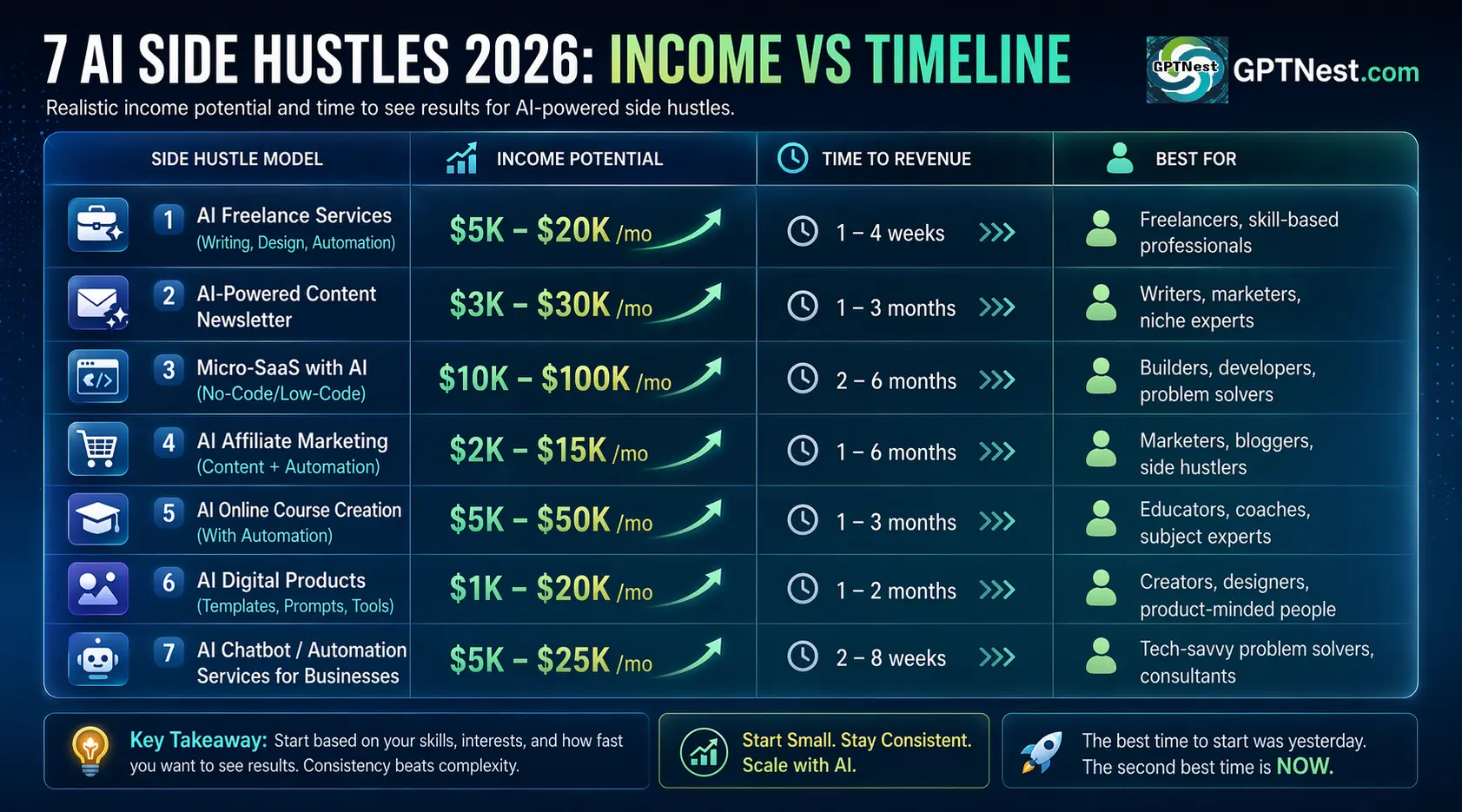
Overview of AI business model categories showing different income levels and effort requirements for 2026

โšก Model Comparison: Income, Effort, and Timeline

A practical comparison of each model across the factors that matter most when choosing where to start.

Business ModelIncome CeilingTime to First RevenueBest For
AI Freelance Services$5kโ€“$20k/month2โ€“6 weeksPeople with an existing skill to pair with AI
Content / Newsletter$3kโ€“$30k/month3โ€“6 monthsWriters, curators, industry insiders
Micro-SaaS$10kโ€“$100k+/month4โ€“10 monthsProblem-solvers willing to learn no-code
Productized Consulting$8kโ€“$25k/month3โ€“8 weeksAI early adopters with domain expertise
Digital Products / Courses$5kโ€“$50k+/month1โ€“3 monthsEducators, practitioners, niche experts
AI-Enhanced E-commerce$10kโ€“$100k+/month2โ€“4 monthsOperators who understand product and audience
Prompt / Workflow Licensing$1kโ€“$15k/month4โ€“8 weeksHeavy AI users with documented processes

๐Ÿ† Pro Tips for Scaling Your AI Side Hustles

The Decision Checklist

Pick based on your existing edge. The model you have the most relevant experience for will produce results faster than the one with the highest theoretical ceiling.
Start with one model only. Every hour spent across two models is worth half as much as an hour spent on one. Focus compounds. Diversification before profitability is a distraction, not a strategy.
Set a 90-day commitment. Most people quit a model right before it would have worked. Give yourself a defined runway โ€” at least 90 days of real effort โ€” before concluding it doesn’t work for you.

Build These Habits From Week One

Document your AI workflows as you build them โ€” they become an asset, not just a process
Talk to potential customers before building anything โ€” what they say will surprise you
Publish your process and thinking publicly โ€” it builds credibility and attracts clients simultaneously
Set a weekly “business review” hour โ€” what worked, what didn’t, what changes next week

โœ… The Single Most Important Decision You’ll Make

Choose who you serve before you choose what you sell. Every model above works better when it’s built around a specific, knowable audience. “Small law firms” is a better starting audience than “businesses.” “Independent yoga instructors” is better than “the fitness industry.” The narrower your audience, the more precisely you can serve them โ€” and the easier everything from marketing to product development becomes.

None of the models above are get-rich-quick schemes, and that’s precisely what makes them worth taking seriously. They’re real businesses built on real value โ€” the kind that holds up when the next AI tool cycle arrives and the hype moves on. The founders and freelancers building durable income in 2026 are doing so because they understand the business, not just the tools.

AI makes the execution of these models faster and more accessible than ever before. What it can’t replace is your judgment about what to build, who to serve, and what actually matters to the people you’re trying to help. Bring that to the table, and the tools become genuinely powerful. Start with the model that feels most like an extension of what you already know, commit to 90 days, and build from there.

โšก Advanced Moves Once You’re Generating Revenue

๐Ÿ’ก Productize Before You Scale

Before adding clients or products, document exactly how you deliver your current offer. Build a process that could be repeated without you doing everything personally. This unlocks two things: the ability to hire help, and the ability to charge more because your delivery is consistent and predictable. Systematizing early is what separates the businesses that plateau from the ones that grow.

โœ… Layer Income Models Strategically

Most successful AI entrepreneurs in 2026 aren’t running one model โ€” they’re running two or three that reinforce each other. A newsletter builds the audience that buys the digital product that leads to consulting inquiries. Build the first model to profitability first, then identify which second model would benefit from the assets you’ve already built. Sequence matters more than diversification.

โš ๏ธ Watch the Tool Dependency Risk

Every AI tool you depend on is a platform risk. Build your business so that the value lives in your relationships, your reputation, and your process โ€” not in a specific tool’s feature set. The tools will change. The clients who trust you, the audience who reads you, and the skills you’ve developed will not. Stay tool-agnostic at the business level, even as you optimize at the workflow level.

More AI Business and Income Guides

Scroll to Top