
๐Ÿ’ฐ AI Income ๐Ÿš€ Business ๐Ÿ”ฅ Trending ๐Ÿ†• 2026 Guide โœ… Updated April 2026

How to Become a Millionaire with AI in 2026: 7 Proven Business Models A step-by-step look at the AI business models actually generating real income โ€” for real people

How to become a millionaire with AI: Entrepreneur building a profitable online business in 2026

The phrase “become a millionaire with AI” gets thrown around a lot โ€” usually attached to unrealistic screenshots and vague promises. But strip away the hype, and there’s something real underneath: AI has genuinely lowered the barrier to starting and scaling businesses that were, just three years ago, only accessible to well-funded teams. In 2026, a single person with the right model, a clear niche, and consistent execution can build something that generates serious income.

This guide doesn’t promise you’ll become a millionaire by next Tuesday. What it does is walk through seven business models that are producing real results for real people โ€” with practical steps, honest trade-offs, and no filler. Some of these you can start this week. Others take months to build. All of them are more accessible in 2026 than they’ve ever been.

Whether you’re exploring your first side project or thinking seriously about going full-time, the key is the same: pick one model, go deep, and build something that solves a specific problem for a specific group of people. AI is the leverage. You’re still the business.

โœ๏ธ By GPTNest Editorial ยท ๐Ÿ“… April 20, 2026 ยท โฑ๏ธ 14 min read ยท โ˜…โ˜…โ˜…โ˜…โ˜… 4.8/5

Before You Dive In โ€” 5 Honest Realities About AI Income in 2026

AI is a tool, not a business. The business is the value you create for a specific group of people. AI helps you create that value faster and more efficiently โ€” it doesn’t replace the need for a clear market, a real offer, and consistent effort.
Niche depth beats niche width. Serving 500 people very well generates more durable income than chasing 50,000 loosely interested ones. The sharper your focus, the stronger your position.
The first $10,000 is the hardest. Every model below has a ramp-up period. Expect 3โ€“6 months before consistent revenue, and plan for that financially. The people who succeed treat this like a real business from day one.
Distribution is the hard part. Getting your offer in front of the right people is harder than building it. Every model below requires a distribution strategy โ€” not just a product.
Compounding beats sprinting. The people who build significant income with AI do so over 12โ€“24 months of focused work, not 30-day challenges. Start with that timeline in mind and you’ll make far better decisions.

7

Proven Business Models

$0

Starting Cost for Most Models

3โ€“6m

Realistic Revenue Timeline

14m

Average Read Time

What You’ll Learn in This Guide

AI-Powered Freelance Services

The fastest path to early revenue โ€” with a meaningful twist on traditional freelancing

๐Ÿš€ Fastest Start

Freelancing with AI isn’t the same as old-school freelancing. The model has shifted. Where a copywriter once spent four hours drafting a landing page, they can now produce three solid drafts in the same time โ€” and spend the remaining time on strategy, positioning, and client relationships. That efficiency gap is where the income opportunity lives.

The key is to specialize tightly. “I do content” is a commodity. “I write onboarding email sequences for B2B SaaS companies under 50 employees” is a practice. AI lets you execute the production side of that specialty fast enough to take on more clients without burning out โ€” or to charge more because your output is significantly better.

High-Demand AI Freelance Niches in 2026

AI-assisted copywriting for product launches, email sequences, and ad campaigns. SEO content production with AI drafting and human editorial oversight. Presentation and pitch deck design combining AI visuals with strategic narrative. AI automation setup for small business workflows.

How to Position Your Rate

Don’t compete on hourly rate โ€” compete on outcome. A client doesn’t care if you used AI to write faster; they care whether the landing page converts. Price by deliverable and result, not by hour. A specialist charging $800 for a five-email welcome sequence will always outperform a generalist charging $40 an hour for the same work.

๐Ÿ“– Real Case โ€” Copywriter, Lyon, 2026

A former in-house content manager went freelance in early 2025 and specialized in onboarding email sequences for fintech apps. She built a tight workflow: customer interview notes in, AI draft out, human editorial pass, client review. By her eighth month, she was producing sequences in two days that used to take a week, taking on four concurrent clients, and billing over โ‚ฌ9,000 per month. The specialization โ€” not just the AI tools โ€” is what made the income possible.

๐Ÿ’ก Getting Your First Client

Build one excellent sample piece โ€” not a portfolio of twenty average ones. A single brilliant email sequence for a fictional but realistic brand, with a clear before/after or outcome framing, will land more conversations than a generic portfolio. Post it on LinkedIn with the thinking behind it. One strong case outperforms volume every time at the start.
Content and Newsletter Businesses

Building an audience asset that compounds over time

A newsletter or content publication is one of the most durable income assets you can build โ€” and AI has made it genuinely feasible for one person to run something that previously needed a small team. The model works because once you have an audience that trusts you, the monetization options multiply: sponsorships, products, consulting, affiliate partnerships.

The constraint isn’t production anymore โ€” AI handles the heavy lifting of research synthesis, first drafts, and formatting. The constraint is editorial judgment. What’s worth covering? What angle does your specific audience need? What’s the take that no one else is giving them? That’s the human work, and it’s where your value comes from.

The Viable Newsletter Formula

Pick one professional audience with a genuine information gap. Publish consistently (weekly is enough). Each edition should give readers one thing they can use immediately โ€” a framework, a tool they haven’t heard of, a real case study. Within six months of consistent publishing, a list of 3,000 engaged subscribers in a B2B niche can generate $3,000โ€“$8,000/month in sponsorship alone.

AI’s Role in the Workflow

Use AI for: summarizing long-form source material, generating section outlines, writing first drafts of explainer sections, formatting and proofreading. Your job is: selecting topics, providing the unique angle, writing the lead paragraph (the most important part), and editing the whole thing until it sounds unmistakably like you.

โœ… Monetization Sequence That Works

Most newsletters monetize too early (before trust is built) or too late (leaving money on the table for months). The right sequence: build to 1,000 engaged subscribers first with zero monetization, then introduce a single relevant affiliate partnership or small sponsor. At 3,000, add a paid tier or sponsored slot. Each stage compounds the next.

AI Micro-SaaS Products

Building small, focused software tools with recurring revenue potential

๐ŸŽฏ High Ceiling

Micro-SaaS means a small, focused software product that solves one specific problem and charges a monthly subscription. In 2026, non-technical founders are building these using AI coding assistants and no-code tools โ€” things that would have required a developer team just four years ago. The sweet spot is a tool that automates a repetitive task a specific professional does every week.

The business model scales well because you build once and earn repeatedly. A tool with 200 users paying $29/month generates nearly $70,000 per year. With low churn in a tightly defined niche, that’s a very achievable number within 18 months of launch.

Finding a Micro-SaaS Idea That Works

The best ideas come from a task you’ve done manually that you wished was automated. Or from listening carefully to a professional community and noting what they say wastes their time. Winning micro-SaaS products tend to have three things: a clear user (e.g., real estate agents), a repetitive task (e.g., writing property descriptions), and a painful alternative (e.g., spending 45 minutes per listing).

Validation Before Building

Before spending months building, validate with a manual version: offer to do the task for free for ten people using AI tools and your own time. If they find it genuinely useful and ask when the automated version is available, you have a product. If they’re politely indifferent, the idea needs refining. This two-week validation step saves most builders from six months of wasted effort.

๐Ÿ“– Real Case โ€” Former Property Manager, Lisbon, 2026

After years managing short-term rentals, a former property manager noticed that writing listings, guest welcome messages, and seasonal promotions consumed hours every week for small operators. She built a simple AI tool that generated these from a property detail form โ€” with tone controls for different platforms. She launched with a โ‚ฌ19/month price point, validated with 30 users from a Facebook group, and hit โ‚ฌ4,000 MRR within her first six months. The tool itself took three weeks to build with an AI coding assistant.

Productized AI Consulting

Turning AI expertise into a repeatable, premium service offer

Most small and medium businesses know they should be using AI better โ€” they just don’t know where to start, what to prioritize, or how to implement it without disrupting existing workflows. That gap is an opportunity. A productized AI consultant offers a defined service (not open-ended advice) at a fixed price, making it easy for clients to say yes and easy for you to deliver consistently.

The key word is “productized.” Instead of “I’ll consult on your AI strategy,” you offer “a 3-session AI workflow audit for service businesses: I’ll map your five most time-consuming processes, identify which ones AI can handle, and deliver a 90-day implementation roadmap โ€” delivered in two weeks for $2,500.” That’s a product, not a vague retainer.

What to Productize

Focus on outcomes a client can understand immediately: “save 10 hours a week on client reporting,” “cut content production time in half,” “automate your onboarding process.” Pair each outcome with a fixed deliverable, a fixed timeline, and a fixed price. Three to four productized offers gives you a full-service ladder without chaos.

Where to Find Clients

LinkedIn is the highest-ROI channel for B2B consulting. Document one implementation you’ve done (even for yourself or a test client) and write about the result. Industry-specific communities on Slack or Circle are also high-signal. One well-placed post describing a specific problem you solve will generate more leads than a month of generic marketing.

Digital Products and AI-Assisted Courses

Building income assets you create once and sell indefinitely

Templates, playbooks, mini-courses, and toolkits have always been attractive income models โ€” create once, sell repeatedly. AI has made them faster to build and easier to keep updated. The challenge has never been production; it’s been knowing what to build and for whom.

The highest-converting digital products solve a very specific problem for a very specific audience at a very specific moment in their journey. “How to start a business” is a book. “How to write your first cold email sequence when you’ve never done sales before” is a $47 product someone will buy tonight at 11pm because they have a meeting tomorrow.

Where AI Helps Most

Use AI to outline course modules, draft written content sections, generate worksheet prompts, build out FAQ documents, and write sales page copy. Your unique contribution is the framework โ€” the way you’ve organized a skill or process that only comes from having done it yourself. The AI gives you execution speed; your experience gives it credibility.

Realistic Revenue Model

A $97 digital product sold to 100 people per month generates $9,700/month. That’s achievable with a small, engaged audience in a specific niche and a consistent content strategy pointing to the product. The math is forgiving โ€” you don’t need viral traffic, you need the right traffic.

AI-Enhanced E-commerce

Using AI to compete in product businesses without a huge team

E-commerce has always been competitive, but AI has shifted where the competitive advantage lives. The operators winning in 2026 aren’t necessarily the ones with the best products โ€” they’re the ones with the best content, the best product pages, the best email sequences, and the fastest response to customer behavior. AI makes all of those executable for a one or two-person team.

The model that’s producing consistent results: niche physical or digital products with a strong content marketing loop. AI generates product descriptions, ad copy variations, email campaigns, and social content at scale. The human work is product selection, customer research, and reading what the data is telling you.

Where AI Delivers the Most Leverage

Product listing optimization (titles, descriptions, feature bullets), A/B testing copy at scale, personalized email sequences based on browsing and purchase behavior, and customer support response drafts. Each of these has a measurable impact on conversion and retention โ€” and AI makes them manageable without a full marketing team.

The Brand Moat

AI can replicate copy, but it can’t replicate a genuine brand story, a trusted community, or a founder voice people connect with. Build those in parallel. The product is the revenue; the brand is the defensibility. Operators who treat them as separate problems build something more durable than those focused on product alone.

Prompt and Workflow Licensing

Packaging your AI expertise as a sellable intellectual asset

This model is newer and still underexplored. If you’ve built a set of prompts or AI workflows that consistently produce excellent results for a specific task โ€” and you’ve tested them thoroughly โ€” there’s a market for that. Agencies, freelancers, and small business owners will pay for a reliable system that saves them weeks of trial and error.

The key distinction: you’re not selling generic prompts (those are everywhere and worth very little). You’re selling a tested, documented workflow for a specific professional use case โ€” with context about when to use each prompt, how to chain them, and what results to expect. That specificity and the testing behind it is what creates the value.

What Makes a Workflow Worth Buying

Documentation of the exact sequence, with examples of input and output at each stage. Clear instructions for what context the user needs to provide. A genuine outcome claim backed by real examples โ€” not “this will make your writing great” but “this produces a 5-email onboarding sequence in under 30 minutes with minimal editing needed.” Specificity sells.

Where to Sell Them

Gumroad and Lemon Squeezy handle sales and delivery simply. Build your audience first through free content that demonstrates the workflow in action โ€” showing inputs and outputs publicly on LinkedIn or X builds trust faster than any product description. Buyers of workflow products almost always come through content, not paid ads.

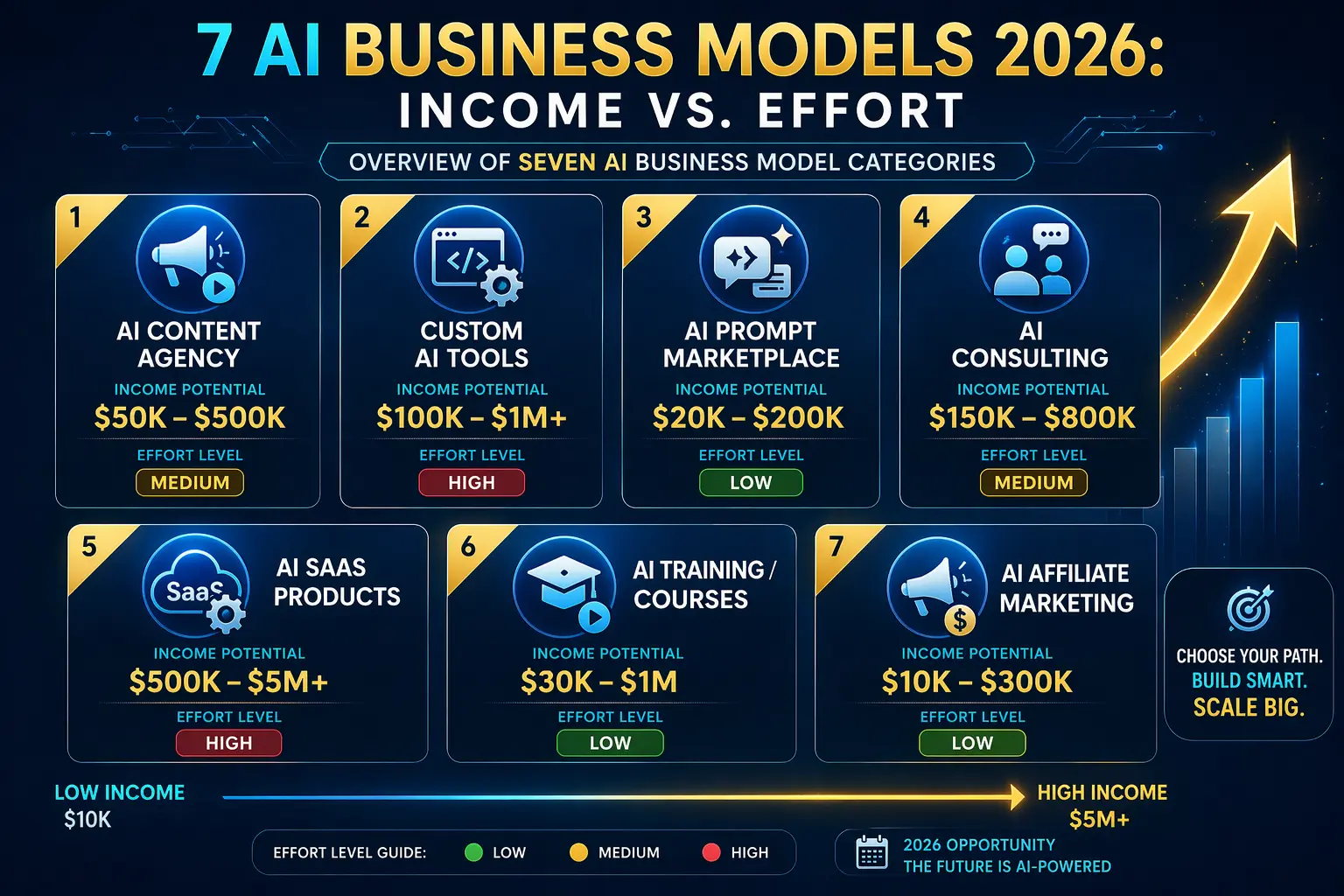
Overview of seven AI business model categories showing different income levels and effort requirements for 2026

โšก Model Comparison: Income, Effort, and Timeline

A practical comparison of each model across the factors that matter most when choosing where to start.

Business ModelIncome CeilingTime to First RevenueBest For
AI Freelance Services$5kโ€“$20k/month2โ€“6 weeksPeople with an existing skill to pair with AI
Content / Newsletter$3kโ€“$30k/month3โ€“6 monthsWriters, curators, industry insiders
Micro-SaaS$10kโ€“$100k+/month4โ€“10 monthsProblem-solvers willing to learn no-code
Productized Consulting$8kโ€“$25k/month3โ€“8 weeksAI early adopters with domain expertise
Digital Products / Courses$5kโ€“$50k+/month1โ€“3 monthsEducators, practitioners, niche experts
AI-Enhanced E-commerce$10kโ€“$100k+/month2โ€“4 monthsOperators who understand product and audience
Prompt / Workflow Licensing$1kโ€“$15k/month4โ€“8 weeksHeavy AI users with documented processes

๐Ÿ† Pro Tips on How to Become a Millionaire with AI

The Decision Checklist

Pick based on your existing edge. The model you have the most relevant experience for will produce results faster than the one with the highest theoretical ceiling.
Start with one model only. Every hour spent across two models is worth half as much as an hour spent on one. Focus compounds. Diversification before profitability is a distraction, not a strategy.
Set a 90-day commitment. Most people quit a model right before it would have worked. Give yourself a defined runway โ€” at least 90 days of real effort โ€” before concluding it doesn’t work for you.

Build These Habits From Week One

Document your AI workflows as you build them โ€” they become an asset, not just a process
Talk to potential customers before building anything โ€” what they say will surprise you
Publish your process and thinking publicly โ€” it builds credibility and attracts clients simultaneously
Set a weekly “business review” hour โ€” what worked, what didn’t, what changes next week

โœ… The Single Most Important Decision You’ll Make

Choose who you serve before you choose what you sell. Every model above works better when it’s built around a specific, knowable audience. “Small law firms” is a better starting audience than “businesses.” “Independent yoga instructors” is better than “the fitness industry.” The narrower your audience, the more precisely you can serve them โ€” and the easier everything from marketing to product development becomes.

None of the seven models above are get-rich-quick schemes, and that’s precisely what makes them worth taking seriously. They’re real businesses built on real value โ€” the kind that holds up when the next AI tool cycle arrives and the hype moves on. The founders and freelancers building durable income in 2026 are doing so because they understand the business, not just the tools.

AI makes the execution of these models faster and more accessible than ever before. What it can’t replace is your judgment about what to build, who to serve, and what actually matters to the people you’re trying to help. Bring that to the table, and the tools become genuinely powerful. Start with the model that feels most like an extension of what you already know, commit to 90 days, and build from there.

โšก Advanced Moves Once You’re Generating Revenue

๐Ÿ’ก Productize Before You Scale

Before adding clients or products, document exactly how you deliver your current offer. Build a process that could be repeated without you doing everything personally. This unlocks two things: the ability to hire help, and the ability to charge more because your delivery is consistent and predictable. Systematizing early is what separates the businesses that plateau from the ones that grow.

โœ… Layer Income Models Strategically

Most successful AI entrepreneurs in 2026 aren’t running one model โ€” they’re running two or three that reinforce each other. A newsletter builds the audience that buys the digital product that leads to consulting inquiries. Build the first model to profitability first, then identify which second model would benefit from the assets you’ve already built. Sequence matters more than diversification.

โš ๏ธ Watch the Tool Dependency Risk

Every AI tool you depend on is a platform risk. Build your business so that the value lives in your relationships, your reputation, and your process โ€” not in a specific tool’s feature set. The tools will change. The clients who trust you, the audience who reads you, and the skills you’ve developed will not. Stay tool-agnostic at the business level, even as you optimize at the workflow level.

More AI Business and Income Guides

Scroll to Top