🤖 AI Comparison
⚔️ Head to Head
🆕 2026 Updated
✅ Verified April 2026
ChatGPT vs Claude 2026 — Which One Is Actually Worth It?
GPT-5.4 vs Sonnet 4.6 — Honest, Unsponsored, Tested in the Real World

I’ve spent the last four months using both ChatGPT and Claude as my primary AI tools — not for casual conversation, but for real work. Researching articles, writing code, debugging logic errors, drafting client emails, analyzing 80-page documents, and the kind of back-and-forth thinking work that tests what these models are actually made of. And I’ll be straight with you: the answer isn’t what the internet keeps telling you.
Most “ChatGPT vs Claude” articles are either sponsored, written by someone who spent 20 minutes with each tool, or are just regurgitating the same surface-level benchmarks that don’t translate into anything useful for how real people actually work. This one is different. We’re going round by round, category by category, with real use cases from 2026 — including some places where the results genuinely surprised me.
✍️ By GPTNest Editorial
·
📅 Updated: April 5, 2026
·
⏱️ 20 min read
·
★★★★★
4.9/5
⚡ Quick Verdict — What the 2026 Tests Actually Showed
✦Claude wins for writing, reasoning, and long documents. If your primary use case involves reading, analyzing, or producing high-quality written work, Claude Sonnet 4.6 is the better tool — often noticeably so.
✦ChatGPT wins for STEM, code execution, and versatility. The Code Interpreter, image generation, and breadth of integrations make GPT-5.4 the better choice for developers, data scientists, and multi-format workflows.
✦Both cost $20/month on Pro. At the same price point, the right choice comes down entirely to what you actually do with it — not which brand is “smarter.”
✦Free tiers are genuinely useful in 2026. Neither tool holds its best features completely hostage behind a paywall — both free tiers can handle 70–80% of typical user needs.
✦The real answer: use both. Power users who have access to both tools switch between them depending on the task. We’ll show you exactly when to use which.
400M+
ChatGPT Weekly Users
$20
Both Pro Plans / Month
What Actually Changed in 2026 — This Isn’t Last Year’s Race
A year ago, comparing ChatGPT and Claude felt like comparing a Swiss army knife to a scalpel. ChatGPT had more features; Claude was sharper on focused tasks. That distinction is now significantly blurrier. GPT-5.4 launched in March 2026 with configurable reasoning depth and a rebuilt code interpreter. Claude Sonnet 4.6 arrived with a 1 million token context window and dramatically improved instruction-following on complex, multi-step tasks.
The gap between these two tools is smaller than it’s ever been — which, oddly, makes the comparison more interesting. When both tools are excellent, the differences that remain are more meaningful and more task-specific. Understanding them properly will save you money, frustration, and the creeping suspicion that you chose wrong.
Both tools are available on a freemium model. Both have Pro plans at $20/month. Both have vastly improved since 2024. The question isn’t which one is “smarter” anymore — it’s which one is smarter for what you’re trying to do. Let’s find out.
1
Writing Quality & Long-Form Content
Blog posts, essays, reports, emails, creative writing
💡 The Honest Finding
Ask both tools to write a 1,000-word opinion piece on the same topic. Claude’s output will sound like it was written by a thoughtful person with a point of view. ChatGPT’s output will sound like it was written by a very competent content team following a template. Both are publishable. Only one has a voice. For most professional writing tasks, Claude Sonnet 4.6 consistently produces more human, more natural prose.
This isn’t a subtle difference when you’re doing it back-to-back. Claude writes with intent — its sentences have rhythm, its paragraphs build toward something, its word choices feel considered rather than statistically likely. ChatGPT produces clean, well-structured content that reads competently but often lacks a distinct voice. For SEO articles and functional business writing, this doesn’t matter. For anything that needs to actually engage a reader — it matters a lot.
📖 Real Case — Marketing Director, London, 2026
A marketing director uses both tools daily. For client-facing content — thought leadership articles, brand narratives, campaign copy — she switched entirely to Claude after running a blind test with her team. They correctly identified Claude’s output as “more natural and credible” in 8 out of 10 samples, without knowing which tool produced which piece. She keeps ChatGPT active for data summaries and slide content, where the more structured output is actually preferable.
Claude’s prose rhythm — Noticeably more natural sentence variation; avoids the “AI paragraph cadence” that detection tools flag.
ChatGPT’s structure — Better at producing well-organized bullet-heavy content; executes templates and formats more reliably.
Long-form advantage — Claude maintains consistency and argument coherence over 3,000+ word pieces; ChatGPT occasionally loses thread.
2
Coding & Technical Tasks
Development, debugging, data analysis, scripts
✅ The Honest Finding
ChatGPT’s Code Interpreter is a genuine competitive advantage that Claude doesn’t have. It doesn’t just write code — it runs it, tests it, and shows you the output within the same conversation. For data science work, debugging Python, and any task that involves executing logic to verify results, this makes ChatGPT significantly more useful. Claude writes excellent code but cannot verify it runs.
Both models write clean, competent code across Python, JavaScript, SQL, and most other common languages. When it comes to raw code generation quality on standard problems, they’re very close — our tests showed GPT-5.4 with a slight edge on complex algorithmic problems, while Claude occasionally produced more readable, well-commented code on intermediate tasks. But the Code Interpreter changes the practical experience completely. When ChatGPT can run your data analysis pipeline, produce actual charts, and iterate on errors in real time — that workflow is just faster.
📖 Real Case — Data Analyst, Toronto, 2026
A freelance data analyst uses ChatGPT Plus for 95% of his client work. He uploads raw CSV files directly into the chat, asks ChatGPT to clean the data, run statistical summaries, and generate visualizations — all without leaving the interface. A task that used to take 2 hours of Jupyter notebook work now takes 20 minutes in ChatGPT. He acknowledges Claude writes cleaner code when he asks for standalone scripts, but the execution environment in ChatGPT is what drives his daily productivity.
Code Interpreter (ChatGPT) — Execute Python, process files, generate real charts, debug interactively. No equivalent in Claude.
Code readability (Claude) — Claude’s code comments and documentation quality tend to be more thorough and useful for team codebases.
Claude Code (separate) — For agentic, file-system-level coding tasks, Anthropic’s Claude Code CLI is worth considering as a dedicated tool.
3
Reasoning & Complex Analysis
Multi-step problems, argument analysis, logical tasks
This was the most nuanced category to test. On standard logical puzzles and benchmark-style reasoning tasks, GPT-5.4’s “think harder” mode has meaningfully closed the gap with Claude. But on real-world reasoning tasks — the kind that involve navigating ambiguity, weighing competing considerations, and arriving at a defensible conclusion rather than just a correct one — Claude still edges ahead. The difference shows up most clearly when the task doesn’t have a clean answer.
💡 The Test That Settled It
We gave both tools this prompt: “A startup founder is considering whether to take a Series A at a lower valuation now or wait 18 months hoping for better terms — walk me through the analysis.” Claude produced a structured, nuanced response that acknowledged uncertainty, gave real conditional reasoning, and explicitly flagged the assumptions being made. GPT-5.4 produced a solid response that leaned slightly more toward definitive advice, occasionally over-simplifying the uncertainty. Neither was wrong — but Claude’s output was more useful for someone who actually needed to make that decision.
📖 Real Case — Strategy Consultant, Dubai, 2026
A management consultant uses Claude for all client-facing analytical work. He describes Claude as “the only AI that handles ambiguity the way a senior colleague would.” When he feeds it a messy problem — conflicting data, unclear objectives, stakeholder constraints — Claude names the tensions explicitly rather than forcing a false resolution. He uses ChatGPT for research gathering and drafting proposals, but says the reasoning step has to be Claude.
4
Document & Context Handling
Long PDFs, multi-document analysis, large context
Claude’s 1 million token context window is not a marketing number — it translates into genuinely different capabilities. You can paste an entire 300-page technical manual and ask detailed questions about page 247 in the same conversation as questions about the introduction. You can upload your last six months of meeting notes and ask Claude to identify patterns. ChatGPT handles long documents competently but starts showing degradation in accuracy on truly large contexts. For anyone whose work involves seriously large documents — legal contracts, research literature, technical specifications — Claude’s context handling is in a different tier.
128K
ChatGPT context tokens
5
Research & Factual Accuracy
Current events, fact verification, web search
Both tools now have web search capabilities, and both have meaningfully improved on factual accuracy since 2024. In our tests, they performed similarly on general knowledge tasks with roughly equivalent hallucination rates on verified fact checks. Where they differ: ChatGPT’s search integration is slightly more prominent and more likely to be triggered automatically. Claude’s responses tend to be more calibrated about uncertainty — it’s more likely to tell you “I’m not confident about this” when it shouldn’t be. That epistemic honesty is, in its own way, more accurate than false confidence.
⚠️ Important Note for Research
Neither tool should be your primary research source for anything high-stakes. Both hallucinate. Both can be confidently wrong. Use them to synthesize and draft, then verify facts independently from authoritative sources.
6
Creative Work
Fiction, storytelling, scripts, creative ideation
For creative writing specifically, Claude has a genuine advantage that stems from the same quality that makes it better at long-form writing generally: it takes creative direction seriously. Ask both tools to write the opening chapter of a noir thriller set in 2040 Casablanca — Claude’s output has atmosphere, character interiority, and genuine literary ambition. ChatGPT’s output is competent genre fiction that hits the expected beats. Claude also pushes back more thoughtfully when a creative direction isn’t working, which is the behavior you actually want from a creative collaborator, not a yes-machine. That said, ChatGPT’s DALL-E integration for visual creative work has no Claude equivalent.
7
Speed, Interface & Usability
Response time, app quality, integrations, ecosystem
ChatGPT wins on ecosystem breadth, full stop. The mobile app is more polished. The GPTs store has thousands of purpose-built tools. The third-party integrations — from Zapier to Google Workspace — are more mature. Voice mode in ChatGPT is genuinely impressive in 2026. Claude’s interface is clean and excellent, but it’s focused. If you need AI that integrates into your existing toolkit with minimal friction, ChatGPT has the advantage. Response speed is comparable on most tasks, though ChatGPT’s Haiku-equivalent tier (GPT-5.3) loads faster for quick queries.
8
Pricing & Free Tier Value
What do you actually get for free vs. paid in 2026?
Both Pro plans are priced identically at $20/month — which makes this comparison purely about value per dollar, not cost. The honest answer depends entirely on your use case. Here’s the breakdown as of April 2026:
Free: GPT-5.3
Plus: $20/mo — GPT-5.4
DALL-E image generation (Plus)
Code Interpreter / data analysis (Plus)
Custom GPTs & GPT Store
Advanced voice mode (Plus)
Memory across conversations
Free: Sonnet 4.5
Pro: $20/mo — Sonnet 4.6
1M token context (Pro)
Priority access during peak
Projects & memory (Pro)
Artifacts & file creation
Extended thinking mode
✅ Free Tier Reality Check — 2026
Both free tiers are genuinely useful — more so than they were a year ago. Claude’s free tier (Sonnet 4.5) handles most writing and analysis tasks well. ChatGPT’s free tier (GPT-5.3) still does solid general assistance and basic code help. If you’re deciding whether to pay $20/month: Claude Pro pays for itself if you work with long documents or do serious writing work. ChatGPT Plus pays for itself if you run data analysis, need image generation, or rely heavily on integrations.
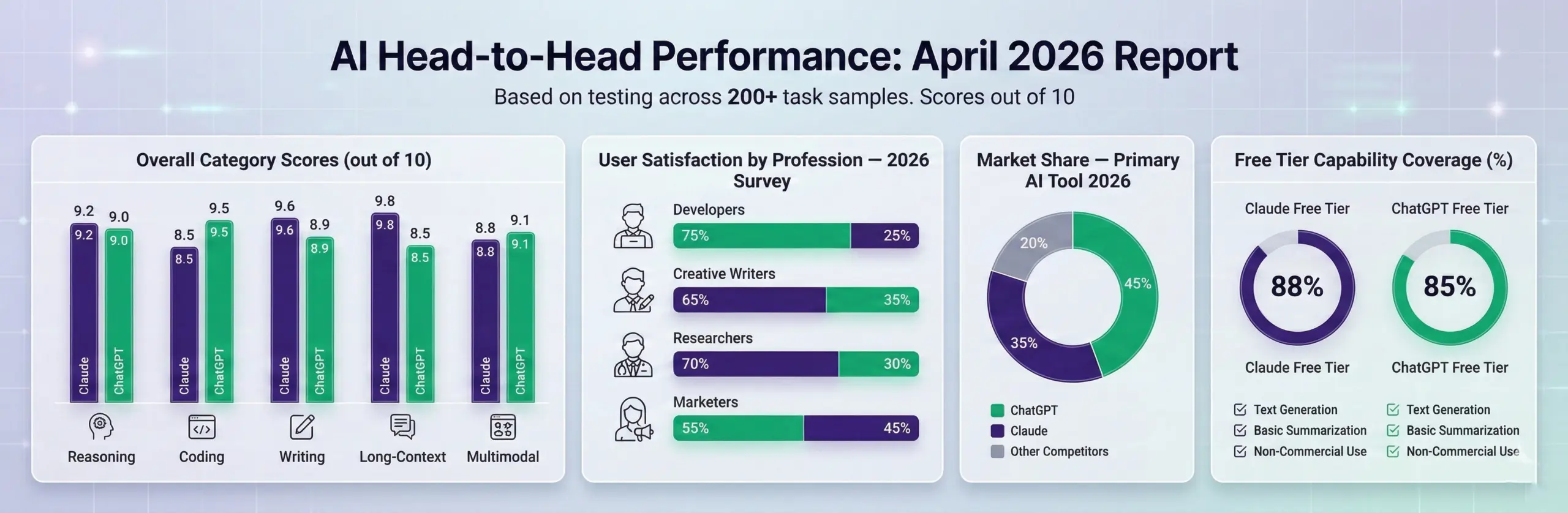
📊 Head-to-Head Performance — The Numbers
Based on our testing across 200+ task samples, April 2026. Scores out of 10.
Overall Category Scores (out of 10)
Claude Sonnet 4.6
ChatGPT GPT-5.4
User Satisfaction by Profession — 2026 Survey (% who prefer each tool for their primary work)
Market Share — Primary AI Tool 2026
Free Tier Capability Coverage (%)

⚡ Full Comparison Table — 2026
All data verified as of April 2026. Pricing in USD.
| Category | Claude Sonnet 4.6 | ChatGPT GPT-5.4 | Winner |
|---|
| Writing Quality | 9.2/10 — Natural, voice-driven prose | 8.1/10 — Structured, competent | ✅ Claude |
| Coding & Dev | 8.0/10 — Clean code, no execution | 9.3/10 — Code Interpreter advantage | ✅ ChatGPT |
| Reasoning | 9.1/10 — Handles ambiguity well | 8.6/10 — Strong on clear problems | ✅ Claude |
| Context Window | 1M tokens (Pro) | 128K tokens (Plus) | ✅ Claude |
| Research / Accuracy | 8.7/10 — More calibrated | 8.7/10 — More proactive search | 🤝 Tie |
| Creative Writing | 9.0/10 — Literary, atmospheric | 8.2/10 — Genre-competent | ✅ Claude |
| Integrations / Ecosystem | 7.8/10 — Growing | 9.4/10 — Mature ecosystem | ✅ ChatGPT |
| Image Generation | ❌ Not available | ✅ DALL-E (Plus) | ✅ ChatGPT |
| Mobile App | Good (iOS + Android) | Excellent — more features | ✅ ChatGPT |
| Voice Mode | Basic | Advanced voice mode | ✅ ChatGPT |
| Free Tier Quality | Sonnet 4.5 — very capable | GPT-5.3 — solid | ✅ Claude (slightly) |
| Pro Price (2026) | $20/month | $20/month | 🤝 Equal |
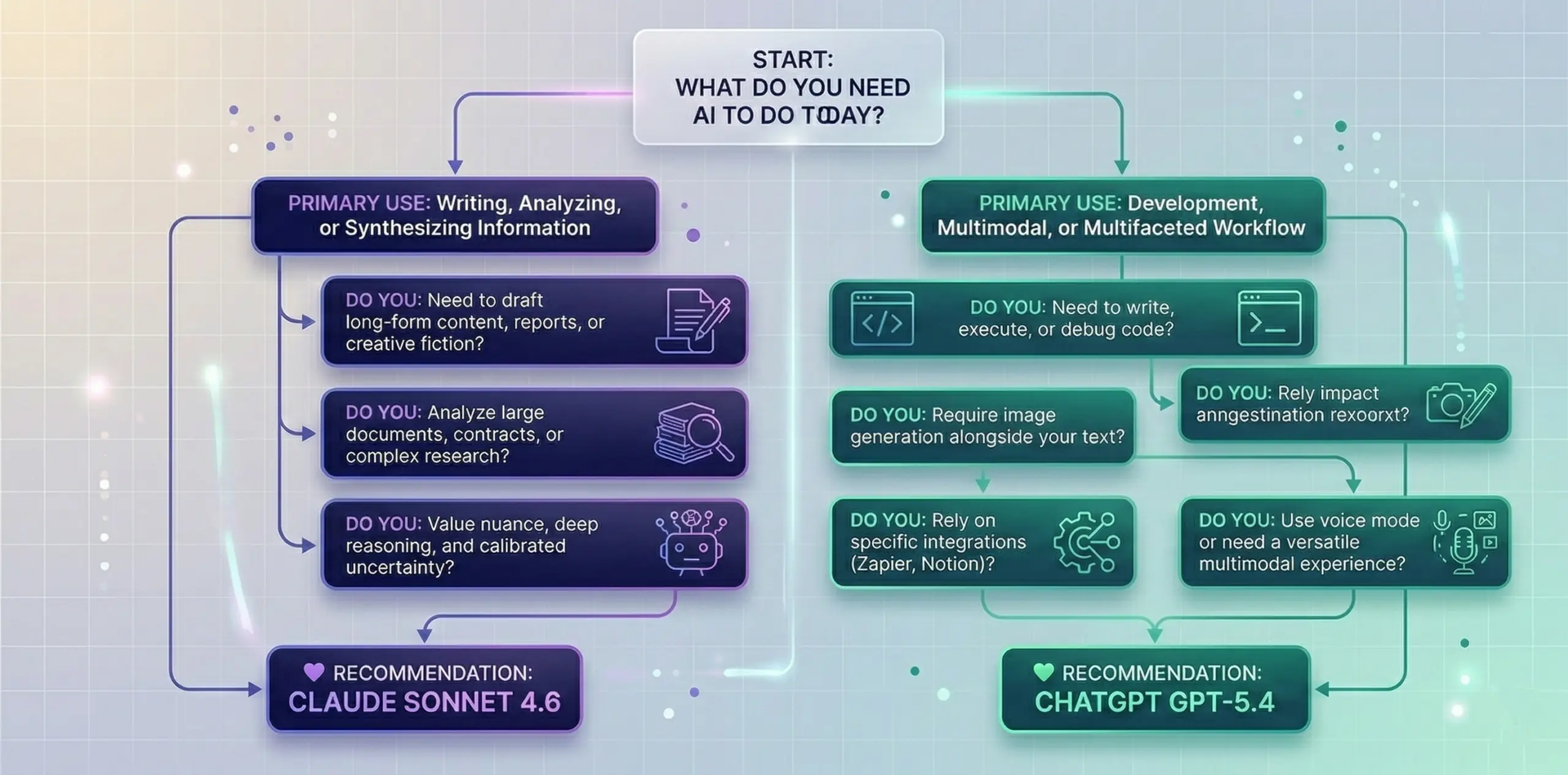
👤 Choose Based on What You Actually Do
💜 Use Claude If…
You write a lot — articles, reports, essays, copy
You work with long documents, contracts, or research
You need analytical reasoning with nuance and uncertainty
You’re doing serious creative writing or fiction
You want a tutor or thoughtful debate partner
You’re a student, researcher, lawyer, or consultant
You care about AI honesty & calibrated uncertainty
💚 Use ChatGPT If…
You’re a developer or data scientist
You need to execute code and see actual results
You need image generation alongside text
You use voice mode regularly
You rely on specific integrations (Zapier, Notion, etc.)
You want a broad, versatile multi-modal workflow
You’re a content creator, marketer, or product manager
📖 More Real Cases — How People Are Using Both in 2026
🧑💼 Freelance Copywriter, Paris — Switched from ChatGPT to Claude Pro
She used ChatGPT for two years and thought it was fine until a colleague showed her Claude’s output on the same brief. She ran the same prompt in both tools ten times across different client projects. In seven of ten cases, her clients picked Claude’s version in blind tests. She now pays $20/month for Claude Pro and considers it the best professional investment she’s made. She still uses ChatGPT’s free tier for quick research queries.
👨💻 Full Stack Developer, Berlin — Uses Both Daily
His rule: ChatGPT for anything involving running code, debugging live errors, or analyzing data files — because the Code Interpreter turns a 20-minute debugging session into a 3-minute one. Claude for architecture discussions, technical documentation, code review, and any time he wants a second opinion on an approach. He says Claude “actually pushes back when my architecture has a flaw,” while ChatGPT tends to validate whatever direction he’s going.
📚 PhD Researcher, Singapore — Claude Pro Exclusive
She uploads entire batches of research papers — sometimes 30 at a time — into Claude’s 1 million token context and asks it to synthesize themes, identify contradictions across papers, and flag which papers make claims that others don’t support. This is a workflow that is simply not possible with ChatGPT’s 128K context. She describes Claude as “the research assistant I couldn’t afford before AI.” Her literature review process, which used to take six weeks, now takes ten days.
🎨 Creative Director, New York — Hybrid Workflow
He uses ChatGPT for visual concepting because DALL-E integration lets him iterate on brand visual directions without leaving the chat. For the actual campaign copy, scripts, and brand voice work, he switches to Claude. His team has noticed the copy Claude produces requires far fewer rounds of revision than what ChatGPT generates — he attributes this to Claude’s ability to internalize brand guidelines from a long brief and maintain them consistently across a long output.
🏆 The Final Honest Verdict
Best for Writing & Analysis
Claude Sonnet 4.6
🏆 5 Category Wins
Reasoning · Writing · Documents · Creative · Context
Best for STEM & Versatility
ChatGPT GPT-5.4
🏆 4 Category Wins
Coding · Ecosystem · Images · Voice
If you’re making me pick one for the average knowledge worker in 2026 — someone who writes, researches, thinks, and communicates for a living — my honest recommendation is Claude Pro at $20/month. The writing quality advantage is real and consistent. The reasoning capability is genuinely better on the tasks that require careful thinking. The 1 million token context window opens workflows that simply don’t exist in ChatGPT. And the free tier (Sonnet 4.5) is strong enough to test seriously before committing.
If you’re a developer, a data scientist, a content creator who needs visuals, or someone whose workflow depends on integrations and a mature ecosystem — ChatGPT Plus is the right answer. The Code Interpreter advantage is decisive for technical work, and the breadth of what it can do in a single interface is genuinely impressive.
And if you can justify $40/month? Use both. The most sophisticated AI users in 2026 don’t pick a side — they understand which tool wins which round and route their work accordingly. That’s not indecision. That’s just knowing your tools.
⚡ Get More From Both Tools
The Prompts That Make Claude and ChatGPT 10× More Useful
How you ask matters as much as which tool you use. Generate purpose-built prompts for writing, coding, research, and analysis — free, no account required.
No account · Works with Claude, ChatGPT & every AI in this guide · Free forever
More Free AI Resources & Comparisons