The Agentic Era: How Google I/O 2026 Just Changed the Future of the Internet
🤖 AI Strategy 🏗️ Infrastructure 🔥 Google I/O 2026 🆕 May 2026 ✅ Updated May 2026

The Agentic Era: How Google I/O 2026 Just Changed the Future of the Internet An AI Systems Architect’s breakdown of what the shift from Chatbot AI to Agentic AI means for your infrastructure, your search strategy, and your 2027 roadmap

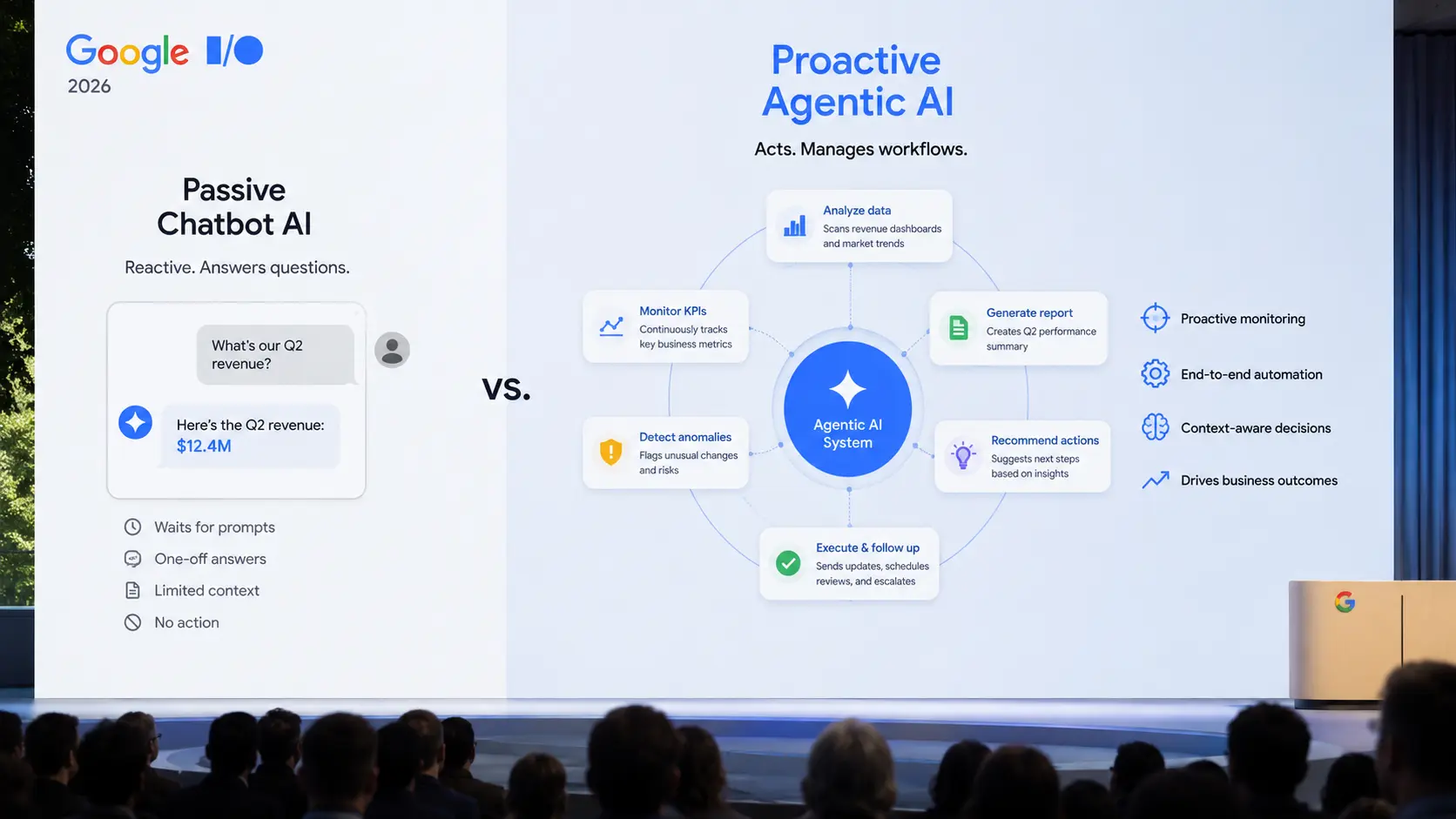
Architectural diagram contrasting passive chatbot AI with proactive agentic AI systems managing enterprise workflows at Google I/O 2026

I have spent seven years designing and deploying AI systems at scale — from orchestrating inference pipelines for document processing to managing the migration of enterprise tools onto large language model backends. In that time, I have watched three distinct waves of “AI adoption” move through the industry. What Google announced at I/O 2026 is not a fourth wave. It is a different ocean entirely.

✍️ By AI Systems Architect, GPTNest · 📅 May 20, 2026 · ⏱️ 18 min read

5 Architectural Shifts You Need to Understand from Google I/O 2026

The chatbot era is architecturally over. Gemini Spark and the Antigravity 2.0 framework establish proactive, background-running agents as the new primitive. Your stack needs to accommodate persistent, stateful AI processes — not just one-shot API calls.
Multimodal is now an API contract, not a UI feature. Gemini 3.5 Flash’s any-to-any processing means your automation pipelines can accept video, audio, and documents as first-class inputs. This changes what “data ingestion” means at the infrastructure level.
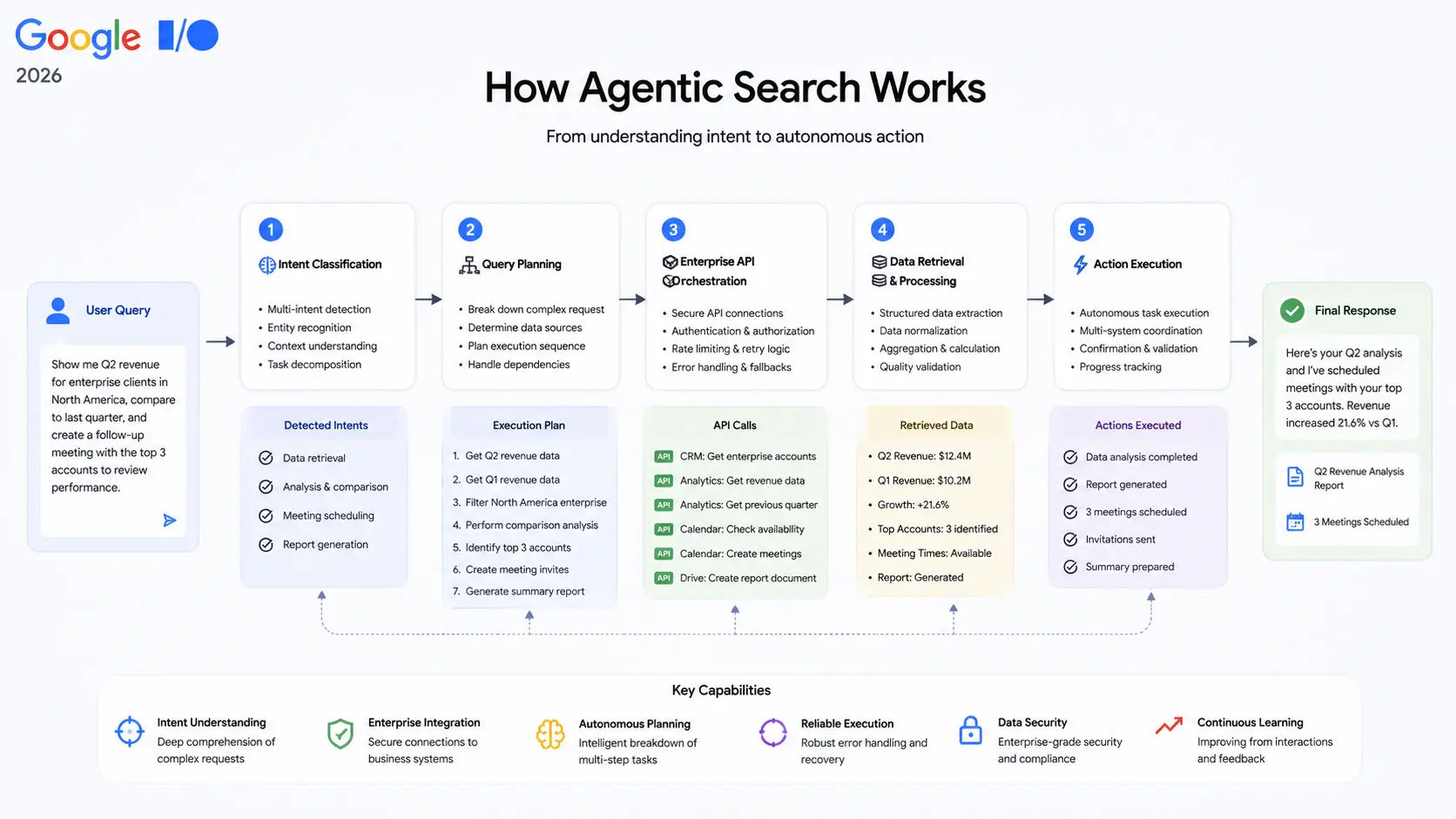
Search is now an action layer. The redesigned Google Search box does not return links. It executes tasks. This forces an immediate rethink of your AEO (Answer Engine Optimization) strategy — your brand must become the agent’s preferred data source.
Android 17 fuses ambient computing with enterprise workflows. The Samsung/Warby Parker glasses integration is not a consumer gadget story. It is the first production deployment of heads-up, hands-free computing at Google’s distribution scale.
Your 2027 infrastructure must be agentic-ready. Legacy event-driven architectures were designed for humans triggering actions. The new paradigm requires pipelines that accommodate agents triggering agents — with appropriate guardrails, audit trails, and cost controls.

2M

Token Context Window — Gemini 3.5 Flash

15+

Modality Combinations Supported by Gemini Omni

~40%

Latency Reduction vs. Gemini 2.0 Flash on Structured Tasks

2027

Deadline to Build Agentic-Ready Infrastructure or Fall Behind

In This Analysis of Google I/O 2026 and the Agentic Era

The End of the Chatbot Era — Why I/O 2026 Was the Tipping Point

From linear, single-shot AI to persistent, autonomous infrastructure

🧠 Context

When ChatGPT launched in late 2022, it established a paradigm that has defined enterprise AI adoption for three years: the request-response loop. A user sends a message. The model generates a reply. The loop terminates. This architecture is familiar, safe, and — critically — it maps cleanly onto existing software patterns. It looks like an API call because it is an API call.

Google I/O 2026 was the industry’s formal announcement that this paradigm is being retired. The centerpiece was not a new language model. It was Gemini Spark and the Antigravity 2.0 agentic framework — a system architecture in which AI agents are not summoned reactively but run persistently in the background, monitoring signals, making decisions, and executing multi-step tasks without waiting for a human to initiate each cycle.

The distinction sounds subtle. It is not. The difference between a chatbot and an agent is the difference between a calculator and a bookkeeper. One computes on demand. The other manages your accounts continuously, flags anomalies, initiates payments, and alerts you only when your attention is genuinely required. That is not a UX upgrade. That is an infrastructural rearchitecture of what “AI in the enterprise” means.

💡 Architect’s Perspective

In seven years of systems deployment, I have seen this pattern before: the shift from batch processing to stream processing, the shift from server-based to serverless compute. Each time, organizations that treated it as a tooling change rather than an architectural shift spent two years rebuilding what they should have designed correctly from the start. The agentic shift is that kind of change.
From Passive to Proactive: What Agentic AI Actually Means for Business

The architectural implications of Gemini Spark and Google Antigravity 2.0

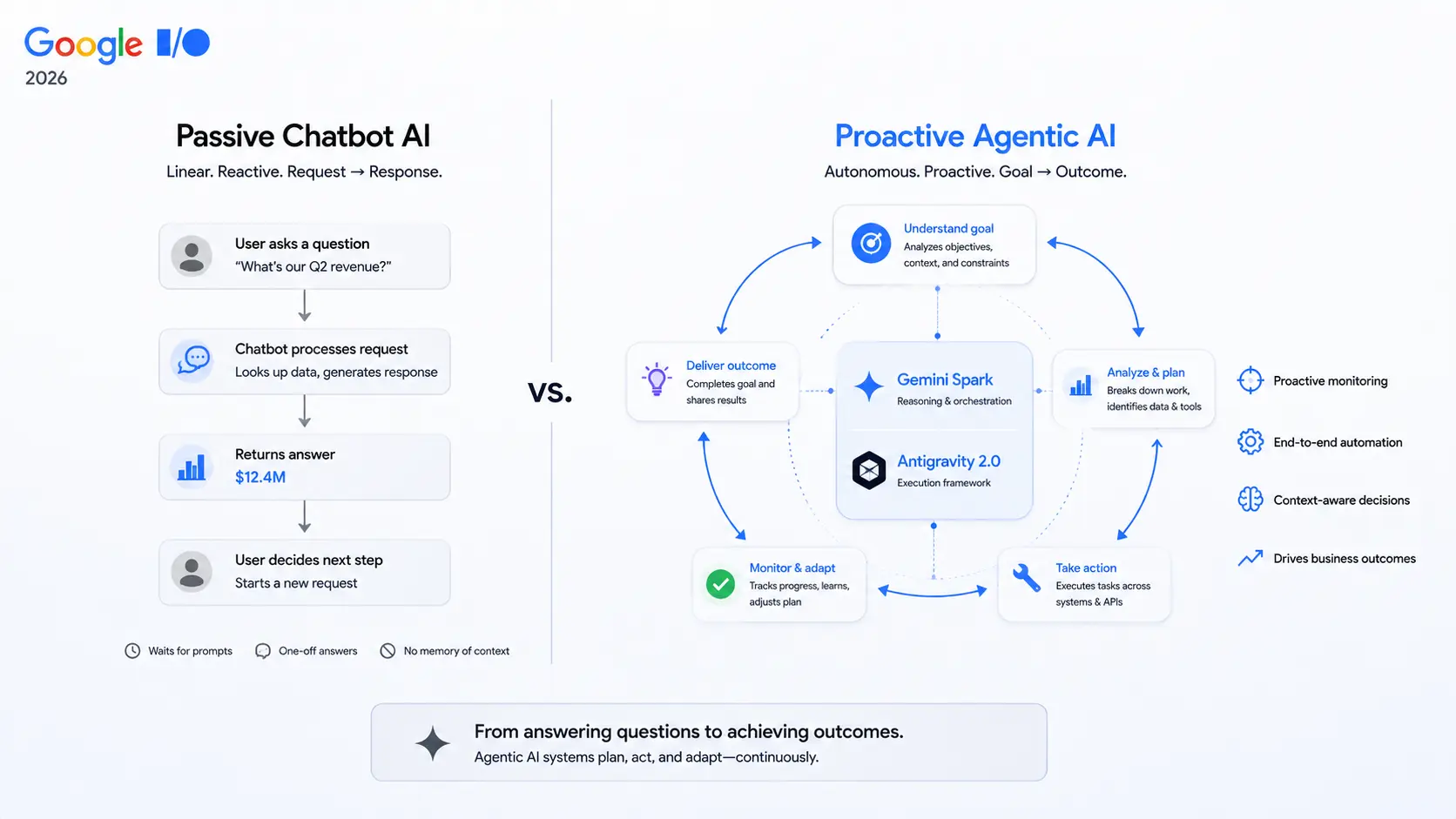
Side-by-side architectural diagram comparing linear chatbot AI request-response pattern with looping proactive agentic AI systems using Gemini Spark and Antigravity 2.0 framework

Let me be concrete about what “proactive agentic AI” means at the infrastructure level, because the marketing language can obscure the engineering reality. A proactive agent is a process that runs on a schedule or in response to environmental signals — not human prompts. It has persistent memory across sessions. It can spawn sub-agents to handle parallel subtasks. And it can execute actions in connected systems: sending emails, updating CRMs, filing tickets, adjusting ad bids, or escalating to a human operator when confidence thresholds are not met.

Gemini Spark, as demonstrated at I/O 2026, handles inbox management as a worked example: monitoring incoming communications, categorizing by urgency and topic, drafting responses that match your historical communication style, flagging items requiring human review, and scheduling follow-ups — all without being invoked once per email. The Antigravity 2.0 framework extends this pattern to any enterprise workflow that can be decomposed into observable states and executable actions.

Implication for Operations Directors

Your approval workflows, exception-handling chains, and escalation protocols need to be redesigned as agent-compatible state machines. Agents need clear permission boundaries, audit trails, and rollback capabilities — none of which your current tool stack was built to provide.

Implication for SaaS Founders

Your product’s competitive moat is shifting from “features” to “agent surface area.” Products that expose clean, well-documented APIs for agent consumption will absorb workflow automation spend. Products that don’t will be routed around by agents that find alternative data sources.

Implication for CTOs

Your infrastructure cost model needs to account for persistent compute, not just burst inference. Agentic processes run continuously, accumulate state, and generate long-tail API calls that differ fundamentally from the traffic patterns your current capacity planning assumes.

Implication for Technical Leads

Observability becomes existential. When an agent makes a decision — why did it choose action A over action B? What data did it act on? Your logging, tracing, and monitoring infrastructure needs to be redesigned to answer these questions reliably, or you will have no meaningful oversight of what your AI layer is doing.

⚠️ The Guardrail Problem

The most dangerous organizational failure mode in the agentic transition is deploying agents without adequate permission scoping. An agent with write access to your CRM, email, and billing systems — and no explicit action constraints — is not a productivity tool. It is an unaudited autonomous process with production access. Define agent permissions as strictly as you would define service account permissions in a zero-trust network architecture.

The New Model Architecture: Gemini 3.5 Flash and Multimodal Omni

Why “any-to-any” processing is an API breakthrough, not just a UI upgrade

⚡ Core Architecture

Gemini 3.5 Flash is the model that makes enterprise agentic workflows economically viable. Its predecessor required a cost-versus-capability tradeoff that made high-frequency agentic calls prohibitive at scale. Gemini 3.5 Flash collapses that tradeoff: it delivers approximately 40% latency improvement over Gemini 2.0 Flash on structured reasoning tasks while maintaining a 2-million-token context window. For agents that need to process large documents, long email threads, or extended interaction histories in near-real-time, this is the enabling technology.

Why Speed and Multimodality Change API-Driven Automations

Gemini Omni‘s any-to-any multimodal processing is being framed in most coverage as a user experience story — you can now send a video and get back text, or send audio and get back a structured document. That framing misses the engineering significance entirely.

The significance is that multimodal input handling is now a first-class API contract, not a wrapper around separate specialized models. In practice, this means your automation pipeline can ingest a customer support call recording, a screen capture of a UI error, and a PDF policy document in a single API request — and receive a structured, actionable response without pre-processing each modality separately. The serialization overhead, the modality routing logic, the intermediate data transformations: all of that pipeline complexity is absorbed into a single model call.

Before Gemini Omni — Typical Multimodal Pipeline

Audio → Speech-to-text service → Text → LLM → Text output. Each modality requires a separate API call, a separate service dependency, separate error handling, separate cost tracking, and a data handoff layer between each stage. Four services minimum for audio + image + document inputs.

After Gemini Omni — Unified Multimodal API

Audio + Image + Document → Single Gemini Omni API call → Structured output. One service dependency, one error surface, one billing relationship, one latency measurement point. The pipeline simplification alone justifies the migration cost for any team running mixed-modality automation.

✅ Multimodal AI API — Practical Impact

For teams building document intelligence pipelines — invoice processing, contract review, compliance checking — the shift to a unified multimodal API means you can now handle scanned PDFs, embedded images, and voice annotations in the same request that previously required three separate preprocessing stages. Measure your current pipeline latency against the Gemini Omni single-call baseline before committing to your next infrastructure sprint.

📖 Architecture Note — From 7 Years of Pipeline Design

The most expensive technical debt I have encountered across enterprise AI deployments is not in the models — it is in the glue code that connects them. Every modality boundary in a pipeline is a fault surface, a latency multiplier, and a maintenance burden. Gemini Omni does not just make AI more capable. It makes AI pipelines dramatically simpler to build, operate, and audit. That operational simplification compounds over time in ways that a benchmark score does not capture.

Android 17 and Ambient Computing: The Rise of Wearable AI

AI-powered audio glasses and the heads-up, hands-free computing layer

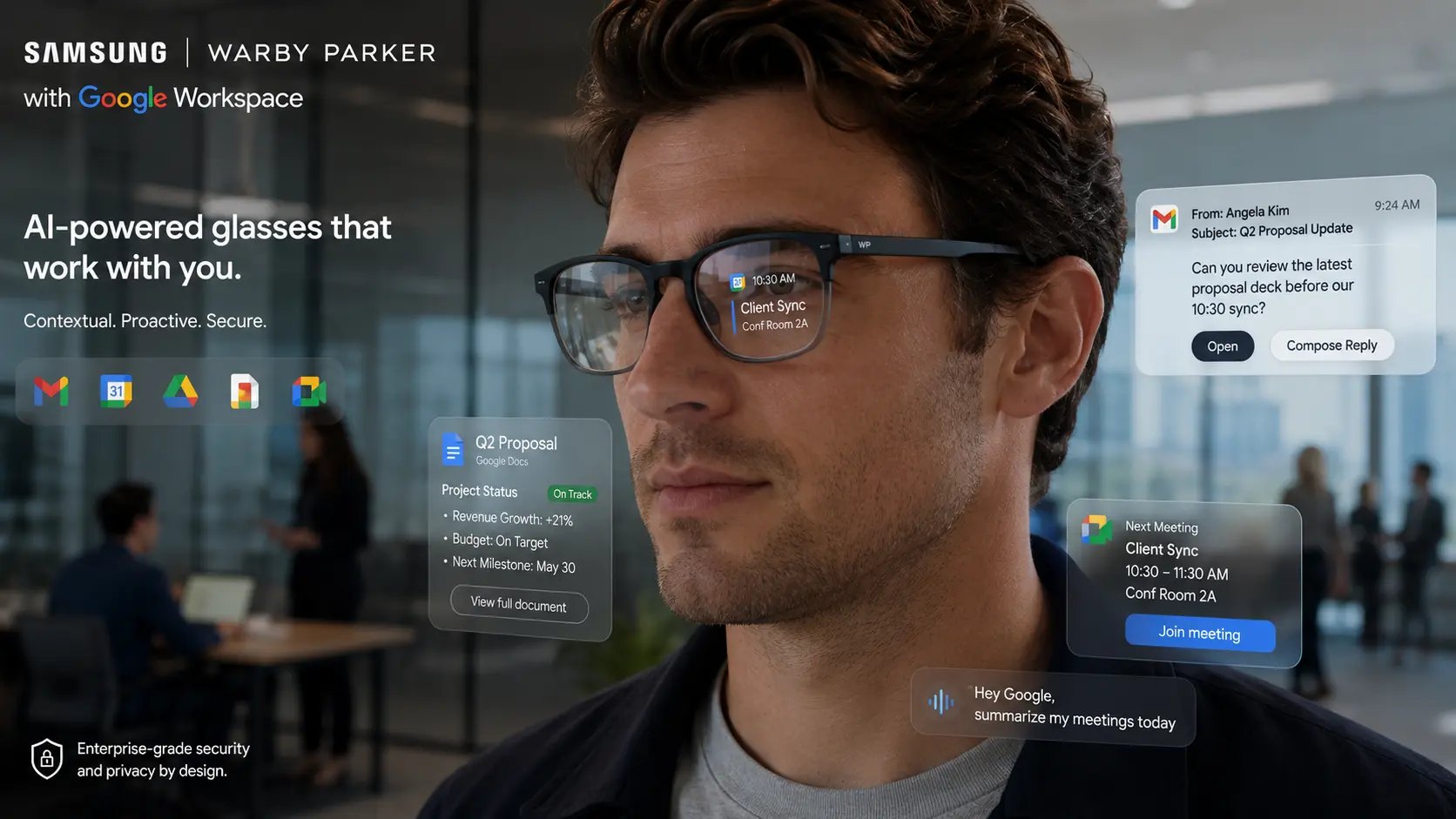
Ambient computing visualization showing Samsung Warby Parker AI-powered smart glasses integrating with Google Workspace enterprise applications, displaying heads-up contextual data overlays in a business environment

The Samsung/Warby Parker audio glasses announced under the Android 17 platform represent something more consequential than a consumer wearable launch. They represent the first mass-market deployment of what the industry has been calling “ambient computing” — AI that exists in the physical environment rather than on a screen you have to deliberately consult.

The glasses run on-device Gemini inference for low-latency tasks — speaker identification, real-time translation, contextual reminders — while offloading complex reasoning to the cloud via a persistent Android 17 session. The integration with Google Workspace means that when you walk into a meeting, your glasses know who is in the room, pull their recent communications with you, surface relevant documents, and can take structured notes that sync to your calendar and task manager without you touching a device.

For enterprise applications, the near-term use cases are in field service, healthcare, and logistics — domains where screen-based computing creates friction and hands-free access to contextual information has direct operational value. A field technician who can query a maintenance manual, log a service action, and escalate an issue by voice while keeping both hands on the equipment is not a science fiction scenario. Android 17 makes it a 2026 production deployment.

💡 Strategic Note for CTOs

The ambient computing layer does not require immediate investment — but it does require forward architectural planning. Applications and data sources that are agent-accessible via clean APIs will be compatible with this layer automatically. Applications that require screen-based interaction will need to be rearchitected. Your API-first modernization work has a second compelling business case: ambient computing compatibility.

Preparing Your Infrastructure for 2027: Moving Toward Agentic-Ready Pipelines

A practical infrastructure roadmap for enterprise agentic workflows

🏗️ Roadmap

Having laid out the architectural shifts, let me be specific about what “agentic-ready infrastructure” actually requires — because the term is being used loosely in a lot of vendor conversations right now, and the implementation gap between “we have an AI chatbot” and “we run enterprise agentic workflows” is significant.

Infrastructure Requirements

Persistent State Management: Agents need durable, low-latency state stores — not session variables. Design for Redis or equivalent persistent caching with agent-scoped namespacing and TTL policies.
Async Task Queues: Agentic workflows are inherently asynchronous. Your existing synchronous API architecture needs a message queue layer — Pub/Sub, SQS, or equivalent — to handle agent-initiated tasks without blocking human-facing interfaces.
Action Permission Registry: Every agent action category requires an explicit permission grant, an approval workflow for high-risk actions, and an immutable audit log. This is not optional — it is the difference between a controlled system and a liability.
Cost Envelope Controls: Agents that run continuously and call sub-agents need hard token budget caps, time-boxed execution windows, and alerting when cost trajectories deviate from baseline. Without controls, agentic infrastructure costs are unpredictable.

Migration Priorities — 2026 H2

Audit all existing automation workflows for agent compatibility — identify which can be migrated to Antigravity 2.0 / Gemini Spark patterns and which require rearchitecting.
Implement Schema.org structured data coverage across your entire public data surface — prioritize entity types that match your product and service categories.
Publish an OpenAPI spec for any internal capability you want to be agent-accessible — including read-only access to your product catalog, availability, and pricing data.
Pilot one internal agentic workflow using Gemini 3.5 Flash — choose a high-frequency, low-risk process (draft email classification, invoice routing, meeting note extraction) to build operational intuition before committing to production-scale deployments.

📖 From Systems Deployment Experience — The Migration Pattern That Works

The most successful AI infrastructure transitions I have been part of followed the same pattern: identify one high-frequency, low-risk internal process, instrument it completely with observability tooling, migrate it to the new paradigm, run it in parallel with the legacy process for thirty days, and use the diff between the two outputs to calibrate agent behavior. Only after that calibration period do you decommission the legacy path. Agentic workflows are no different — the pilot process teaches your organization how agents behave in your specific environment, which is knowledge you cannot get from documentation alone.

⚡ Strategic Readiness Matrix: Agentic AI Adoption

Where leading organizations stand and what the transition requires — May 2026.

Capability AreaChatbot-Era StateAgentic-Era RequirementPriority
AI Interaction ModelReactive, user-initiated promptsProactive, event-triggered agents with persistent state🔴 Critical 2026
Data IngestionText-only structured inputsMultimodal AI API — any-to-any via Gemini Omni🔴 Critical 2026
Search StrategyKeyword SEO, blue-link rankingAEO: Schema.org, OpenAPI spec, entity authority🔴 Critical 2026
ObservabilityRequest/response loggingAgent decision traces, action audit logs, cost envelopes🟠 High Priority Q3
Permission ArchitectureUser-level access controlsAgent-scoped permissions with approval workflows🟠 High Priority Q3
Compute ModelBurst inference, serverlessPersistent agent processes, async task queues🟡 Plan for 2027
Hardware LayerScreen-first interfacesAmbient computing APIs (Android 17 / wearable AI)🟡 Plan for 2027

🏆 Conclusion: Adapt or Become Obsolete — The Internet Is Now a Proactive Ecosystem

Google I/O 2026 was not a product announcement event. It was an architectural manifesto. The combination of Gemini Spark’s proactive agent framework, Gemini 3.5 Flash’s enterprise-viable speed and cost profile, Gemini Omni’s unified multimodal API, the Agentic Search redesign, and Android 17’s ambient computing platform constitutes a coherent, mutually reinforcing architectural vision for what the internet becomes in the next three years.

That vision is an internet that does not wait for you to query it. It monitors your context, anticipates your needs, executes tasks on your behalf, and presents you with results and decisions — not links and search results. For users, this is an enormous productivity gain. For businesses built on the assumption that humans click links, read pages, and fill out forms, it is an existential challenge that requires immediate strategic response.

The organizations that will lead in 2027 are not the ones with the most AI features. They are the ones whose infrastructure, data, and brand are most legible to the agents that will be making decisions on their customers’ behalf. Building that legibility — through structured data, clean APIs, entity authority, and agentic-compatible workflows — is the most important infrastructure investment your organization can make in the second half of 2026.

💡 Final Architect’s Note

Seven years of systems deployment has taught me that the organizations that successfully navigate paradigm shifts are rarely the ones with the biggest budgets. They are the ones with the clearest mental model of what changed and why. The agentic shift is well-defined enough now to plan against. The only failure mode that matters is waiting until the shift is visible in your metrics before beginning the response — by then, you are rebuilding from behind.

More AI Infrastructure & Strategy Guides

Scroll to Top