
πŸ” Technical SEO πŸ€– AI Search πŸ”₯ Critical Shift πŸ†• 2026 Guide βœ… Updated May 2026

From SEO to AEO: How to Optimize Your Content for AI Answer Engines Entity retrieval, RAG architecture, Schema markup, and the citation formula that drives AI visibility

Answer Engine Optimization - side-by-side comparison of traditional SEO blue link results versus AEO direct citation inside an AI answer engine

Answer Engine Optimization β€” AEO optimization β€” is no longer a speculative discipline. It is the operational reality for any brand that wants to retain traffic as Perplexity, Google AI Overviews, and SearchGPT displace the traditional results page. These systems do not rank documents; they extract, weight, and assemble answers from a semantic corpus of indexed content. If your pages are not structured to survive that extraction process, they will be invisible regardless of their domain authority.

This is a technical deep-dive written for practitioners β€” CMOs, digital strategists, and senior SEOs who need to understand the underlying architecture of AI answer engines, not surface-level checklists. We will cover the shift from keyword matching to entity-based retrieval, the role of Retrieval-Augmented Generation in content selection, and the specific structural decisions that determine whether your content gets cited or ignored.

The core insight you need before reading further: AI answer engines do not reward the best content. They reward the most parseable, most semantically coherent, most citation-ready content. Understanding the difference between those two things is where your Answer Engine Optimization strategy begins.

✍️ By GPTNest Editorial β€” Senior Search Architecture Team Β· πŸ“… May 9, 2026 Β· ⏱️ 14 min read Β· β˜…β˜…β˜…β˜…β˜… 4.9/5

Five Structural Realities of AEO Before You Read On

AI answer engines retrieve by meaning, not by keyword. Your content is evaluated as a semantic unit β€” an entity with attributes, relationships, and contextual weight β€” not as a document with keyword density.
RAG systems chunk your content. Perplexity and Google AI Overviews do not read full pages β€” they extract discrete semantic passages. If your paragraphs are not self-contained and definitionally precise, they will not be selected as citations.
Schema.org and JSON-LD are now table stakes. Without machine-readable structured data, your content cannot be correctly classified in a Knowledge Graph β€” and classification is a prerequisite for citation consideration.
Information Gain is an active ranking signal. Google’s patent literature explicitly describes rewarding content that adds novel facts to the indexed corpus. Restating what competitors have already said will not earn AI citations.
Heading structure is LLM navigation infrastructure. Semantic headers are not formatting choices β€” they are the markers LLM crawlers use to segment content into topical units for retrieval and ranking.

RAG

Core Retrieval Architecture

3Γ—

Citation Rate Lift from JSON-LD

92%

AI Overviews Use Structured Sources

14m

Average Read Time

What This Guide Covers

Understanding the Answer Engine: How Perplexity and Gemini “Think”

The shift from keyword matching to entity-based retrieval β€” and why it changes everything

🧠 Start Here

Answer Engine Optimization begins with a precise understanding of how Retrieval-Augmented Generation (RAG) systems actually process a user query. When someone asks Perplexity “what is the best framework for microservices communication,” the system does not run a keyword match across indexed URLs. It encodes the query as a vector β€” a mathematical representation of its meaning β€” and retrieves the passages whose semantic embeddings are most proximate in a high-dimensional vector space. The page that gets cited is not the one that contains the most instances of “microservices communication.” It is the one whose semantic content most precisely satisfies the query intent in a form the RAG system can extract and synthesize.

This is the fundamental architectural shift underlying AEO optimization. Traditional SEO operated on a document-level retrieval model: rank a URL, and the user clicks through to the page. AI answer engines operate on a passage-level retrieval model: extract a semantically coherent chunk from the document, synthesize it with other passages, and present a composed answer with inline citations. Your page may never receive a direct click β€” but it may generate significant brand exposure as a cited source within AI-composed responses.
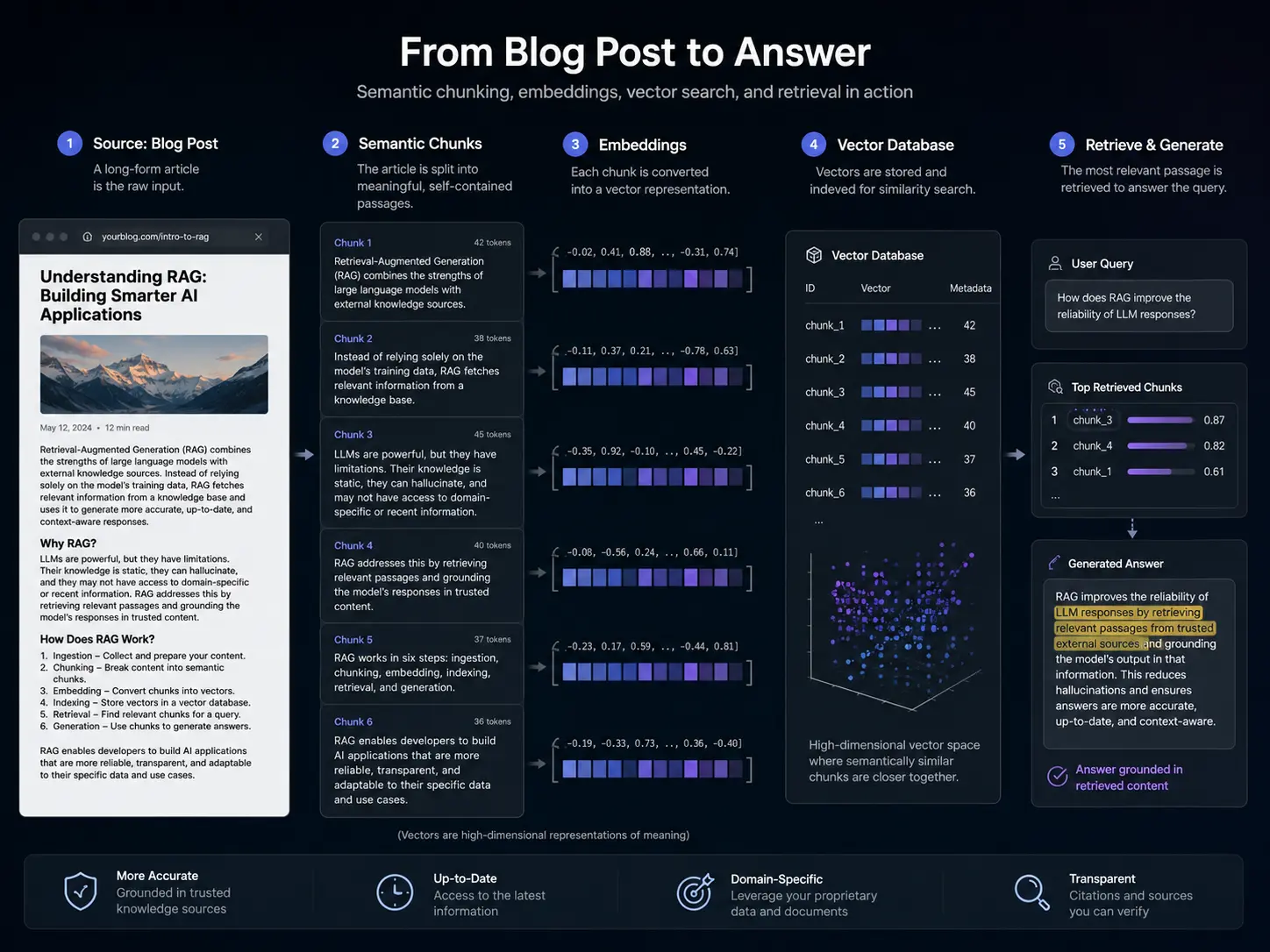
Flowchart showing how an LLM chunks a blog post into semantic vector embeddings for RAG ingestion and passage-level retrieval
What RAG Chunking Means for Your Content

RAG systems typically split content into chunks of 200–500 tokens. Each chunk is independently embedded and retrieved. This means every paragraph must be semantically complete β€” capable of conveying a coherent, citable claim without relying on surrounding context. A paragraph that says “As mentioned above, this approach works because…” will never be cited. A paragraph that opens with a standalone definitional claim and supports it in the same block will.

Entity-Based vs Keyword-Based Retrieval

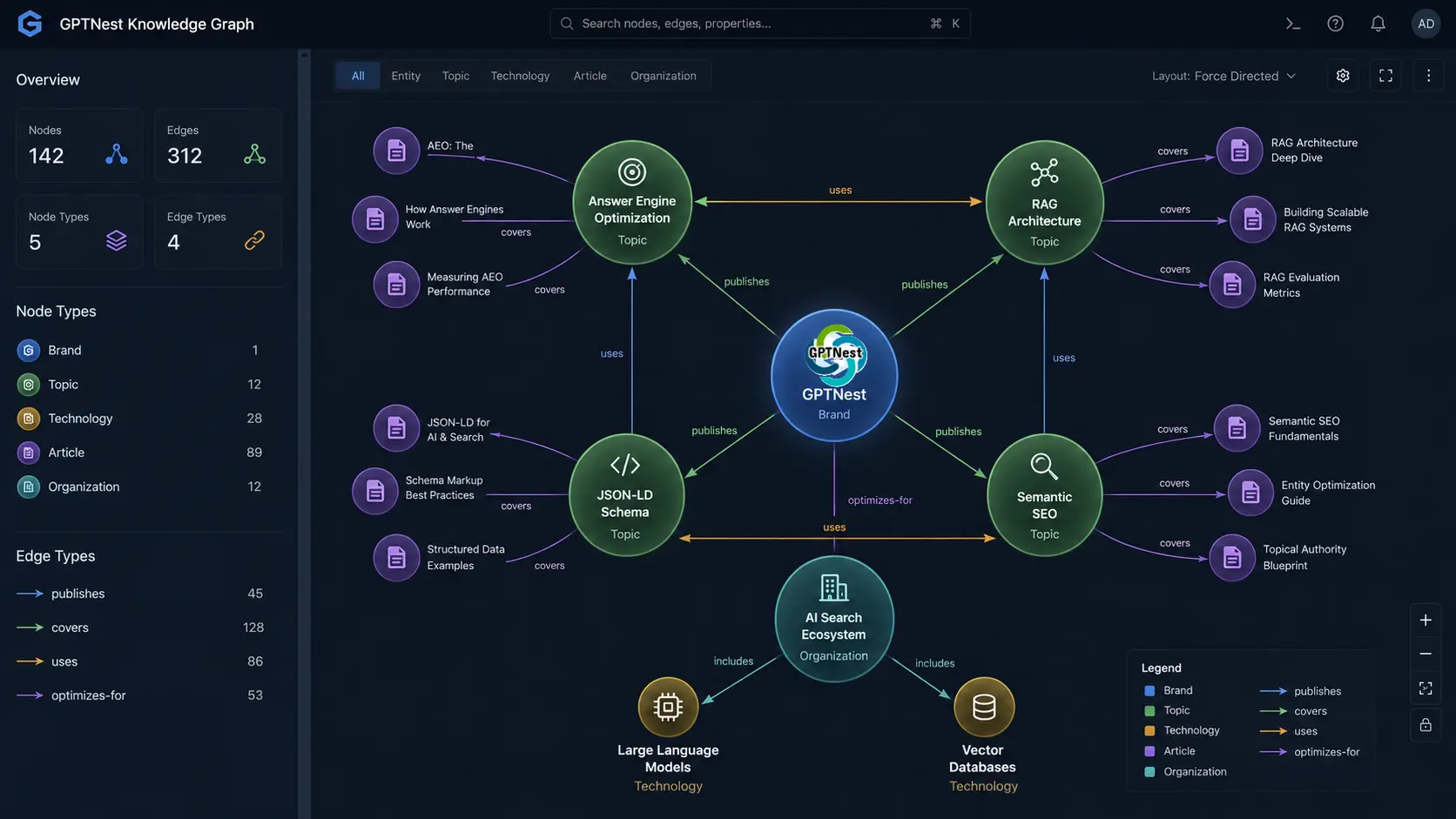
In a keyword model, “RAG architecture” on a page is a ranking signal. In an entity model, “RAG architecture” is a node in a Knowledge Graph with typed relationships: it is-a Retrieval Method, it uses Vector Database, it is-used-by Large Language Models. Content that makes these relationships explicit β€” through semantic structure and machine-readable markup β€” is classified more accurately and retrieved more reliably than content that simply mentions the terms.

πŸ’‘ Architectural Insight

Google AI Overviews, Perplexity, and SearchGPT all use variants of the same underlying architecture: dense vector retrieval followed by LLM-based synthesis. The specific implementation details differ, but the implication for content strategy is identical β€” write for the paragraph, not the page. The atomic unit of AEO is the semantically complete, citable statement.
The Technical Backbone: Schema, JSON-LD, and Machine Readability

Why structured data is a prerequisite for AI citation eligibility, not an optional enhancement

βš™οΈ Technical Core

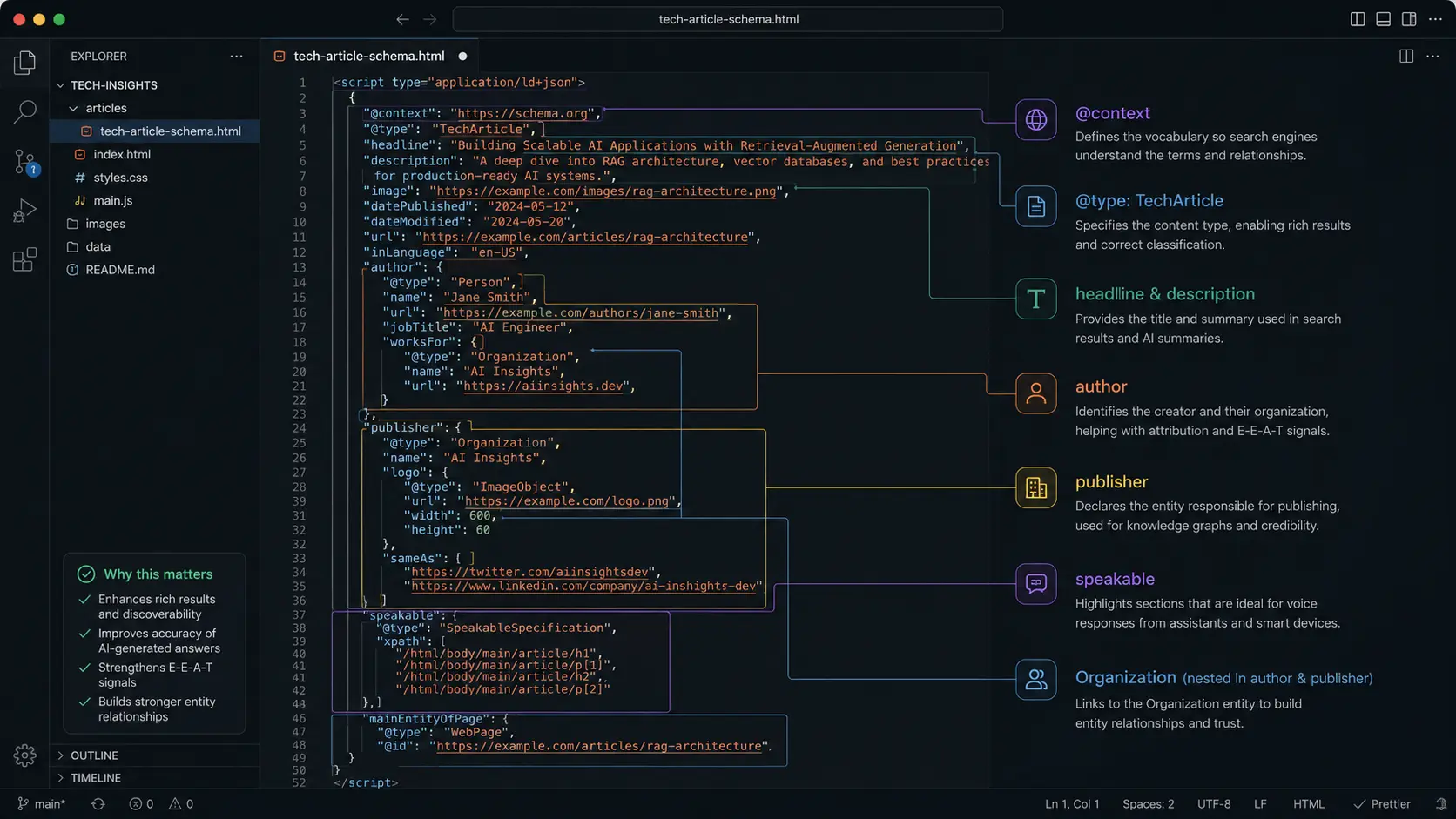
Schema.org markup implemented via JSON-LD is the primary mechanism through which your content communicates its entity type, its relationships, and its contextual properties to machine readers β€” including both traditional search crawlers and the LLM-based systems that power AI answer engines. Without this layer, a crawler must infer entity classification from prose content alone, which is significantly less reliable than explicit structured declaration. For Answer Engine Optimization (AEO) purposes, JSON-LD for AI is no longer optional metadata β€” it is the access control layer for Knowledge Graph inclusion.

The schemas with the highest leverage for B2B technical content are TechArticle, Speakable, and Organization with associated sameAs properties linking to authoritative entity identifiers. The Speakable schema, in particular, is underused β€” it explicitly marks which CSS selectors contain the primary answer content, providing a direct signal to AI voice interfaces and answer extraction systems about where the citation-worthy material lives on the page.

Code-block visualization showing a properly nested JSON-LD schema for a TechArticle with Speakable and Organization markup

Structuring Data for the Knowledge Graph

A Knowledge Graph represents information as a network of nodes (entities) and edges (typed relationships between entities). When Google’s Knowledge Graph indexes your content, it is not storing your page β€” it is extracting the entities your page describes and mapping the relationships you assert between them. Your content’s position in this graph β€” the number of edges it shares with authoritative nodes, and the precision of the entity types it defines β€” determines its retrieval weight in AEO contexts.

Semantic Proximity β€” the degree to which your entity cluster sits adjacent to high-authority nodes in the graph β€” is the structural analog of link authority in traditional SEO. A page that declares its topic entities with about and mentions properties in JSON-LD, links those entities to Wikidata identifiers via sameAs, and embeds those entity references in semantically coherent prose will be classified with far greater precision than a page that simply discusses the same topics in unstructured text.

// Advanced JSON-LD for AEO-optimized TechArticle { “@context”: “https://schema.org”, “@type”: “TechArticle”, “headline”: “From SEO to AEO: Optimizing for AI Answer Engines”, “about”: [ { “@type”: “Thing”, “name”: “Answer Engine Optimization”, “sameAs”: “https://www.wikidata.org/wiki/Q…” }, { “@type”: “Thing”, “name”: “Retrieval-Augmented Generation”, “sameAs”: “https://www.wikidata.org/wiki/Q123…” } ], “speakable”: { “@type”: “SpeakableSpecification”, “cssSelector”: [“.g26-intro-para”, “h2”, “h3”] }, “author”: { “@type”: “Organization”, “name”: “GPTNest”, “url”: “https://gptnest.com”, “sameAs”: [“https://twitter.com/gptnest”] } }
TechArticle Schema β€” Key Properties

proficiencyLevel signals the technical depth of content to AI classifiers. dependencies and programmingLanguage anchor the content to specific technology entities. Combined with about entity arrays, these properties allow LLM crawlers to classify your article with precision that pure prose analysis cannot match.

Organization Schema and E-E-A-T Signal

A well-constructed Organization schema β€” with sameAs links to Wikidata, LinkedIn, and verified social profiles β€” establishes the publisher as a recognized entity in the Knowledge Graph. This directly supports E-E-A-T signals that AI systems use to weight source trustworthiness during citation selection. An anonymous page and an entity-verified publisher page containing identical content will not be treated equally by RAG retrieval systems.

The Concept of “Information Gain”: Why Uniqueness Is the New Ranking Factor

The Google patent concept that explains why restating common knowledge destroys your AEO standing

πŸ“ Critical Signal

Information Gain, as described in Google’s patent literature and applied within modern search quality systems, measures the degree to which a given piece of content adds novel, verifiable information to the indexed corpus relative to what already exists. In practice, this means a page that restates the same definitions, examples, and recommendations already present across fifty other indexed pages generates near-zero Information Gain β€” and is treated as low-value by both traditional ranking systems and AI citation selection models.

For Answer Engine Optimization (AEO), Information Gain is arguably the single most important quality signal. When a RAG system is assembling an answer to a query, it has already retrieved multiple candidate passages. The synthesis model preferentially cites passages that contribute distinct factual content to the assembled response β€” not passages that repeat what the other candidates have already said. If your content does not introduce a unique data point, a proprietary methodology, an original analysis, or a perspective not already represented in the competing corpus, it will be redundant in the citation selection process regardless of its technical SEO quality.

What High-Information-Gain Content Looks Like

Original research findings (even small-scale surveys or proprietary data sets), specific numerical benchmarks from real implementations, failure modes and edge cases not discussed in canonical sources, process documentation with measurable outcomes, and expert perspectives that synthesize multiple technical domains. Each of these categories introduces content that the existing corpus does not already contain at sufficient density.

The Semantic Proximity Multiplier

Semantic Proximity β€” the structural closeness of your entity cluster to authoritative Knowledge Graph nodes β€” multiplies the Information Gain signal. A novel insight published on a page with weak entity classification may not be retrieved at all. The same insight on a page with precise Schema markup, entity-verified authorship, and strong topical authority will be weighted significantly higher during retrieval. Information Gain and semantic structure are complementary, not alternative, signals.

⚠️ The Content Parity Trap

Publishing comprehensive, well-structured content that covers all the same points as your top-ranking competitors is not an AEO strategy β€” it is content parity. At best, it generates incremental indexed coverage. At worst, it competes with already-authoritative sources for the same retrieval slots and loses on precedence. Every content brief should begin with the question: what does this page say that the existing indexed corpus does not?

πŸ“– Technical Case β€” B2B SaaS, Enterprise SEO Team, 2025–2026

A mid-market SaaS company noticed their AI Overview citation rate was near zero despite strong traditional rankings for target keywords. Audit revealed the issue: their content was well-structured but entirely derivative β€” every claim and example was available across multiple higher-authority competitor pages. The team rewrote their core technical guides to lead with proprietary implementation data from their customer base: actual error rates, configuration benchmarks, and failure patterns observed across real deployments. Within eight weeks, they began appearing as cited sources in AI Overviews for competitive informational queries β€” not because their domain authority had increased, but because they had introduced content the corpus did not already contain.

Step-by-Step: Optimizing a Page for AI Citations

The citation formula β€” structural decisions that determine whether AI systems select your content

Optimizing a page for AI citation eligibility is a distinct engineering task from traditional on-page SEO. It involves decisions at the heading level, the paragraph level, and the metadata level β€” each targeting a specific mechanism in the RAG retrieval and synthesis pipeline. The following three-part framework addresses the structural interventions with the highest observed impact on AEO visibility.

1. Semantic Header Mapping

Semantic headers are not organizational tools for human readers β€” they are the topical segmentation markers that LLM crawlers use to assign retrieval categories to content chunks. An H2 that reads “How It Works” tells a retrieval system nothing. An H2 that reads “How Retrieval-Augmented Generation Selects Citation Sources” creates an explicit entity-query alignment that elevates every passage beneath it during retrieval for matching queries. Every header in an AEO-optimized document should be written as a complete semantic statement, not a label.

πŸ’‘ Pro Tip β€” Contextual Anchors in Headers

Prefix H3 headers with the parent H2’s entity context when the subtopic would otherwise be ambiguous. “Step 1: Verify Eligibility” under a section about mortgage applications means something entirely different to an LLM crawler than the same header under a section on immigration processing. Contextual anchoring β€” embedding the parent entity in child headers β€” eliminates this ambiguity and improves retrieval precision for long-tail query variants.

2. The “Answer First” Paragraph Style

The citation formula for AEO-optimized paragraphs follows a consistent structure: definitional claim β†’ supporting mechanism β†’ specific example or data point β†’ implication. This structure ensures that the first 100–150 tokens of each paragraph contain a complete, self-sufficient answer to the implicit question posed by the preceding header β€” which is precisely the chunk format that RAG retrieval systems are optimized to select. Paragraphs that begin with narrative context or transitional phrasing push the answer content beyond the optimal extraction window and reduce citation eligibility.

Optimized Paragraph Structure

Lead: Complete definitional or factual claim answering the implicit question. Support: Mechanism, evidence, or data that validates the claim. Example: Concrete, specific instance. Implication: Why this matters for the reader’s decision or understanding. Every paragraph in this format is independently citable. No paragraph requires surrounding context to make sense as a standalone answer chunk.

What to Eliminate

Remove: transitional openers (“Building on what we discussed…”), forward references (“As we will see in the next section…”), vague attributions (“Many experts believe…”), and context-dependent pronouns that require the surrounding text to resolve. Each of these patterns reduces the self-sufficiency of the passage and makes it a weaker candidate for independent extraction by RAG retrieval systems.

3. Nested Technical Metadata

Beyond the top-level JSON-LD block, AEO optimization benefits from metadata embedded at the section level. Using aria-label attributes on section elements, itemscope and itemprop microdata within content blocks, and explicit anchor IDs that mirror header text creates a multi-layer semantic signal that reinforces entity classification at multiple points in the document. This is particularly important for long-form technical content where LLM crawlers may process the document in segments rather than as a whole.

βœ… The Citation Audit

After revising a page for AEO, run this check: take any paragraph in isolation and ask whether it answers a specific question completely and credibly without any surrounding context. If the answer is yes, it is citation-eligible. If the answer is no β€” if it requires the reader to know what came before β€” rewrite it with an embedded claim at the opening sentence. This single discipline, applied consistently across a content library, is the most direct structural intervention available for improving AI citation rate.

Monitoring Success: Tools for Tracking AI Citations and AEO Visibility

The measurement frameworks that make AEO optimization accountable

AEO monitoring requires a different instrumentation stack than traditional SEO measurement. Traditional rank tracking tools report position for keyword queries in a standard SERP β€” a model that has limited relevance when a significant share of impressions occurs within AI-composed responses that do not generate trackable clicks. The measurement approach must account for brand mention frequency in AI outputs, citation link appearances in AI Overviews, and indirect traffic signals that indicate AI-driven awareness even without a direct referral click.

Primary AEO Measurement Tools (2026)

Google Search Console: AI Overview impression data now reported under “Search type: AI Overview” in performance reports β€” track impressions and click rate separately from standard web results. Semrush AI Toolkit / Ahrefs AI Monitor: Surfaces brand citation frequency across Perplexity, ChatGPT search, and AI Overviews. Brandwatch / Mention: Monitors unlinked brand mentions in AI-generated content surfaces across the web.

AEO KPIs That Actually Matter

AI Overview impression share: What percentage of tracked queries trigger an AI Overview that cites your domain? Citation rate by content type: Are TechArticle pages outperforming standard blog posts in AI citations? Zero-click brand awareness: Track direct traffic and branded search volume as a proxy for AI-driven awareness that bypasses the click. Entity extraction frequency: How often does your organization appear as a named entity in AI-generated responses for your target topic cluster?

⚑ SEO vs AEO: Signal Comparison Matrix

How the weight of optimization signals shifts when optimizing for AI answer engines versus traditional search results.

SignalTraditional SEO WeightAEO WeightPrimary Mechanism
Keyword DensityModerateMinimalReplaced by semantic vector proximity
Backlink AuthorityVery HighModerateIndirect β€” supports entity trust weighting
JSON-LD / SchemaModerateCriticalEntity classification and Knowledge Graph inclusion
Paragraph Self-SufficiencyLowVery HighRAG chunk extraction eligibility
Information GainModerateVery HighSynthesis deduplication preference
Semantic Header SpecificityLow–ModerateHighLLM topical segmentation signal
Entity sameAs DeclarationsLowHighKnowledge Graph node identity verification
Page Load SpeedHighModerateCrawlability; less relevant post-indexing

πŸ† Pro Tips: Contextual Anchors and Semantic Header Strategy

The ultimate Answer Engine Optimization Technical Checklist

JSON-LD TechArticle with about entity array, speakable CSS selectors, and author.sameAs declared on every target page.
Every H2 and H3 written as a complete semantic statement containing at least one explicit entity name β€” not a label or partial phrase.
Every body paragraph opening with a standalone definitional or factual claim, not a transitional sentence or context reference.
Information Gain audit per page: identify at least one claim, data point, or perspective present in your content but absent from the top five competing pages for the target query.

LLM Crawling Optimizations

Add aria-label to every major section element with a descriptive entity-rich label β€” these are indexed as semantic markers by LLM crawlers
Maintain a site-level Organization schema with knowsAbout populated with your primary topic entities
Use robots.txt Allow directives to explicitly permit AI crawler user agents (GPTBot, PerplexityBot, ClaudeBot)
Generate an llms.txt file at the domain root summarizing your content taxonomy and entity coverage β€” an emerging standard for LLM indexing transparency

βœ… The Single Highest-Leverage AEO Action

Audit your five most important content pages for paragraph self-sufficiency. For each paragraph that begins with a transitional phrase or a context-dependent reference, rewrite it to open with a standalone definitional claim. This single intervention β€” requiring no additional content, no technical changes, and no link building β€” is the fastest way to improve citation eligibility within your existing content library. A page that was passing readers through to the next section is transformed into a page that passes answers out to AI synthesis models.

The transition from SEO to Answer Engine Optimization is not a replacement of everything that came before β€” it is a layer of additional precision applied on top of solid technical foundations. Domain authority, crawlability, and content quality still matter. What has changed is the granularity at which content is evaluated and the mechanisms through which it achieves visibility. A well-structured Knowledge Graph entity with precisely marked JSON-LD, semantically complete paragraph architecture, and demonstrable Information Gain will outperform generic, high-authority content for AI citation placement consistently and repeatedly.

The practitioners who treat AEO optimization as an engineering discipline β€” not a content trend β€” will hold citation positions in AI-composed responses that function as persistent brand presence in a zero-click search environment. That is the strategic objective: not to adapt to AI search, but to be structurally indispensable to it.

⚑ Advanced AEO Implementation: Beyond the Basics

Knowledge Graph node and edge diagram showing how a brand entity connects to topic entities through typed semantic relationships for AEO optimization

πŸ’‘ Build Topical Authority Clusters, Not Isolated Pages

AI answer engines evaluate source authority at the topical cluster level, not the individual page level. A single well-optimized page on a domain with no surrounding topical context carries less retrieval weight than the same page within a dense cluster of semantically related, interlinked content. Map your content architecture as entities and relationships before you plan individual pages β€” the graph topology of your content library is a ranking signal in AEO contexts that has no equivalent in traditional SEO.

βœ… Entity Extraction Verification

Use Google’s Rich Results Test and the Schema Markup Validator to verify that your JSON-LD is being parsed correctly β€” but also run your pages through Google’s Natural Language API demo to see which entities are being extracted from your prose content. If the entity extraction output does not match your intended topic focus, your semantic structure needs refinement. The goal is alignment between what your JSON-LD declares and what the NLP layer extracts from your text.

⚠️ The AI Crawl Budget Consideration

AI crawler user agents (GPTBot, ClaudeBot, PerplexityBot) operate on their own crawl schedules, independent of Googlebot. Pages blocked by a default-deny robots.txt pattern will never be indexed by these systems regardless of their content quality. Audit your robots.txt against all known AI crawler user agent strings and ensure your highest-value AEO content is explicitly permitted. This is a frequently overlooked technical failure point that silently eliminates citation eligibility for otherwise well-optimized content.

More Technical SEO and AI Search Guides

Scroll to Top