
๐Ÿ“„ ATS Strategy ๐Ÿค– AI Career Tools ๐Ÿ”ฅ High Impact ๐Ÿ†• 2026 Guide โœ… Updated May 2026

How to Write an ATS-Beating CV with AI: Reverse-Engineering HR Systems A technical recruiter’s framework for bypassing automated filters using AI prompt chains in 2026

ATS resume optimization flowchart showing how Workday and Taleo extract structured data fields from a CV

Before a human recruiter ever reads your resume, a piece of software has already decided whether you’re worth considering. ATS resume optimization isn’t a buzzword โ€” it’s a structural reality of modern hiring. Platforms like Workday, Taleo, and Greenhouse handle the vast majority of enterprise job applications, and their screening logic is far more nuanced than a simple keyword scan. Knowing how those systems work โ€” and how to use AI to reverse-engineer them โ€” is the difference between getting a callback and disappearing into the void.

This guide to ATS resume optimization isn’t about gaming the system with tricks that get you flagged. It’s about understanding what ATS algorithms actually parse, what signals they weight, and how to build a precise AI prompt chain that produces a tailored, interview-worthy CV โ€” without fabricating skills you don’t have or inflating titles you didn’t hold.

What follows is grounded in how enterprise HR technology actually functions โ€” not wishful thinking about what recruiters want to see. If you’re a senior professional, a tech worker navigating a competitive market, or anyone tired of sending applications into silence, this is the framework that changes the outcome.

โœ๏ธ By GPTNest Editorial ยท ๐Ÿ“… May 3, 2026 ยท โฑ๏ธ 15 min read ยท โ˜…โ˜…โ˜…โ˜…โ˜… 4.9/5

The Hidden Wall of Hiring โ€” 5 Facts Most Applicants Don’t Know

75% of CVs never reach a human. Enterprise ATS platforms reject the majority of applications before a recruiter sees them โ€” not because candidates are unqualified, but because their documents fail to parse correctly or score below the system threshold.
Modern ATS uses semantic matching, not exact keywords. Taleo and Workday run probabilistic scoring models. Writing “managed cross-functional teams” when the JD says “led cross-functional collaboration” may still score โ€” but only if the semantic distance is close enough.
Formatting kills more applications than weak experience. Multi-column layouts, text boxes, headers in table cells, and graphics-heavy Canva exports break parsers. The ATS extracts garbled data โ€” and your profile looks incomplete.
Generic CVs are mathematically penalized. TF-IDF-based scoring rewards candidates who mirror the language density of the job description. A one-size-fits-all resume consistently underscores against a tailored one โ€” even with identical experience.
AI can reverse-engineer the gap โ€” but only if grounded in truth. LLMs are exceptional at cross-referencing your actual experience against a JD and surfacing the language bridge. The candidate who learns this workflow has a structural advantage. The one who uses AI to fabricate skills will fail the technical screen.

75%

CVs Rejected Before Human Review

3ร—

Higher Callback Rate, Tailored CV

4

AI Prompt Chain Steps

15m

Average Read Time

What You’ll Learn in This Guide

Understanding the Enemy: How ATS Resume Optimization Works

Semantic scoring, TF-IDF weighting, and what the parser actually sees

๐ŸŽฏ Foundation

The outdated advice about ATS resume optimization fails because it misunderstands how enterprise platforms operate in 2026. Systems like Workday, Taleo, and Greenhouse don’t perform a simple string match. They use a combination of semantic keyword matching, TF-IDF scoring, and in some deployments, machine learning models trained on the hiring company’s past successful hires.

TF-IDF โ€” Term Frequency-Inverse Document Frequency โ€” is a statistical measure originally from information retrieval. In the recruitment context, it weights terms that appear frequently in a job description but are less common across the broader corpus of resumes. If a JD uses “stakeholder alignment” six times and most resumes never mention it, that phrase carries disproportionate scoring weight. Using it authentically โ€” assuming it reflects actual experience โ€” materially improves your ranking.

Semantic matching adds another layer. Modern ATS plugins and AI-enhanced modules can recognize that “oversaw a team of engineers” and “engineering team leadership” are semantically proximate. But there are limits to that proximity, and the closer your language mirrors the JD, the less semantic inference the system needs to do in your favor.

What ATS Parsers Actually Extract

Most ATS systems parse your resume into discrete data fields: contact info, job titles, company names, employment dates, education credentials, and a skills inventory. The parser strips formatting and reads raw text. Anything trapped in a table cell, text box, or graphic is invisible to the extractor โ€” it simply never populates in the candidate’s profile.

The Scoring Threshold

Many enterprise deployments set a minimum match score before a profile enters the recruiter’s queue. Candidates below that threshold are automatically filtered โ€” not reviewed, not held. The threshold is configurable by the employer, which is why identical experience can result in very different outcomes at different companies using the same underlying platform.

โš ๏ธ The “Invisible Text” Trap

Some guides recommend hiding white-on-white keyword blocks in resumes to boost ATS scoring. This is detectable by modern systems and is treated as manipulation โ€” resulting in automatic disqualification and potential flagging across an employer’s applicant database. It is not a gray area. Do not do it.
The “Master CV” Approach: Grounding the AI in Your Reality

Why the source document you feed the AI determines everything

Before you run a single prompt, you need a master career document โ€” a comprehensive, unformatted record of everything you’ve done professionally. Not a polished CV. Not a LinkedIn export. A raw, exhaustive inventory: every role, every significant project, every metric you remember, every technology you’ve used, every initiative you led or contributed to. This is the source of truth the AI will work from.

When doing ATS resume optimization, this step matters because LLMs don’t fabricate better when given less information โ€” they fabricate more. Without a grounded source document, the model fills gaps with plausible-sounding but invented detail. Feed it specifics, and it tailors. Feed it vagueness, and it invents. The master CV prevents hallucination by removing the need for it.

What to Include in Your Master CV

Every role with company, title, dates, team size, and budget scope where relevant. Project names, outcomes, and the tools or methods used. Metrics โ€” revenue generated, costs reduced, timelines beaten, users served. Skills by category: hard technical, soft leadership, domain-specific. Certifications, publications, and significant contributions, however minor they seem.

Format Guidelines for AI Ingestion

Plain text or simple markdown. No tables, no columns, no design elements. Structure by role, chronologically. Keep bullet points raw and unpolished โ€” the AI will refine them. Include the ugly first drafts of bullet points you were never happy with. The model will find the signal in the noise and clean it up.

๐Ÿ“– Real Case โ€” Senior Product Manager, Casablanca, 2026

A product manager with eight years of experience had been sending the same CV to every role and wondering why response rates were low. She spent one afternoon building a 2,400-word master career document โ€” every role, every product, every relevant metric she could recall. When she fed that document into the prompt chain below alongside a target JD from a Series B fintech, the AI identified six semantic gaps between her experience and the role’s language โ€” and generated tailored bullet points that positioned her existing work in the exact vocabulary the employer’s ATS was scoring. She had three interview requests within two weeks. Nothing was fabricated. The work was always there; it just wasn’t described in the right language.

Step-by-Step AI Prompt Chain for Resume Tailoring

A structured four-step workflow from raw history to interview-ready document

โšก Core Method

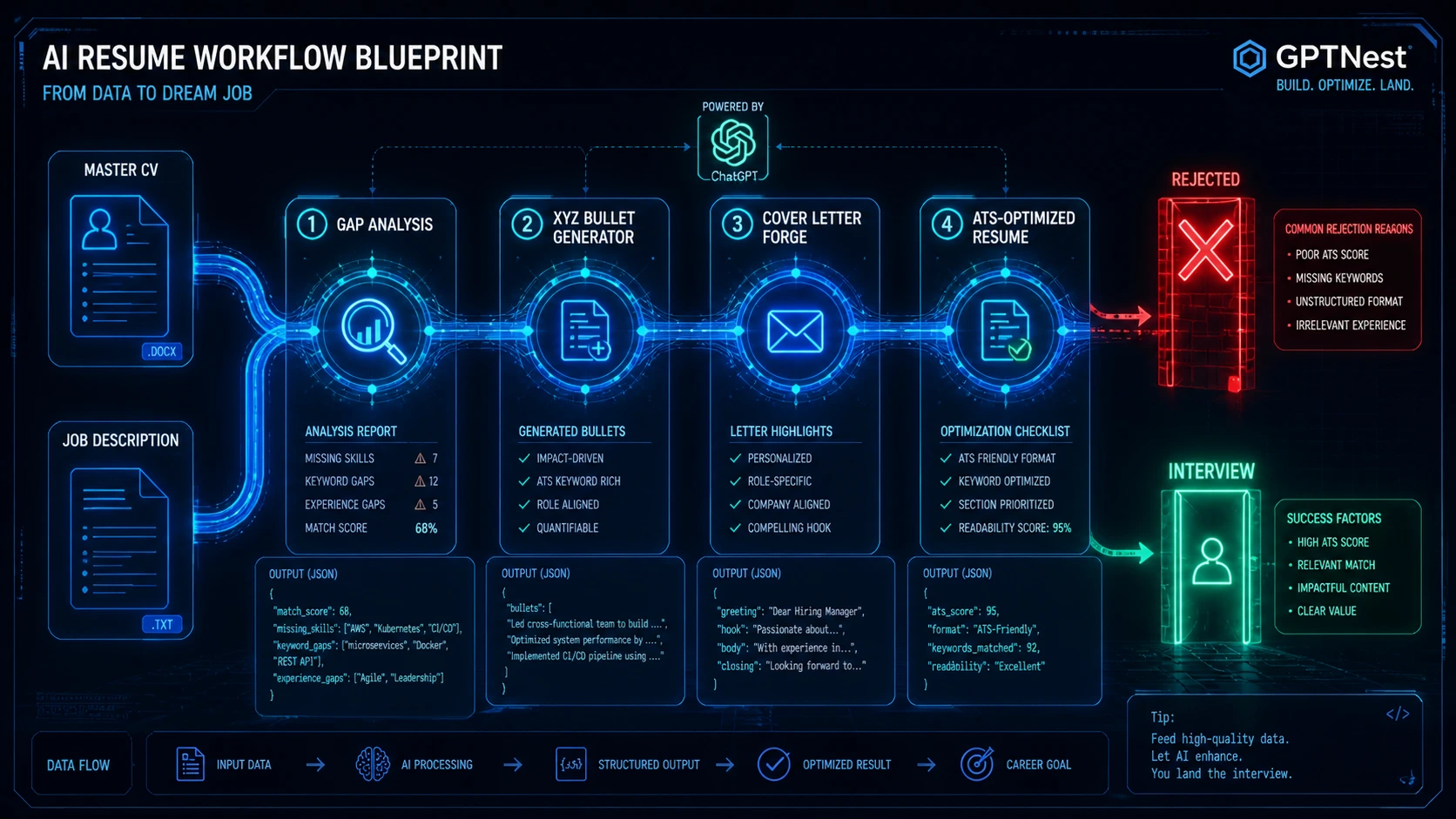
This prompt chain is designed to be run sequentially. Each step builds on the previous. You are not running four independent prompts โ€” you are running a structured pipeline where the output of each stage becomes the input for the next. The architecture is: ingest master history โ†’ ingest target JD โ†’ identify semantic gaps โ†’ generate tailored output.

AI prompt chain workflow diagram: Master CV and Job Description inputs flowing through gap analysis into a tailored ATS-optimized resume output

Step 1 The Gap Analysis Prompt

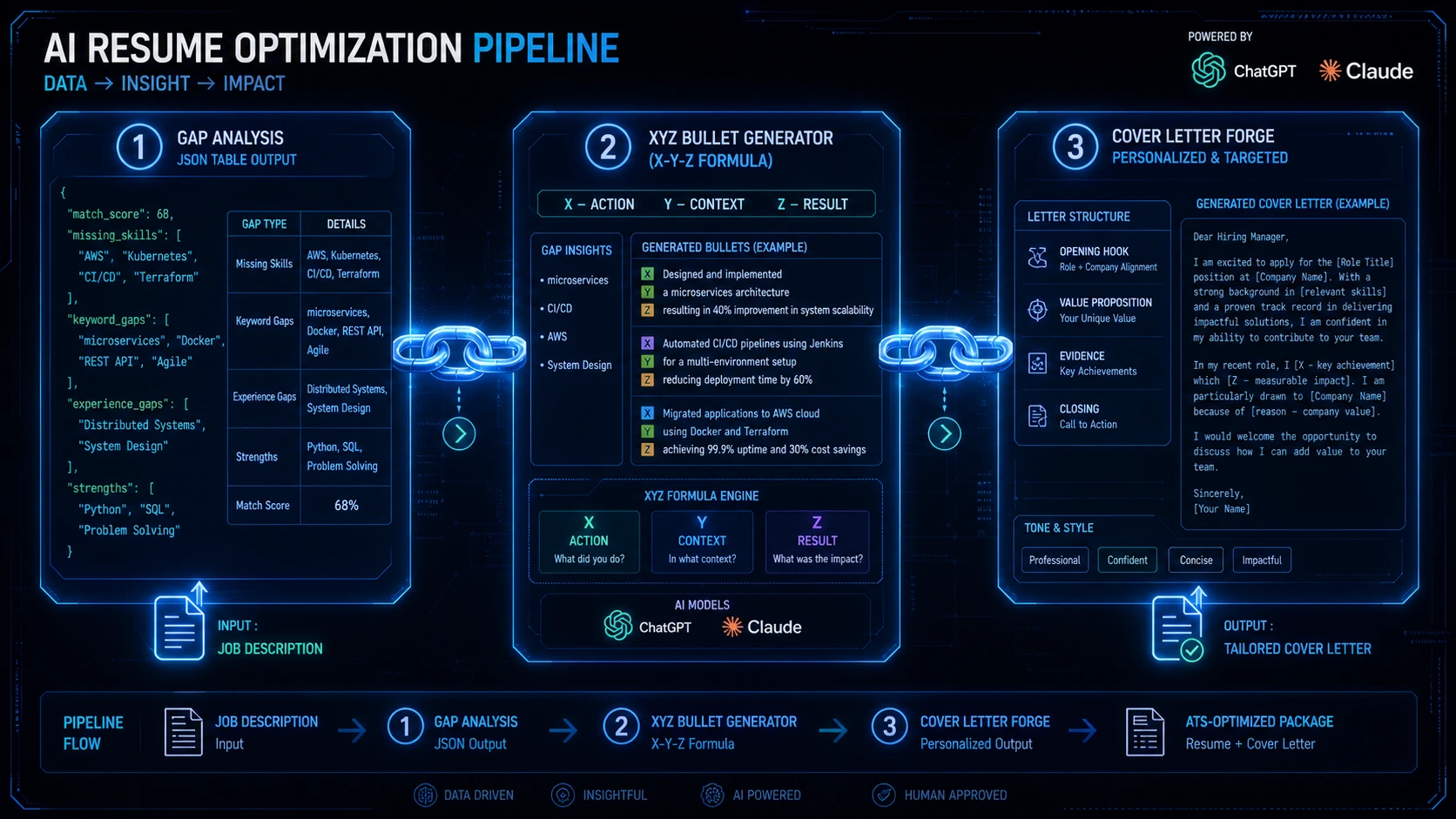
For effective ATS resume optimization, this is the diagnostic step. You are asking the AI to act as a rigorous technical recruiter, compare your master career history against the JD, and output a structured list of semantic gaps โ€” skills, competencies, and vocabulary present in the JD that are absent or under-represented in your current document.

Prompt Template โ€” Gap Analysis

Act as a strict Senior Technical Recruiter with 10 years of experience screening
candidates for enterprise technology roles. I will give you two documents:

DOCUMENT 1 โ€” MY MASTER CAREER HISTORY:
[Paste your full master CV here]

DOCUMENT 2 โ€” TARGET JOB DESCRIPTION:
[Paste the full JD here]

Your task:
1. Analyze both documents rigorously.
2. Output a JSON table with three columns: “Missing Keyword,” “JD Frequency,” and
“Closest Match in My History.”
3. Flag any skills present in the JD that have no analog in my history whatsoever.
4. Do not invent experience I don’t have. Only surface gaps and partial matches.
5. Score my overall semantic alignment with this JD as a percentage.

๐Ÿ’ก How to Use the Gap Analysis Output

Review the JSON table carefully. Items in the “Closest Match” column are opportunities โ€” you likely have experience that covers these gaps but have been describing it in different language. Items with no analog are genuine gaps. For those, either acknowledge them honestly or leave them absent. Do not invent them.

Step 2 The XYZ Bullet Point Generator

The XYZ formula โ€” originally developed for Google’s hiring process โ€” structures experience bullets as: Accomplished [X] as measured by [Y], by doing [Z]. This format is valuable not just because it’s readable to humans, but because it forces specificity that scores well in ATS semantic analysis. Vague bullets produce vague scoring. Metric-anchored bullets are unambiguous.

Side-by-side comparison of a generic resume bullet point versus an XYZ formula bullet point optimized for ATS semantic scoring

Prompt Template โ€” XYZ Bullet Point Generator

Using the gap analysis from Step 1 and my master career history, rewrite the
bullet points for my [specific role] position.

Rules:
1. Use the XYZ formula: “Accomplished [X] as measured by [Y], by doing [Z].”
2. Naturally incorporate the missing semantic keywords identified in the gap analysis,
but only where they genuinely reflect the underlying experience.
3. Do not invent metrics. If I haven’t provided a number, use a qualifier
(“significantly,” “measurably”) and flag it for me to verify or replace.
4. Output 5โ€“7 bullets per role. Keep each under 2 lines.
5. Use active verbs aligned with the JD’s language register.

Step 3 The Cover Letter Alignment Prompt

Cover letters that score well with hiring managers are not generic introductions โ€” they are tight arguments for why this candidate, for this specific role, at this specific company. Feed the AI your tailored CV bullets, the JD, and basic research about the company, and ask it to construct that argument.

Prompt Template โ€” Cover Letter Alignment

Write a 3-paragraph cover letter for this role. Rules:

Paragraph 1: Open with the specific problem this role exists to solve,
based on the JD. Do not open with “I am writing to apply.”

Paragraph 2: Map two or three of my tailored CV bullets directly to that problem.
Use metrics where available. Do not repeat the CV verbatim โ€” reframe it as narrative.

Paragraph 3: One sentence on why this company specifically, one sentence on next steps.

Tone: Direct, confident, no filler phrases like “passionate about” or “team player.”
Length: Under 280 words. No more than 3 paragraphs.

โœ… Step 4 โ€” Final Verification Pass

Before submitting, run a final check prompt: “Review this tailored CV against the JD and identify any claims that could be challenged in a technical interview. Flag anything that sounds more experienced than my underlying history justifies.” This prevents the most common failure mode: passing the ATS and failing the screen call because the CV overstated.

The Formatting Trap in ATS Resume Optimization

Canva exports, Midjourney graphics, and multi-column layouts that destroy your application

โš ๏ธ Critical

The rise of AI design tools has produced a generation of visually impressive resumes that perform terribly with ATS parsers. A Canva template with a sidebar skills column, a decorative header, and a profile photo might look polished to a human. To an ATS parser, it’s a parsing nightmare. The sidebar text may be extracted out of order or ignored entirely. The header graphic is invisible. The two-column layout often collapses into a single confusing string of text when the parser strips formatting.

The hierarchy of format choices, from most to least ATS-safe, is: plain text (.txt), simple single-column Word (.docx), and PDF exported from Word. PDFs exported from design tools are the most problematic, because the underlying document structure is often rasterized or poorly tagged, making text extraction unreliable.

What ATS-Safe Formatting Actually Looks Like

Single-column layout. Standard section headers: Work Experience, Education, Skills, Certifications. Dates formatted consistently (MM/YYYY or Month YYYY). No text boxes, no tables for layout, no icons, no photos, no colored backgrounds, no columns. Company name and job title on the same line or adjacent lines. Bullet points using standard hyphens or round bullets โ€” not custom glyphs.

When Design Resumes Are Acceptable

There is a narrow use case for designed resumes: industries where the document is reviewed directly by a human โ€” creative roles at design agencies, portfolio-driven fields, or situations where you’re handing a resume to someone in person. In these cases, have two versions: an ATS-safe plain version for digital applications and a designed version for human-first contexts.

๐Ÿ’ก Quick ATS Format Test

Copy and paste your resume into a plain text editor. Remove all formatting. Read it from top to bottom. If the content flows in a logical, readable order โ€” contact info, then each role clearly delineated with title, company, dates, and bullets โ€” your underlying structure is ATS-safe. If it reads as chaotic or jumbled, your formatting is creating parsing problems.

โšก ATS Platform Comparison: Workday vs Taleo vs Greenhouse

Key parsing behavior and optimization priorities across the three dominant enterprise ATS platforms in 2026.

PlatformParsing MethodSemantic MatchingOptimization Priority
WorkdayStructured field extraction + ML scoringHigh โ€” uses NLP-based semantic proximityMirror JD verb/noun phrases closely
Taleo (Oracle)Rule-based parser with keyword weightingModerate โ€” relies more on exact term frequencyTF-IDF alignment; repeat key terms naturally
GreenhousePDF/DOCX text extraction + manual scoringLow โ€” more human-review dependentClean formatting; recruiter-readable structure
LeverSmart field parsing with enrichment APIsModerate โ€” LinkedIn integration enriches profilesLinkedIn profile alignment critical
iCIMSText-based extraction; strong PDF supportModerate โ€” configurable by employerSkills section visibility; avoid complex layouts

๐Ÿ† Pro Tips: LinkedIn, Hallucinated Skills & Passing the Human Test

LinkedIn Profile Optimization with AI

The About section: Use the gap analysis prompt adapted for LinkedIn โ€” ask the AI to rewrite your About section using the semantic vocabulary of your target role family, not just your current title.
Skills endorsements: LinkedIn’s algorithm surfaces candidates partly based on skills match. Add skills that the gap analysis identified as missing โ€” only those you genuinely hold. Endorsements from colleagues amplify these signals.
Headline engineering: Most people use their current job title. A recruiter searching LinkedIn uses role-specific keywords. Prompt AI to generate a headline that balances your current identity with the vocabulary of roles you’re targeting.

The Hallucinated Skills Problem

AI will sometimes surface skills you don’t have if your prompt doesn’t explicitly restrict it. Always instruct the model: “Only draw from experience documented in my master CV. Flag any suggestion that has no grounding in my history.”
Technical screens expose fabrication immediately. A CV listing “distributed systems architecture” will be tested on it. If you can’t speak to it in a 20-minute technical screen, it doesn’t belong on the document.
The reputational cost is significant. Recruiters talk. Failing a screen for overstating a skill can affect your standing with a staffing firm or within a company’s ATS database for future applications.

โœ… The Human Test โ€” AI Gets You the Interview, You Have to Pass It

Every optimized CV has a downstream requirement: the person named in it has to show up and perform at the level it implies. Before submitting, read your tailored CV as if you were preparing for the interview it might generate. Can you speak to every bullet point for three minutes? Can you handle a technical challenge on every skill listed? If the answer to any item is no, revise the document โ€” not the interview prep. The gap analysis exists to close real gaps, not manufacture fictional ones.

The structural advantage that AI career coaching provides in 2026 is real and significant โ€” but it is a language and positioning advantage, not a fabrication engine. The candidates who use it best are the ones who start with the most honest, detailed master career history and let the AI do the translation work, not the invention work.

ATS resume optimization through AI prompt chains levels a playing field that was previously tilted toward candidates who happened to use the right vocabulary. Your experience may already qualify you for roles you’ve been overlooked for. The prompt chain above is the tool that surfaces that alignment โ€” and gets the right document in front of the right system before a human ever has to make a judgment call.

โšก Advanced Techniques for Senior-Level Candidates

๐Ÿ’ก Executive Summary Optimization

For senior and VP-level candidates, the professional summary at the top of the CV carries disproportionate weight in both ATS scoring and initial human review. Treat it as a separate optimization target: prompt the AI to write a 4-sentence summary that front-loads the three most important semantic keywords from the JD, states scope (team size, budget, geographic remit), and ends with a specific outcome claim. This single paragraph often determines whether a recruiter reads the rest.

โœ… Competitive Intelligence Prompting

Ask the AI: “Based on this JD, what type of candidate profile is this company likely comparing me against? What would a ‘perfect match’ resume look like, and where does mine diverge from that profile?” This surfaces assumptions baked into the job description โ€” seniority signals, industry-specific vocabulary, implicit credential preferences โ€” that aren’t always visible on a direct read.

โš ๏ธ The Recency Signal

ATS platforms and human reviewers both weight recent experience more heavily than older experience. If your strongest alignment with a target role comes from a position that ended three years ago, address this directly in your cover letter. Do not rely on an optimized CV to overcome a recency gap on its own โ€” the cover letter is the right place to contextualize a non-linear career trajectory.

More AI Career & Prompting Resources

Scroll to Top