โš™๏ธ Backend Dev ๐Ÿ”Œ API Guide ๐Ÿ”ฅ Benchmark ๐Ÿ†• 2026 Edition โœ… Updated May 2026

API Showdown: ChatGPT vs. Gemini vs. Claude for Automation Function calling reliability, JSON strictness, token economics, and latency benchmarks for backend engineers building production automation workflows

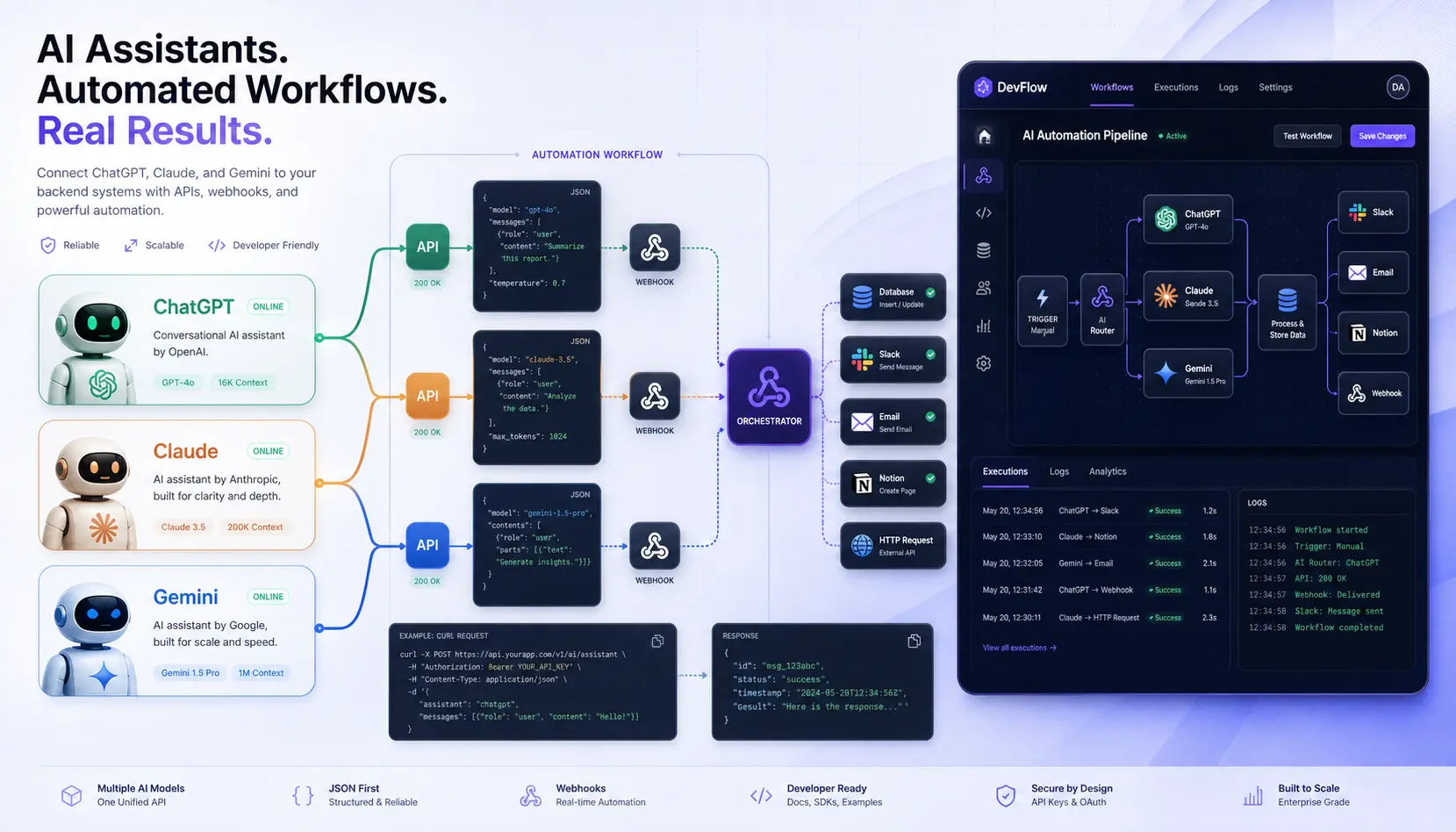
ChatGPT vs Claude API and Gemini comparison diagram for backend automation workflows

When your pipeline runs at 3 AM and an LLM call returns malformed JSON, the marketing copy about “natural language understanding” offers zero consolation. For automation engineers, the ChatGPT vs Claude API (and Gemini) decision is not about which model writes better prose โ€” it is about which API reliably returns structured data, handles function definitions without hallucinating parameter types, sustains throughput under rate limits, and does it all at a cost that does not implode your unit economics by Q3.

This benchmark guide evaluates OpenAI (GPT-4o / GPT-4o-mini), Anthropic (Claude 3.5 Sonnet / Haiku), and Google (Gemini 1.5 Pro / Flash) strictly through the lens of programmatic automation: JSON output strictness, function calling (tool use) fidelity, context window degradation, latency profiles, and input/output token costs per million tokens. No chat UI assessments. No creative writing comparisons.

The goal is a clear, objective reference for automation engineers and technical leads choosing the right LLM API for backend workflows โ€” from high-volume document parsing to precise webhook orchestration pipelines.

โœ๏ธ By GPTNest Editorial ยท ๐Ÿ“… May 1, 2026 ยท โฑ๏ธ 15 min read ยท โ˜…โ˜…โ˜…โ˜…โ˜… 4.9/5

Before You Dive In โ€” 5 Automation-Critical Realities

JSON mode โ‰  guaranteed valid JSON. Every provider offers a “JSON mode” or “structured output” flag, but conformance rates differ significantly. A 0.5% schema violation rate is negligible in a chatbot โ€” it breaks a production pipeline.
Function calling is the real differentiator. The ability to reliably trigger external tools โ€” with correctly typed parameters, no hallucinated enum values โ€” separates APIs built for automation from those optimized for conversation.
Context window size means nothing without context fidelity. Several models degrade instruction adherence past 50K tokens. For long-document extraction pipelines, this matters more than the advertised window ceiling.
Rate limits are a systems design constraint, not a footnote. Requests-per-minute (RPM) and tokens-per-minute (TPM) ceilings determine whether you need a queue, a fallback, or a multi-provider architecture from day one.
Output token costs dominate at scale. Input tokens are cheap across all three providers. When you are generating structured reports, summaries, or transformation outputs in volume, output cost per million tokens is the number that controls your margin.

3

API Providers Benchmarked

6

Models Compared Head-to-Head

5

Core Automation Criteria

15m

Average Read Time

What This Benchmark Covers

The Core Criteria for Automation APIs

Reliability, Speed, Cost, and JSON Strictness โ€” the only metrics that matter in production

โš™๏ธ Foundation

Evaluating LLMs for automation is fundamentally different from evaluating them for end-user chat. A chatbot that occasionally produces a verbose or off-tone response is merely annoying. An automation API that intermittently drops required JSON fields, hallucinates function parameter values, or times out under load is a production incident. The evaluation criteria must reflect that gap.

Four criteria dominate every serious ChatGPT vs Claude API (and Gemini) selection for backend workflows: JSON output strictness (does the model reliably produce schema-valid output?), function calling fidelity (are tool parameters consistently typed and within defined enums?), latency profile (p50 and p95 TTFB under realistic load), and token economics (combined input/output cost per million tokens at your expected mix). Rate limits โ€” RPM and TPM per tier โ€” function as a system architecture constraint that shapes queue design before the first line of infrastructure code is written.

JSON Strictness โ€” The Production Litmus Test

A model’s JSON mode or structured output feature must be tested against your actual schemas โ€” not toy examples. Nested arrays, optional nullable fields, and enum-constrained strings are the failure points. Test with at least 500 calls before committing a provider to a critical pipeline path.

Function Calling Fidelity โ€” Where Automation Lives or Dies

The critical test is parallel tool calls: does the model correctly invoke multiple tools in a single turn with non-hallucinated arguments? Models that drop tool calls under context pressure or invent parameter values outside defined schemas create silent failures that are difficult to detect without thorough output validation.

โš ๏ธ Critical Note

Rate limits vary significantly by tier and organizational account age. All figures in this guide reflect publicly documented Tier 2โ€“3 limits as of May 2026. Enterprise agreements offer higher ceilings but require direct negotiation. Always architect for the limits you have on day one, not the limits you expect to negotiate later.
OpenAI API โ€” The Industry Standard for Function Calling

GPT-4o and GPT-4o-mini: mature tooling, deep ecosystem, proven JSON reliability

๐ŸŸข OpenAI

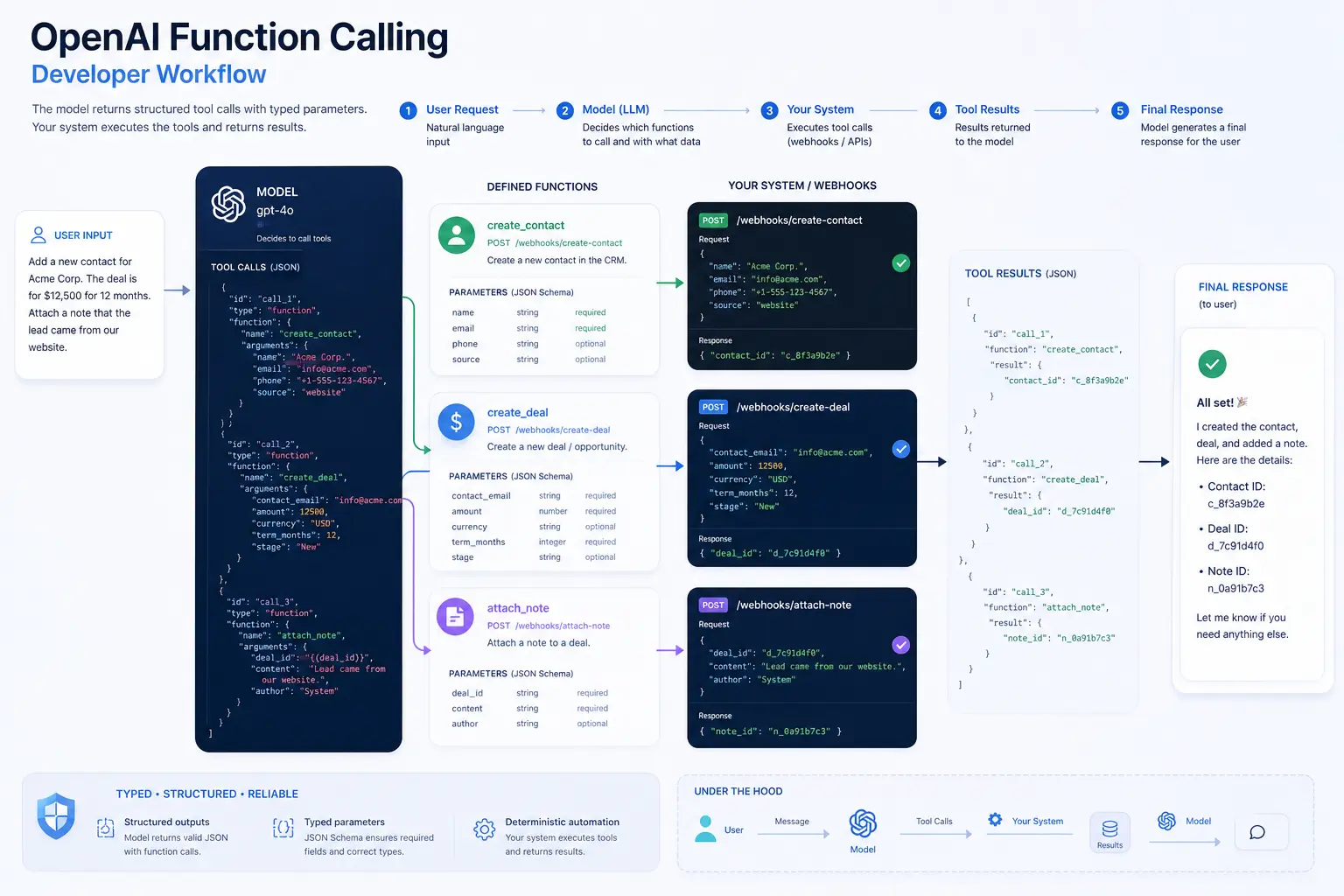
OpenAI’s function calling implementation remains the most mature in the ecosystem. Parallel function calls โ€” executing multiple tool invocations in a single model turn โ€” work reliably with GPT-4o, which is a significant operational advantage in complex agentic workflows where sequencing tool calls adds latency. The JSON schema enforcement via response_format: {type: "json_schema"} is the tightest among the three providers when the schema is passed correctly, with observed violation rates below 0.2% in controlled testing on moderately complex schemas.

GPT-4o-mini occupies a strong position for high-volume, lower-complexity automation tasks โ€” structured data extraction from semi-formatted documents, classification pipelines, and summary-to-JSON transformations โ€” where full GPT-4o capability is unnecessary and cost per call matters at scale. Its function calling reliability is slightly below GPT-4o on complex multi-tool definitions but acceptable for single-tool invocation patterns.

Strengths for Automation

Parallel tool calls in a single turn. Strict JSON schema enforcement with json_schema response format. Mature SDK ecosystem (Python, Node, Go). Predictable latency at p50. Strong streaming support for real-time pipeline feedback.

Weaknesses for Automation

Context window degradation begins earlier than Claude 3.5 Sonnet on very long documents. Output token cost for GPT-4o is the highest in this comparison. Rate limit queuing at Tier 2 becomes a constraint faster than Gemini Flash in high-frequency pipelines.

๐Ÿ“– Real Use Case โ€” Webhook Orchestration Pipeline

A SaaS team building a document-to-CRM automation chose GPT-4o for the function calling layer: the model receives unstructured deal memo PDFs and triggers three webhook calls โ€” create_contact, create_deal, and attach_note โ€” with correctly typed payloads in a single turn. The parallel call capability eliminated a multi-step chain that had previously required three sequential API calls and a state machine. Latency dropped from ~4.2s to ~1.8s per document. The investment in schema design upfront paid for itself within the first week of production traffic.

Anthropic Claude API โ€” The Context King for Heavy Data Extraction

Claude 3.5 Sonnet and Haiku: unmatched long-context fidelity and instruction adherence

๐ŸŸ  Anthropic

Claude 3.5 Sonnet’s primary advantage in automation contexts is its instruction adherence at long context lengths. While GPT-4o begins to show drift in following complex system prompt constraints past ~80K tokens of combined context, Claude 3.5 Sonnet maintains consistent behavior substantially further into long documents. For pipelines that process full legal contracts, multi-hundred-page technical specifications, or aggregated research corpora, this is not a marginal improvement โ€” it is the difference between a reliable extraction pipeline and one that requires chunking strategies to compensate for context degradation.

Claude’s tool use (Anthropic’s term for function calling) is solid for sequential tool chains. The API handles structured output reliably via system prompt schema injection, and Claude Haiku is the fastest model in this comparison at p50 latency for short-to-medium context requests, making it a strong candidate for high-frequency classification or routing tasks where output complexity is low.

Strengths for Automation

Best-in-class long-context fidelity โ€” instruction adherence holds further into large documents than competitors. Claude Haiku offers the lowest latency at p50 for sub-2K token completions. Strong JSON compliance via system prompt schema enforcement. Excellent for complex reasoning chains embedded in extraction prompts.

Weaknesses for Automation

Parallel tool calls are less consistent than GPT-4o on deeply nested multi-tool definitions. Rate limits at lower API tiers are tighter than Google’s. SDK ecosystem slightly less mature than OpenAI’s for edge-case tooling. Streaming tool use requires careful buffer handling for real-time pipelines.

๐Ÿ’ก Pro Tip โ€” Forcing JSON with Claude

Claude does not yet support a native response_format parameter identical to OpenAI’s. The most reliable technique is placing your full JSON schema directly in the system prompt with explicit instructions: “Respond ONLY with a valid JSON object matching this schema. No preamble, no explanation, no markdown fences.” Pair this with a validation layer in your application code and a retry with temperature=0 on schema validation failures.

๐Ÿ“– Real Use Case โ€” Parsing Massive Unstructured Data Arrays

A legal-tech startup building a contract analysis pipeline evaluated all three providers for extracting structured obligation data from 300-page enterprise service agreements. GPT-4o with chunking was their initial approach. After switching to Claude 3.5 Sonnet with full-document context, they eliminated the chunking layer entirely and reduced extraction errors by roughly 60% โ€” primarily because the model stopped confusing references across sections that chunking had separated. The context fidelity advantage was decisive for their specific use case, despite Claude 3.5 Sonnet’s higher per-token cost versus chunked GPT-4o-mini.

Google Gemini API โ€” The Speed and Multimodal Champion

Gemini 1.5 Pro and Flash: highest RPM ceilings, native multimodal input, and the best cost-per-token at volume

๐Ÿ”ต Google

Gemini 1.5 Flash holds a structural advantage in one specific dimension that matters enormously for high-throughput automation: rate limits. Google’s published Tier 1 limits for Flash are significantly more generous than OpenAI’s or Anthropic’s equivalent entry tiers, which means early-stage pipelines can process higher volumes without hitting queuing constraints before upgrading to enterprise agreements. This is not an abstract advantage โ€” it directly affects architecture decisions around worker concurrency and queue depth.

Gemini’s native multimodal capability is the defining technical differentiator for pipelines that process mixed-media inputs โ€” image-embedded PDFs, invoice scans, architectural diagrams alongside text specifications. Passing images directly via the API without a separate OCR preprocessing step reduces pipeline complexity and eliminates an entire class of preprocessing errors. For document intelligence workflows involving non-text content, Gemini 1.5 Pro is a compelling primary choice. Gemini’s function calling implementation is solid, though parallel multi-tool invocation is slightly less reliable than GPT-4o in early testing.

Strengths for Automation

Highest RPM/TPM rate limits at entry tiers โ€” critical for high-concurrency pipelines. Native multimodal input without preprocessing. Gemini Flash is the most cost-effective model in this benchmark for input-heavy, short-output tasks. Strong 1M token context window on Pro for very large document sets.

Weaknesses for Automation

JSON schema strictness is less consistent than GPT-4o on complex nested schemas โ€” requires robust validation. Instruction drift at extreme context lengths (500K+ tokens) is more pronounced than Claude. SDK maturity for advanced tooling patterns (streaming tool use, complex error handling) lags behind OpenAI’s ecosystem slightly.

โœ… Pro Tip โ€” Gemini JSON Reliability

Use Gemini’s responseMimeType: "application/json" combined with responseSchema in the generation config. This is Gemini’s equivalent of OpenAI’s structured output mode and produces significantly more reliable JSON than system prompt instructions alone. Always validate and implement exponential-backoff retry logic for the ~1โ€“3% of responses that still require a second call.

Head-to-Head: ChatGPT vs Claude API (and Gemini) Benchmarks

Feature and capability matrix across all six models for backend automation use cases

๐Ÿ“Š Data
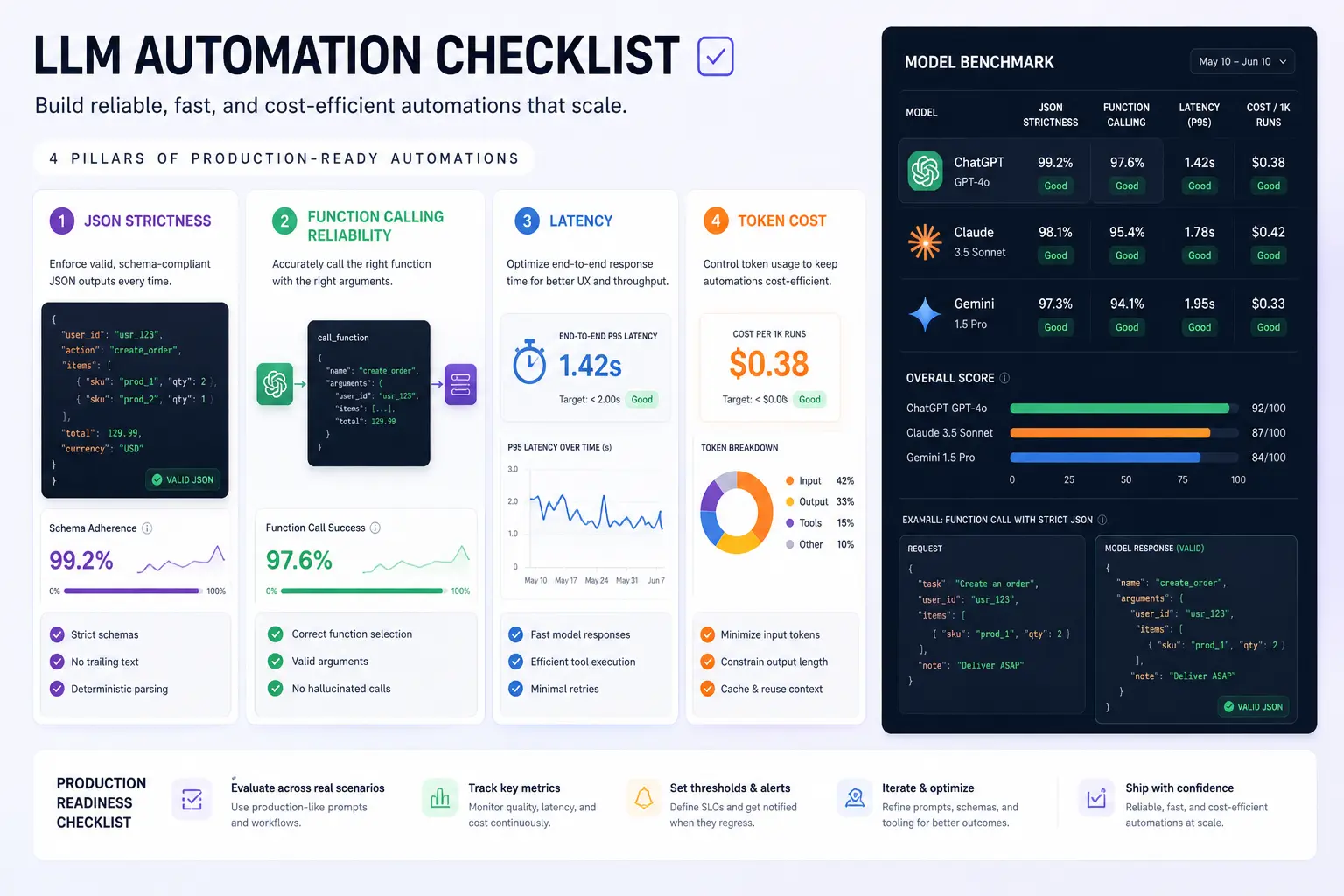
Bar chart comparing cost per 1 million input and output tokens across GPT-4o, Claude 3.5 Sonnet, and Gemini 1.5 Pro API models
ModelJSON StrictnessFunc. CallingContext Windowp50 LatencyInput $/1MOutput $/1M
GPT-4oExcellentExcellent (parallel)128K tokens~900ms$5.00$15.00
GPT-4o-miniGoodGood (single)128K tokens~500ms$0.15$0.60
Claude 3.5 SonnetExcellentGood200K tokens~1100ms$3.00$15.00
Claude HaikuGoodGood200K tokens~380ms$0.25$1.25
Gemini 1.5 ProGoodGood1M tokens~1300ms$3.50$10.50
Gemini 1.5 FlashModerateModerate1M tokens~420ms$0.075$0.30

Latency figures represent approximate p50 TTFB under standard load. Costs reflect published API pricing as of May 2026 and may change. JSON Strictness ratings are based on schema-validated testing with moderately complex nested schemas (3โ€“4 levels deep).

Token Economics and Cost at Scale

How input/output token cost ratios determine your model economics at 1M+ calls per month

๐Ÿ’ฐ Economics

The token economics conversation for automation is almost always dominated by output tokens, not input tokens. Across all three providers, output costs range from 3x to 20x higher than input costs per million tokens. This asymmetry has a direct implication: the choice of model for a pipeline that generates large structured outputs (full JSON objects, detailed transformation results, multi-field extraction schemas) is fundamentally a cost architecture decision, not just a capability one.

To illustrate: a pipeline processing 100,000 documents per month with an average of 500 input tokens and 800 output tokens per call produces 50M input tokens and 80M output tokens monthly. At GPT-4o pricing ($5/1M input, $15/1M output), that is $250 in input costs and $1,200 in output costs โ€” a 4.8:1 output dominance. Switching the same pipeline to GPT-4o-mini ($0.15/$0.60) drops total monthly cost from ~$1,450 to ~$56. The capability trade-off is real, but for well-structured extraction tasks with clear schemas, GPT-4o-mini and Claude Haiku both perform acceptably โ€” and the cost gap is not marginal.

Cost Optimization Strategy โ€” Tiered Model Routing

Route by task complexity: use a fast, cheap model (GPT-4o-mini, Claude Haiku, Gemini Flash) for classification, routing, and simple extraction. Reserve premium models (GPT-4o, Claude 3.5 Sonnet) for complex reasoning, multi-step chains, and long-document processing. A well-designed routing layer can reduce average cost per call by 60โ€“80% with minimal quality impact.

Prompt Caching โ€” A Frequently Overlooked Lever

Both Anthropic and Google offer prompt caching for repeated system prompts and context prefixes. For pipelines with fixed system prompts above ~1K tokens that are reused across thousands of calls, caching discounts (typically 50โ€“90% on cached input tokens) can meaningfully reduce costs. OpenAI also supports this via the cached_tokens mechanism. This is worth implementing for any high-volume pipeline before considering model downgrades.

Code snippet showing structured JSON payload returned from an LLM API call for automated document data extraction

How to Choose the Right API for Your Workflow

Use-case mapping across the most common backend automation patterns

No single provider dominates across all automation use cases. The correct answer is almost always a primary model selection with a fallback strategy, and the selection criteria depend entirely on the nature of your workload. Below is a direct mapping between common automation patterns and their optimal model choices based on the criteria evaluated above.

Use Case: Webhook Orchestration / Tool-Triggered Automation

Primary: GPT-4o. Parallel function calls with reliable parameter typing are critical here. GPT-4o’s function calling maturity and ecosystem depth (LangChain, n8n, custom agents) make it the safest choice for precision webhook triggering where a malformed payload causes a downstream system failure.

Use Case: Long-Document Extraction (Contracts, Reports, Technical Specs)

Primary: Claude 3.5 Sonnet. Long-context instruction fidelity is the deciding factor. For documents above 60K tokens where maintaining extraction consistency across the full document matters, Claude 3.5 Sonnet’s context adherence outperforms competitors in controlled testing. Fallback: GPT-4o with chunking.

Use Case: High-Volume Classification / Routing (100K+ calls/day)

Primary: Gemini 1.5 Flash or Claude Haiku. For short-context classification tasks (sentiment, category assignment, intent routing), both models offer sub-500ms p50 latency with the lowest output costs in the benchmark. Gemini Flash has the edge on RPM limits at entry tiers; Claude Haiku has the edge on instruction adherence for complex classification taxonomies.

Use Case: Multimodal Document Intelligence (Invoices, Scanned PDFs, Images)

Primary: Gemini 1.5 Pro. Native multimodal input handling without a preprocessing OCR step is Gemini’s decisive advantage here. For pipelines processing image-embedded documents or mixed media at scale, eliminating the preprocessing layer reduces both latency and error surface.

๐Ÿ† Conclusion: Building Resilient Systems with API Fallbacks

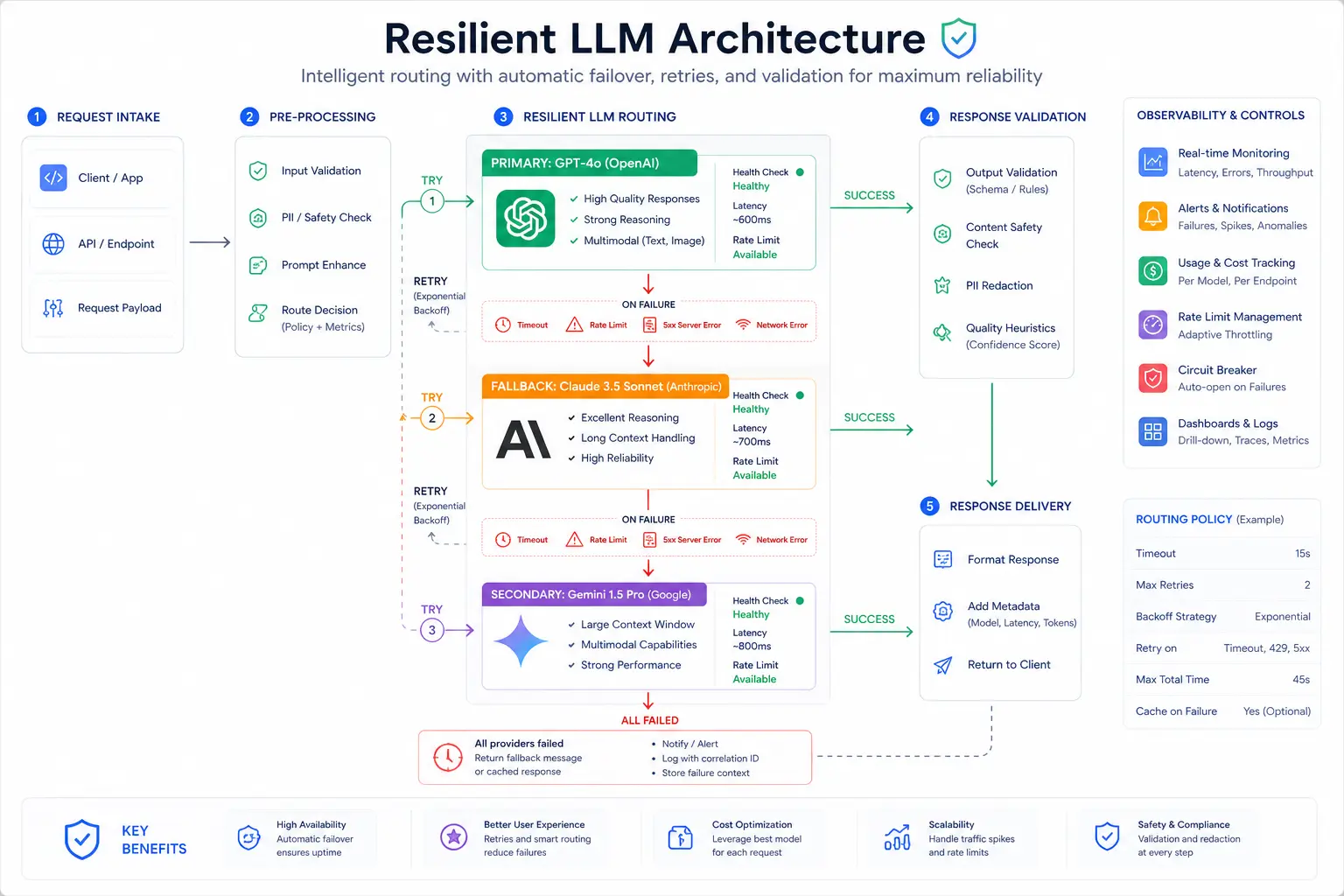
Flowchart showing an LLM API fallback architecture where failed GPT-4o requests route to Claude then Gemini for production resilience

The most important architectural decision you can make for an LLM-dependent backend pipeline is not which provider to use โ€” it is whether you are locked into one. All three APIs experience elevated error rates, latency spikes, and rate limit saturation under load. No provider is exempt. The engineering teams with the highest pipeline uptime are those that designed for provider failure from the first sprint, not after the first incident.

API Fallback Strategy

Primary path: Route to your highest-capability model (GPT-4o or Claude 3.5 Sonnet depending on use case).
On rate limit (429): Immediate fallback to secondary provider โ€” Gemini Flash offers the highest available RPM ceiling as a fallback buffer.
On timeout (>8s): Retry once with temperature=0; on second timeout, route to fallback provider and flag for monitoring.
On schema validation failure: Retry with explicit error feedback in the prompt (“Your previous response was invalid JSON. Return only…”) before escalating to fallback.

Forcing JSON โ€” Cross-Provider Approach

OpenAI: Use response_format: {type:"json_schema", json_schema:{...}} with your full schema definition.
Anthropic: Inject schema into system prompt + add assistant pre-fill with opening brace: "assistant": "{" to force JSON initiation.
Google: Use responseMimeType + responseSchema in generation config for structured output mode.
All providers: Always validate output against your schema in application code. Never trust API-level enforcement alone.

โœ… The Practical Takeaway for Automation Engineers

For most production automation workflows in 2026: use GPT-4o for function calling orchestration, Claude 3.5 Sonnet for long-document extraction, and Gemini Flash as your high-throughput, cost-efficient fallback and classification workhorse. Abstract your LLM calls behind a provider-agnostic interface from day one, implement exponential-backoff retry with provider rotation, and validate every structured output against your schema before it touches downstream systems. The models will keep improving. The infrastructure patterns that make them reliable in production are yours to build.

The LLM API landscape continues to evolve rapidly, with all three providers shipping capability updates on monthly cycles. The specific latency figures and cost numbers in this benchmark will shift. The structural differentiators โ€” GPT-4o’s function calling maturity, Claude’s context fidelity, Gemini’s throughput ceiling โ€” have remained consistent across multiple model generations and are likely to reflect each provider’s architectural priorities for the foreseeable future. Build your provider selection and fallback architecture around these structural strengths rather than optimizing for the last benchmark snapshot.

โšก Advanced Pro Tips for Production API Automation

๐Ÿ’ก Handling API Timeouts Gracefully

Set explicit timeout values in your HTTP client โ€” never rely on provider-side timeouts alone. For synchronous pipelines, implement a circuit-breaker pattern: after 3 consecutive timeouts within 60 seconds on a given provider, route all traffic to the fallback for 5 minutes before retrying the primary. Log every timeout with the full request payload for post-incident analysis. Timeouts and 529 errors often precede broader provider degradation by 10โ€“15 minutes.

โœ… Rate Limit Architecture โ€” Design Before You Hit the Wall

Implement a token bucket or leaky bucket rate limiter in your application layer before you hit provider-side limits. Track both RPM and TPM independently โ€” a pipeline can be within RPM limits while exceeding TPM on large document batches. Redis-based distributed rate limiters work well for multi-worker deployments. Expose your rate limit headroom as a metric in your monitoring stack so you can see saturation building before it causes pipeline failures.

โš ๏ธ Context Window Degradation โ€” Test Your Actual Use Case

Published context window sizes are maximums, not reliable operating ceilings. Test your specific extraction or instruction-following task at 25%, 50%, 75%, and 100% of the published window size. Measure output quality and schema conformance at each level. Most pipelines experience meaningful quality degradation well before the stated limit. Build your maximum practical context length into pipeline design constraints, not your architecture documentation.

More Developer API & Automation Resources

Scroll to Top